
A Cat’s Nighttime Behavior Leads to a Life-Changing Medical Discovery
An Unusual Appointment
Veterinarians are often accustomed to urgent calls at unpredictable hours. Pet owners frequently believe that a professional must be ready to address any concern at any time, whether minor or life-threatening.
However, one particular appointment stood out not because of urgency, but because of the tone in the caller’s voice. Anna, a woman in her mid-fifties, scheduled a daytime visit with a concern that sounded simple on the surface.
She explained that her cat was preventing her from sleeping. Yet her voice carried no frustration—only deep exhaustion, as if restful nights had been out of reach for a long time.
Meeting Luna
When Anna arrived, her appearance reflected a sense of order and care. She was neatly dressed, composed, and carried her pet carrier with remarkable gentleness.
Inside was Luna, a sturdy gray cat with thick fur and wide, observant eyes. The animal appeared calm, showing no signs of distress or aggression.
Anna introduced her pet with affection, explaining that her husband had chosen the name. Despite the peaceful appearance, she described Luna as anything but quiet during the night.
A Pattern That Disrupted Sleep
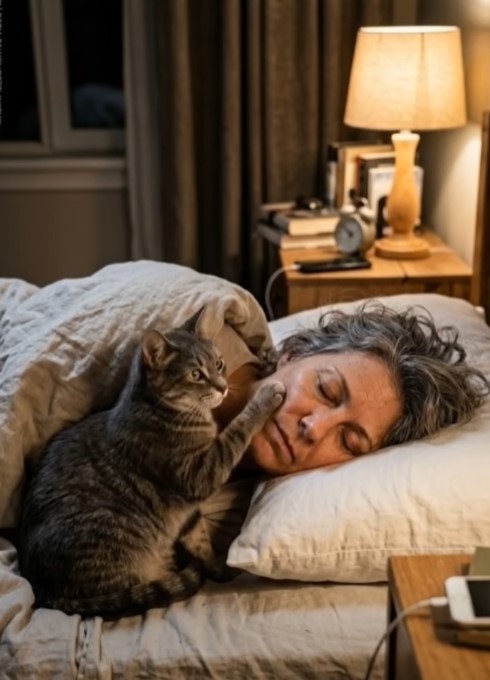
Anna carefully detailed the nightly routine that had been troubling her for months. Each night, without fail, Luna would wake her between three and four in the morning.
At first, the cat would gently tap her face with a paw. If there was no response, the behavior would escalate. Luna would become more persistent, sometimes biting lightly or pulling at the blanket.
The only way to calm the situation was for Anna to get out of bed and move to the living room. Once she settled on the couch, Luna would stop the behavior entirely.
Strangely, the cat would then return to the bedroom, curl up on the pillow, and sleep peacefully until morning.
Months Without Rest
This pattern had continued for approximately three months. At first, Anna believed it might be a change in the cat’s personality.
Over time, she began to question her own perception, wondering if stress or fatigue was affecting her interpretation of events.
Seeking help, she consulted a therapist, who suggested that stress-related insomnia might be the cause. She was prescribed sedatives, but the situation did not improve.
A Healthy Animal
A full examination of Luna revealed no physical issues. The cat’s heart rate was steady, breathing normal, and weight within a healthy range.
There were no signs of illness, discomfort, or behavioral disorders that could explain the nighttime disturbances.
From a veterinary standpoint, Luna appeared to be in excellent health.
A Shift in Perspective
With the cat ruled out as the source of the problem, attention turned to Anna herself. The situation began to suggest a deeper, less obvious explanation.
The focus shifted from the animal’s behavior to the circumstances surrounding it.
Anna was asked how she felt when Luna woke her during the night. Her response revealed important details.
Symptoms That Raised Concern
Anna described a consistent physical reaction when she was awakened. Her heart would race, her mouth would feel dry, and breathing sometimes became difficult.
She also mentioned a sensation that her blood pressure might be rising sharply during these episodes.
To cope, she would take medication and move to another room, where her condition gradually improved.
An Overlooked Clue
A simple question brought forward another key detail. Anna recalled that a neighbor had once mentioned her breathing patterns during sleep.
According to that observation, she would sometimes become very quiet, followed by sudden gasping for air.
This detail, combined with her nighttime symptoms, pointed toward a possible medical issue rather than a behavioral problem in the cat.
Understanding the Cat’s Behavior
Animals are often highly sensitive to changes in their environment, including subtle physical signals from humans.
Changes in breathing patterns, heart rate, or movement can be detected by pets, even when those changes go unnoticed by the person experiencing them.
In such situations, animals may respond instinctively, reacting to what they perceive as a potential threat.
Luna’s persistent attempts to wake her owner could be interpreted as a response to these physiological changes.
A Critical Recommendation
Although it was not possible to confirm the exact cause during the appointment, the situation clearly warranted further investigation.
Anna was advised to undergo a comprehensive medical evaluation. This included checking blood sugar levels, heart function, and sleep-related breathing patterns.
The suggestion marked a turning point, shifting the focus from managing symptoms to identifying an underlying condition.
A Follow-Up That Changed Everything
One week later, Anna made another call. This time, her voice sounded different—calmer and more energized.
She had followed through with the recommended tests, and the results provided clear answers.
Her blood sugar levels were found to be elevated, indicating a metabolic concern that required attention.
Further Medical Findings
Additional examinations revealed heart-related issues that had not previously been diagnosed.
Perhaps most importantly, tests showed that she was experiencing interruptions in breathing during sleep.
These findings explained the symptoms she had been experiencing at night, including the sudden awakenings and physical discomfort.
A New Path Forward
Anna was referred for specialized care, including treatment for her heart condition and further evaluation of her sleep patterns.
Medical professionals emphasized the seriousness of the findings and the importance of addressing them promptly.
With proper treatment, she began to see noticeable improvements in her overall well-being.
A Remarkable Connection
Reflecting on the experience, Anna recognized the significance of her cat’s behavior. Without those nightly interruptions, the underlying health issues might have remained undetected for much longer.
What initially appeared to be a disruptive habit turned out to be a potential warning signal.
The situation highlighted the unique bond between humans and animals, as well as the ways in which pets can respond to changes that are not immediately obvious.
Life After Diagnosis
As treatment progressed, Anna’s sleep gradually improved. The intense nighttime episodes became less frequent, and her overall health began to stabilize.
Luna’s behavior also changed. Instead of waking her owner urgently, the cat began to rest quietly beside her.
The disruptive pattern was replaced with a calm presence, as if the initial need to intervene had passed.
A Lesson in Awareness
This experience serves as a reminder that seemingly small or unusual behaviors can sometimes point to more significant issues.
In this case, a pet’s actions provided an early indication of a serious health condition.
Paying attention to such patterns can lead to timely intervention and improved outcomes.
The Quiet Role of a Companion
Luna’s actions may never be fully explained, but their impact is undeniable. What began as a source of concern ultimately became part of a life-changing discovery.
The story underscores the importance of observing both human and animal behavior closely, especially when patterns shift unexpectedly.
In the end, the bond between Anna and her cat proved to be more than companionship—it became a critical link to understanding her health.