
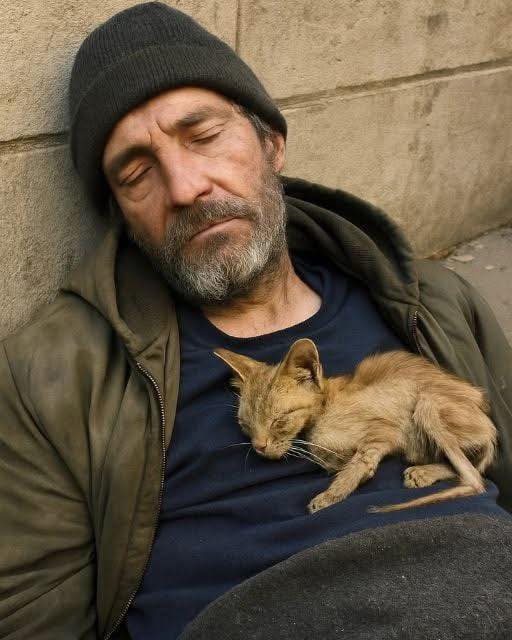
The Quiet Weight of Loyalty and Loss in a Human-Animal Bond
An Emotional Story Defined by Silence and Responsibility
What makes this story so emotionally powerful is not the presence of dramatic heroism, but the absence of it. The man at the center of the narrative is not described as strong, celebrated, or in control of his circumstances. Instead, he is presented as exhausted, emotionally distant, and largely forgotten by the wider world around him. His life appears shaped by hardship rather than stability, and by survival rather than comfort.
Yet within that difficult condition, a different kind of strength becomes visible. He continues to act with responsibility even when it does not serve his own immediate survival needs. This quiet form of decision-making is not loud or performative. It is internal, steady, and rooted in obligation toward another living being. The emotional impact of the story emerges from this contrast between his vulnerability and his consistent sense of duty.
Rather than framing him as a conventional hero, the narrative highlights something more grounded and human: the ability to still choose care for another life even when personal circumstances are unstable. This makes his actions feel less like a symbolic gesture and more like a deeply personal commitment that exists independently of external recognition.
The Emotional Center: “She chose me”
The phrase “She chose me” stands as the emotional core of the entire story. It carries a weight that extends beyond its simplicity. In context, it represents not only the bond between a man and a stray cat, but also the way meaning can form in moments of extreme isolation.
To many observers, a stray animal might appear insignificant when compared with urgent human needs such as shelter, warmth, or physical survival. However, for someone experiencing profound loneliness and instability, the act of being chosen by another living creature can restore a sense of identity and dignity that has otherwise been eroded over time. The bond becomes more than companionship. It becomes recognition.
In situations where individuals lose access to stable housing, consistent work, family connection, or trusted relationships, life often becomes a gradual process of social disappearance. Each of these losses reduces the number of meaningful human interactions. In that environment, even a small bond with an animal can take on heightened significance. It becomes routine, structure, emotional grounding, and a reminder that connection is still possible.
Within this frame, the relationship between the man and the cat is not presented as a secondary detail. It becomes central to his emotional existence. The attachment represents continuity in a life otherwise marked by instability and withdrawal.
Loneliness, Survival, and Emotional Dependency
The story also reflects a broader reality about human endurance under conditions of prolonged hardship. When individuals are removed from stable social systems, emotional resilience often shifts away from abstract ideas and toward immediate, tangible bonds. Attachment becomes a form of survival in itself.
As traditional structures such as family contact, consistent housing, and social trust begin to fade, relationships do not disappear all at once. Instead, they tend to fall away gradually. In that process, even a single remaining connection can take on disproportionate importance. The presence of a pet may become the last consistent form of companionship available.
This is why the man’s refusal to abandon the cat does not read as irrational behavior. From his perspective, leaving the animal behind may have felt equivalent to losing the final remaining relationship in his life. The decision is therefore not framed as defiance, but as preservation of meaning.
In this sense, the story illustrates how emotional survival does not always align neatly with physical survival. What sustains a person psychologically may not be identical to what sustains them materially. Human beings are often maintained through attachment, even when other forms of support have collapsed.
System Boundaries and Difficult Choices
Another important layer in the narrative is the quiet tension between individual emotional needs and institutional constraints. Outreach systems and shelters are designed with specific rules and limitations. These may include concerns related to safety, sanitation, allergies, liability, and available capacity.
Within those systems, decisions are often guided by structure rather than individual emotional circumstances. This can create situations where the policies intended to provide help may unintentionally conflict with deeply personal bonds. The result is not necessarily cruelty or neglect, but a structural limitation in how assistance can be delivered.
The emotional difficulty arises when survival needs are split into categories that cannot easily be reconciled. Physical safety may be offered in one space, while emotional survival is tied to something that cannot be accommodated within that same environment. In such moments, individuals are forced into choices that are not purely practical, but deeply personal and moral.
The story reflects this tension without assigning blame. Instead, it highlights how complex human situations can become when systems and lived experience do not align perfectly. The man’s attachment to the cat exists in a space that policies do not easily account for, yet it remains central to his sense of stability.
Care as Sacrifice and the Meaning of Protection
One of the most striking images in the narrative is the man protecting the cat with bare, freezing hands. This detail emphasizes the physical cost of care. Even in conditions of visible suffering, his attention remains directed outward rather than inward. His instinct is to preserve warmth and safety for a smaller, more vulnerable life.
This form of protection reveals care as an act of sacrifice rather than convenience. It suggests that love, in its most stripped-down form, often appears not as comfort but as endurance. The act of prioritizing another being’s safety while neglecting one’s own comfort becomes a defining feature of his character within the story.
There is a humility embedded in this behavior. It is not driven by recognition or reward. Instead, it exists as a consistent pattern of responsibility toward something he perceives as dependent on him. Even when his own condition is fragile, his focus remains steady on maintaining the well-being of the animal.
Absence, Uncertainty, and the Power of an Unresolved Ending
The conclusion of the story does not offer resolution or explanation. Instead, it ends in absence. There are no clear answers, no definitive outcomes, and no final confirmation of what happened next. What remains is an impression rather than a conclusion.
This lack of closure contributes significantly to the emotional weight of the narrative. Rather than resolving tension through explanation, the story leaves space for reflection. The absence of certainty mirrors the unpredictability of real life, particularly for individuals living in unstable conditions where outcomes are often unknown.
The imagery that remains—an outline on concrete and traces of orange hair—functions as a quiet reminder of impermanence. It emphasizes how easily people can disappear from public attention and how quickly individual lives can become reduced to fragments of evidence rather than complete stories.
Yet even within this absence, there is a sense of dignity that persists. The man is not reduced to stereotypes, simplified categories, or abstract interpretations. Instead, he remains defined by specific human qualities: loyalty, gentleness, and moral clarity under difficult conditions. These qualities remain visible even when other aspects of his life are uncertain.
Humanity Revealed Through Connection
At its core, the story emphasizes that human worth cannot be measured solely through external markers such as possessions, housing status, or social classification. Instead, it suggests that humanity often becomes most visible in moments where those external markers are stripped away.
In the absence of stability, the remaining evidence of character is often found in how a person relates to others, including non-human life. The cat’s complete trust in the man becomes a central part of this idea. Trust, once established, reflects consistency of care and emotional presence, even in difficult circumstances.
The narrative also points to a deeper emotional truth: compassion does not always disappear under hardship. In some cases, it becomes more visible. While adversity can harden individuals, it can also reveal tenderness that might otherwise remain hidden in more comfortable conditions.
A life marked by scarcity does not automatically result in emotional emptiness. Instead, it can sometimes highlight the value of small bonds more clearly. Even in conditions of extreme limitation, the presence of one meaningful relationship can become a stabilizing force that gives structure to daily existence.
Conclusion: The Weight of a Small Bond
Ultimately, the story suggests that survival is not only physical but also emotional. People endure difficult conditions not solely through logic or planning, but through attachment and meaning. When nearly everything else has been lost, even a single bond can become essential to continuing forward.
The relationship between the man and the cat represents this idea in its simplest form. It is not defined by scale or visibility, but by consistency and mutual reliance. In that connection, the story finds its emotional center.
What remains most significant is not what the man owned or where he lived, but the fact that he remained capable of care. Even under conditions of hardship, he continued to protect, to prioritize another life, and to act with a sense of responsibility that transcended his circumstances.
In the end, the story leaves behind a quiet reminder that human dignity is often expressed in the smallest acts of loyalty. And sometimes, the most profound evidence of humanity appears not in moments of success, but in moments of loss, where care still manages to survive.