
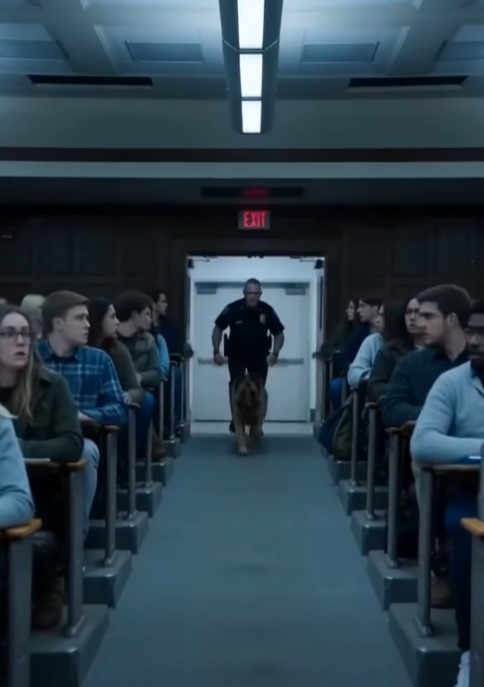
K9 Unit Enters University Lecture Hall and Uncovers Professor’s Hidden Past
A Sudden Interruption in a Quiet Classroom
The afternoon had begun like any ordinary day inside Professor Eleanor Grey’s university lecture hall.
Nearly eighty students sat before her, focused on notes, laptops, and the ongoing discussion of American literature. The room carried the familiar rhythm of an academic setting, with the soft hum of the projector and the quiet sound of pens moving across paper.
That calm ended when the heavy oak doors at the back of the auditorium suddenly swung open.
A uniformed state police officer stepped into the room with a disciplined K9 at his side. The sound of the dog’s harness and the officer’s boots immediately drew every eye in the hall.
Professor Grey paused at the podium, a marker still in her hand. The students stopped writing. No one understood why a police officer and a service dog had entered a literature lecture without warning.
The officer did not begin with an explanation. He simply scanned the room, then guided the dog down the center aisle.
The animal did not stop near the students. It did not focus on backpacks or personal belongings. Instead, it moved with unmistakable purpose toward the front of the lecture hall.
Soon, the K9 reached Professor Grey’s personal desk.
The Dog’s Alert at a Locked Drawer
The dog rounded the desk and stopped beside a small locked wooden drawer on the lower right side.
It pressed its nose against the seam, sniffed deeply, and became completely still. Its tail stiffened. Then it sat directly in front of the drawer and let out a low whine.
The officer recognized the behavior immediately. The dog had alerted.
Professor Grey’s expression changed. The color drained from her face as the entire room watched in silence.
The officer approached her calmly and asked to see what was inside the drawer. His voice remained firm, but there was no aggression in his manner.
Professor Grey did not respond like someone hiding contraband. Instead, she appeared overwhelmed by fear and grief.
She quietly asked the officer to step away from the drawer.
Officer Henry Collins then addressed her by name. He told her that he believed she already knew what was inside.
With trembling hands, Professor Grey removed a small silver key from her cardigan pocket and placed it on the desk.
The officer unlocked the drawer.
What the Drawer Contained
When the drawer opened, the students expected to see something alarming.
Instead, they saw a bundle of faded envelopes tied with a frayed blue ribbon, a small dusty cardboard jewelry box, and a worn child-sized lavender winter scarf.
The atmosphere in the room shifted instantly.
There was no scandal in the drawer. There was no threat. The objects inside were ordinary, fragile, and deeply personal.
Officer Collins handled the items gently. On the top envelope, written in Professor Grey’s own handwriting, was one name: Lily.
Then the officer looked at her and delivered the words that changed everything.
“We found her.”
Professor Grey collapsed into her chair as the meaning of those words reached her. The students, who had moments earlier been gripped by confusion and suspicion, now witnessed the beginning of an emotional reunion nearly a decade in the making.
The Child Professor Grey Never Forgot
The objects in the drawer belonged to the memory of a little girl named Lily.
Nine years earlier, Professor Grey had not yet been a tenured professor. She was a young assistant instructor living in a rented duplex on the edge of town.
Her neighbor was a struggling young mother named Marianne, who worked long hours at more than one job. Marianne’s daughter, Lily, was six years old when she first entered Eleanor’s life.
Lily was quiet, watchful, and serious for her age. She often seemed more guarded than shy, as though she had learned early that the world could not always be trusted.
One rainy afternoon, Eleanor noticed the child sitting outside without a proper jacket. Marianne was not home, and the girl was shivering in the cold.
Eleanor invited her inside for warm tea and graham crackers.
That simple act became the beginning of a bond that would shape both of their lives.
After that day, Lily began coming to Eleanor’s home after school. Eleanor helped her with spelling, gave her warmth when the apartment next door was cold, and wrapped the lavender scarf around her neck on winter mornings.
She called her Lily-bug.
A Promise Written in Green Crayon
During one evening at Eleanor’s kitchen table, Lily asked what Eleanor did at the university.
Eleanor explained that she taught people how to read stories and write their own words. She told Lily she was a professor.
The little girl thought about it, then wrote a sentence on a scrap of paper in green crayon.
One day, I will be a professor too.
That paper remained inside the small cardboard jewelry box in the locked drawer for years.
To Professor Grey, it was not just a child’s note. It was proof that Lily had existed, that she had dreamed, and that she had once felt safe enough to imagine a future.
But that future was shattered when Marianne disappeared.
One evening, Marianne failed to return from work. Days later, her car was found abandoned near the state line. With no guardian available and no legal arrangement in place, Lily was taken by social services.
Eleanor pleaded to keep her. She explained that Lily knew her, trusted her, and was safe with her.
But she was not a relative. She was not yet a licensed foster parent. In the eyes of the system, she had no legal standing.
Lily was taken away.
Years of Searching and Silence
Professor Grey did not accept the separation quietly.
For years, she tried to find Lily. She called offices, wrote letters, hired legal help she could barely afford, completed foster care requirements, and pushed for any information that could lead her back to the child.
Again and again, she was told that the case was confidential.
Her letters were returned. Case workers changed. Phone numbers stopped working. Eventually, Lily vanished into the sealed records of the foster and adoption system.
Unable to reach her, Eleanor created a private memorial inside her university desk.
She placed the scarf, the letters, and the small keepsake box in the drawer. Whenever grief became too heavy during long teaching days, she would touch the wood and remind herself that Lily had not been forgotten.
That drawer became a vault of memory.
It also became the reason the K9 had entered the lecture hall years later.
How the K9 Found the Connection
Officer Collins explained that old foster care and adoption files from Lily’s district had been reopened after irregularities were discovered.
A young woman named Lillian Reed had filed a request to trace her origins.
Lily’s name had been legally changed after adoption, and she had grown up in Ohio. But even as an adult, she carried fragments of memory that would not fade.
She remembered old books, paper, tea, a safe voice reading stories, and a lavender scarf wrapped around her neck during cold mornings.
Most importantly, she remembered making a promise to a woman named Eleanor.
Officer Collins had not entered the university by chance. He had brought the K9, Bruno, to confirm the connection through scent and personal objects linked to Lillian’s childhood.
Bruno had been given the scent from an old doll Lillian had kept from that period of her life.
When the dog entered the lecture hall, it went straight to the drawer containing the scarf and letters.
That alert led directly to the moment Professor Grey heard the words she had waited nine years to hear.
Lillian Walks Into the Lecture Hall
After Officer Collins revealed that Lily had been found, the doors at the back of the auditorium opened again.
This time, a young woman stood there.
She wore a simple gray coat and carried herself carefully, as though stepping into a memory she had spent years trying to recover.
Professor Grey recognized her before she reached the front of the room.
The child’s face had changed into the face of a grown woman, but the eyes were the same. They were the same gray eyes that had once looked out from a social worker’s car as Lily was taken away.
Lillian walked down the aisle slowly as the students remained silent.
When she reached the desk, she looked at the open drawer and touched the faded lavender scarf.
She remembered it.
She remembered the cold mornings. She remembered Eleanor wrapping it around her neck to protect her from the wind.
Then Professor Grey said the old nickname she had not spoken aloud in years.
Lily-bug.
A Reunion in Front of Eighty Students
Lillian looked at her and said the name she had carried in memory for nearly a decade.
Miss Eleanor.
The two embraced in front of the entire lecture hall.
Professor Grey apologized through tears, explaining that she had tried every way possible to find her. Lillian told her she already knew.
As an adult, Lillian had found records showing Eleanor’s petitions, phone calls, and letters. She had learned that Eleanor had never abandoned her.
For years, Lillian had been told that her memories were unreliable, that trauma had caused her to invent a safe place and a kind woman who read to her.
But the letters, the scarf, the drawer, and Eleanor herself proved that the memories were real.
Lillian also revealed that she had kept the childhood promise.
She had earned a master’s degree in literature and was preparing to apply for a doctoral fellowship. She wanted to teach because of Eleanor.
The Class Becomes a Witness to Grace
The students did not intrude on the moment.
Instead, they quietly helped protect it.
Charlotte closed the drawer with care. Thomas brought water to the podium. Isabel gathered papers that had fallen and returned them respectfully.
What had begun as a shocking police interruption became something entirely different.
The lecture hall became the place where a lost connection was restored.
Officer Collins and Bruno eventually left the room, giving Eleanor and Lillian the space they needed. They still had paperwork to complete, but the most important truth had already been established.
Lily had come back.
A New Chapter After Years Apart
Professor Grey and Lillian left the university together and returned to Eleanor’s home.
It was not the same duplex where Lily had once eaten graham crackers and practiced spelling words, but it carried the same atmosphere. Books filled the rooms. Tea waited in the kitchen. The scent of old paper and cedarwood remained.
Lillian said it smelled exactly as she remembered.
Over the following hours, they began the slow process of filling in the years that had been stolen from them.
Lillian spoke about foster homes, adoption in Ohio, and the kind family who had raised her. She explained that although they had treated her well, a part of her had always felt unfinished.
Eleanor spoke about the years of grief, the porch light she kept on, and the locked drawer that held everything she could not say aloud.
Their reunion did not erase the past. It did not restore missed birthdays, school years, or all the ordinary moments they had lost.
But it gave them the truth.
Peace Returns to the Drawer
Two days later, Professor Grey returned to her lecture hall.
The room was filled with the same students who had witnessed the reunion. This time, there was no fear or confusion in their faces. There was respect.
Before beginning the day’s lesson, she thanked them for the dignity they had shown during one of the most important moments of her life.
She told them that the most powerful stories are sometimes the ones people live in silence.
In the months that followed, Lillian remained nearby. She found work at a library while preparing her doctoral fellowship applications. She moved into the spare bedroom of Eleanor’s home, and together they began rebuilding a life that had once been interrupted by forces beyond their control.
They read the old letters one by one.
They grieved what had been lost without pretending it could be easily repaired.
They also created new routines, new memories, and a new sense of belonging.
One winter afternoon, Lillian visited Eleanor’s university office and placed a small white envelope inside the once-empty drawer.
Inside was a single sentence written in her adult handwriting.
This time, it is I who have come back, and I will not lose myself again.
For the first time in nine years, Eleanor closed the drawer without grief.
She closed it with peace.