
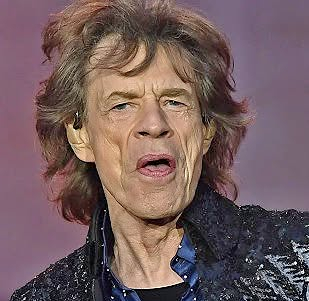
Mick Jagger Signals His Children May Not Inherit a Massive Rolling Stones Fortune
A Rock Legend With Decades of Success
Sir Mick Jagger has spent more than six decades at the center of one of the most famous rock bands in music history.
As the frontman of The Rolling Stones, he became one of the most recognizable performers in the world, known for his voice, stage presence, and lasting influence on popular music.
The band was formed in London in 1962 and went on to build a career that few musical groups have ever matched.
Over the years, The Rolling Stones released 122 singles, 31 studio albums, and 77 music videos, creating a catalog that has reached audiences across generations.
The group has sold more than 200 million records worldwide and has remained active for an extraordinary period of time.
After 61 years together, The Rolling Stones stand among the longest-running musical acts in modern entertainment history.
That level of success has brought enormous wealth to the band and its members, including Jagger.
Yet despite his financial success, the 80-year-old singer has recently made clear that his children should not assume they will receive a huge share of money tied to the band’s music catalog.
Jagger’s View on His Fortune
Jagger is the father of eight children, and his family spans a wide age range.
His children range from young childhood to adulthood, with the oldest born in 1970 and the youngest born in 2016.
Because of the size of his family and the value connected to The Rolling Stones’ music, questions about inheritance naturally attract public attention.
However, Jagger has suggested that his children do not need hundreds of millions of dollars from a future catalog deal.
He made his position clear with the statement, “The kids can live comfortably without $500 million. Come on,”
The comment reflected a direct and practical view of wealth, inheritance, and responsibility.
Rather than presenting his fortune as something automatically reserved for his children, Jagger indicated that the money could potentially serve a larger purpose.
His words also showed that he does not appear to view extreme inherited wealth as necessary for his children’s comfort or future security.

The Rolling Stones Catalog Question
Jagger’s comments came while discussing the future of The Rolling Stones’ post-1971 music catalog.
In recent years, several major artists have made large deals involving the rights to their songs, recordings, or both.
Such deals can bring enormous sums of money, especially when the artist has a catalog with lasting cultural and commercial value.
The Rolling Stones’ catalog is among the most valuable in rock music because of the band’s global success, long history, and continuing popularity.
For now, Jagger has said he has no current plans to sell the band’s post-1971 catalog.
If a sale were ever made, the money involved could be extremely large.
That is why his statement about his children living comfortably without $500 million drew attention.
It suggested that Jagger sees a possible catalog sale not simply as a family inheritance issue, but as a decision with broader meaning.
Music Catalog Sales Have Become Major Business
The sale of music catalogs has become a major trend among well-known performers.
When artists sell rights connected to their music, the arrangement can involve songwriting copyrights, recordings, or both, depending on the terms of the deal.
For artists with decades of successful songs, these agreements can be worth hundreds of millions of dollars.
Bob Dylan is one of the major names connected with such a deal.
He sold his entire catalog to Universal Music for a reported $300 million.
Katy Perry has also been among the performers connected with multimillion-dollar music rights deals.
Dolly Parton has also been mentioned in connection with a possible sale of rights tied to her music.
These deals show how older catalogs can continue to carry major value long after songs are first released.
For a band like The Rolling Stones, whose music has remained famous across decades, the potential value of such a deal would naturally be enormous.

A Different Use for the Money
Jagger did not describe his children as needing a massive catalog windfall.
Instead, he suggested that the money could be directed toward a meaningful cause if a sale ever happened.
His view was summed up in the statement, “You might make a difference in the world,”
That remark pointed to the possibility of charitable giving or another socially useful purpose.
While Jagger did not announce a specific plan, his comments made clear that he believes money of that size could have an impact beyond his immediate family.
The idea also places him among public figures who have questioned whether very large fortunes should automatically pass from one generation to the next.
For Jagger, the issue appears to be less about denying his children comfort and more about whether extreme wealth could be used more constructively.
His words suggest that he sees a difference between providing security and handing down an extraordinary fortune.
A Large and Well-Known Family
Jagger’s family life has long been part of public interest because of his relationships and the number of children he has.
He has eight children with five different women.
His oldest child is Karis, who was born in 1970 during his relationship with Marsha Hunt.
He also has a daughter, Jade, who was born during his marriage to Bianca Jagger.
Jagger and Bianca were married from 1971 until 1978.
During his long relationship with actress Jerry Hall, Jagger had four more children.
Those children are Elizabeth, James, Georgia May, and Gabriel.
Jagger and Hall were together from 1977 until 1999, and their family became one of the most publicly recognized parts of his personal life.
Jagger’s son Lucas was born during his relationship with model Luciana Gimenez Morad.
His youngest child, Deveraux, was born in 2016.
Deveraux’s mother is Melanie Hamrick, a former ballerina and choreographer who is Jagger’s current partner.
A Fortune With Many Possible Directions
With eight children, any inheritance decision involving Jagger’s wealth would naturally be complicated.
The value of The Rolling Stones’ music, combined with Jagger’s long career and public profile, makes the subject especially notable.
Still, his comments suggest that he does not see his children as dependent on a future catalog sale.
His position is striking because the amount being discussed is not small.
A figure such as $500 million would represent life-changing wealth for almost any family.
Jagger’s response showed that he believes his children are already able to live comfortably without that kind of additional fortune.
That view may surprise some fans, especially because many people assume that a celebrity’s wealth will simply be passed directly to family members.
In Jagger’s case, the future may be more complex.

The Legacy of The Rolling Stones
The Rolling Stones’ success is central to why the discussion matters.
Few bands have remained famous and commercially important for as long as they have.
From their formation in London in 1962 to their continued place in music history, the group has maintained a rare level of recognition.
Their recorded output, live performances, and cultural impact have helped make their catalog one of the defining collections in rock music.
For Jagger, that legacy is not only financial.
It is also connected to a lifetime of performance, creativity, and public attention.
That may be one reason he has not rushed to sell the band’s post-1971 catalog, even as other artists have made major deals.
Holding onto such a catalog keeps control of a major part of the band’s history.
At the same time, any future sale could create an opportunity to direct money toward causes beyond private inheritance.
A Clear Message About Wealth
Jagger’s remarks offer a rare look at how one of the world’s most famous musicians thinks about money and family.
He has spent most of his life building a career that generated worldwide fame and enormous financial success.
Yet he appears unwilling to treat every part of that wealth as something his children must automatically receive.
His comments do not suggest that his children will be left without support.
Rather, they suggest that he believes there is a limit to how much inherited wealth is necessary.
For someone with a large family and a music catalog that could be worth hundreds of millions of dollars, that position is significant.
It also adds another dimension to Jagger’s public image.
Beyond the stage, the fame, and the long history of The Rolling Stones, he is also considering what kind of impact his wealth could have after decades in music.
Whether or not a catalog sale ever happens, his message was clear.
His children may be comfortable, but he does not believe they need an additional $500 million from The Rolling Stones’ music to live well.
For Jagger, a fortune that large could possibly do more than support one family.
It could, in his own words, help make a difference in the world.