
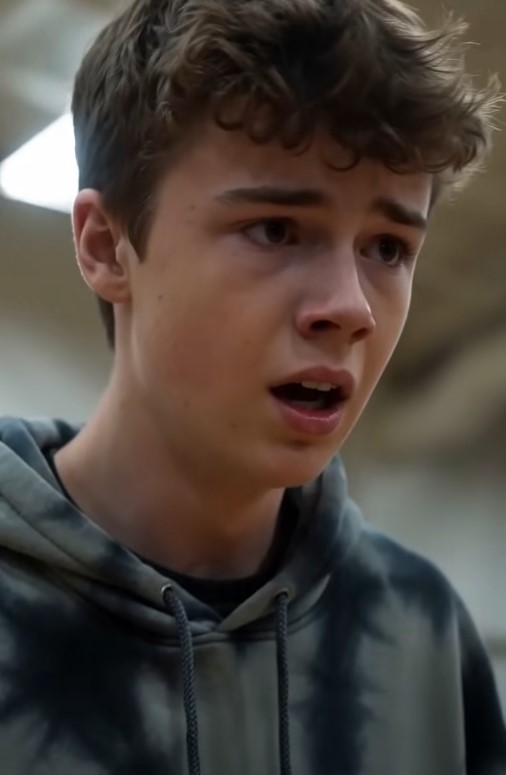
Student With Prosthetic Leg Turns Cruel Gym Prank Into Powerful Dance Performance
A Pep Rally Becomes A Public Setup
The school gymnasium was supposed to be the setting for a mandatory pep rally, but for one student, it quickly became something far more personal and painful.
Standing alone at the center of the polished basketball court, she realized the event had not been random. The so-called “Spring Fling Dance-Off” had been arranged to embarrass her in front of the entire student body.
Chloe, the head cheerleader, had pushed a microphone toward her with a smile that seemed friendly on the surface but carried a much harsher meaning. Her attention dropped immediately to the student’s left leg, where a prosthetic replaced what had been lost below the knee.
The prosthetic was made of carbon fiber and titanium. It helped her walk and gave her back some independence, but it had also become the center of insecurity after a devastating accident three years earlier.
The bleachers were crowded with upperclassmen. Phones were already raised. The teachers who should have been supervising the assembly were not visible, and the doors were closed.
Then Chloe called for music.
A harsh electronic beat filled the gym, loud, fast, and difficult to follow. It was not chosen to support a real performance. It was chosen to make anyone in the center of the floor look awkward.
A group of students began chanting, “Dance! Dance! Dance!”
She froze. When she tried to move back, her prosthetic caught slightly on the floor. She stumbled, and the gym erupted in laughter.
The Moment The Music Changed
The prank seemed to be going exactly as planned. Students filmed from the bleachers as the humiliation unfolded, and the laughter echoed across the gym walls.
Then the electronic music suddenly stopped.
A sharp burst of feedback cut through the room, and the noise faded into silence. For a moment, it seemed as though the cruel joke had simply run out of momentum.
Instead, a soft piano chord began playing through the speakers. It was followed by a gentle acoustic guitar, and the student immediately recognized the song.
It was her mother’s song.
The recording had been hidden away for years on an old hard drive. She had not listened to it since the accident that changed her life and took her mother from her.
Then her mother’s voice filled the gym.
“Little bird on the wire, don’t you look down…”
The entire atmosphere shifted. The laughter stopped. The students who had raised their phones to record a joke suddenly lowered them or stood motionless, unsure of what they were witnessing.
The song brought back the memory of the last day she had shared with her mother. She remembered being fourteen, sitting in the car after a dance competition, holding a silver medal and complaining that it was not gold.
Her mother had encouraged her with the final words she would ever hear from her.
“You’ll fly higher next time, kiddo. Just keep dancing.”
Moments later, a drunk driver’s truck crossed the center line. The crash took her mother’s life and left her left leg crushed beyond repair.
A Quiet Student Steps In
As the song continued, the student looked toward the DJ booth and saw that the person controlling the soundboard was no longer Chloe’s friend.
Leo, a quiet senior from the AV club, had taken over.
They had worked together on a history project months earlier. During that project, she had accidentally left behind a flash drive containing not only school files but also a private folder labeled “Mom.”
Leo had returned the drive without explanation, and she had hoped he had never opened the folder. But when the music played in the gym, she understood that he had heard the recording.
Leo did not smile or wave. He simply looked down from the booth and gave her a slow nod.
Chloe quickly realized she was losing control of the prank. Her expression changed from confidence to panic as the room responded to the emotional weight of the song.
She tried to stop it.
“Cut the music!” she hissed loudly, waving her arms at the booth. “Cut it right now!”
Leo ignored her.
Instead of ending the song, he turned it up slightly. Chloe then told the student to leave, but the student stayed where she was.
From Humiliation To Movement
For three years, the student had hidden much of herself. She wore loose clothing to conceal the prosthetic. She avoided attention. She quit activities she once loved, including dance and theater.
The accident had taken her mother and changed her body, but it had also taken away her belief that she still belonged in the spaces where she once felt alive.
Standing in the gym, she looked down at the metal and carbon fiber supporting her. For the first time in a long while, she did not see it only as a symbol of loss.
She saw it as the reason she was still standing.
As her mother’s voice continued, she shifted her weight. The prosthetic joint clicked sharply, a sound she had often tried to hide.
This time, she let the sound become part of the moment.
She raised her arm slowly and moved with the music. She could not dance exactly the way she had before the crash, but she could still feel rhythm, memory, grief, and strength.
She planted her prosthetic foot against the hardwood and began to turn.
The movement was simple, grounded, and deliberate. It was not the same kind of dancing that had once won medals, but it was honest. It was hers.
She leaned into the limp instead of hiding it. She used the difference in her body as part of the choreography, transforming what others had targeted into a visible statement of survival.
By the time the song reached its final line, tears were running down her face. But they were no longer tears of shame.
She was dancing.
The Gym Falls Silent Before Applause
When the final lyric played, the student stopped in the center of the court.
“Fly, my little bird…”
The music faded, and the gym fell into a silence so deep that even the hum of the lights seemed audible.
She expected the laughter to return. She expected the prank to continue.
Instead, one student in the top row stood and began clapping.
Then another student joined. Within moments, the entire gymnasium rose to its feet.
The applause grew louder until it filled the building. The same crowd that had been prepared to watch her humiliation was now cheering for her.
Chloe stood on the sidelines, stunned and diminished. Her friends began backing away, as if trying to separate themselves from what had just happened.
Principal Evans and Mr. Harrison soon entered the gym after hearing the noise. What they found was not a normal assembly but the aftermath of a cruel setup that had failed in full view of the student body.
Chloe tried to describe it as a joke.
“It was just… we were just doing a dance-off,” she said. “It was just a joke.”
Principal Evans repeated the word with clear disbelief.
The student, however, refused to collapse into pity. When asked whether she had been hurt, she answered calmly.
“I’m fine,” she said. “I was just finishing my routine.”
The Boy In The AV Booth Explains
After leaving the center of the gym, she went to the AV booth, where Leo was packing up his equipment.
She wanted to know how he had known what the song meant. The file had not been labeled with details. It had only been inside a folder connected to her mother.
Leo explained that when she had left the flash drive at his house, he had accidentally opened the folder while looking for their project slides. The song began playing before he realized what it was.
He admitted he had made a copy, knowing it was wrong, but he said he felt she should not be the only person carrying the memory alone.
His own father had died when Leo was in middle school, and he recognized the sound of grief in the recording.
When he saw Chloe cornering her in the gym, he understood what was happening. The original track had been selected to break her confidence.
Leo said, “I wasn’t going to let them break you.”
She pointed out that he had played her deceased mother’s song for hundreds of students.
Leo corrected her gently.
“I played a lifeline,” he said. “You’re the one who decided to dance to it.”
A Father Watches The Video
By the time she returned home, the video was already spreading quickly. Students had shared it across social media, and the moment was gaining attention far beyond the school.
Her father, a public defender who had also been living under the weight of grief, noticed immediately that something had happened.
When he asked whether she had been hurt, she told him someone had tried to play a joke on her at school. He became angry and prepared to call the school, but she told him it had been handled.
Then she showed him the video.
As the recording began, he saw his daughter standing alone in the gym. Then the piano chord played.
Her father recognized the song instantly.
When her mother’s voice came through the phone, he broke down. He watched the entire performance in silence, seeing his daughter dance again for the first time since the accident.
After the video ended, he hugged her and apologized for not being able to fix what had happened.
He told her he was sorry she had to stop dancing.
She answered with words that marked a turning point for both of them.
“I didn’t stop, Dad,” she whispered. “I didn’t stop. I just took a really long pause.”
The Aftermath Brings Accountability
The next morning, the video had reached millions of views. Her father told her it had jumped from local groups to national feeds overnight.
Many comments came from people sharing their own experiences with grief, disability, recovery, and feeling unseen. Amputees and dancers responded to the performance with support.
The local news wanted an interview, but her father declined, saying his daughter had already spoken through her performance and wanted privacy.
Later that morning, they went to a meeting with Principal Evans, the superintendent, Chloe, and Chloe’s parents.
Her father made it clear that what happened was not a harmless incident. He described it as a targeted act of bullying against a disabled student and a serious failure of school supervision.
Chloe’s mother tried to frame it as a poor joke that had unexpectedly made the student famous, but the father rejected that argument.
The superintendent proposed consequences, including a two-week suspension for Chloe, removal from her cheer captain role, and a school-wide assembly on disability awareness.
The student accepted that Chloe needed consequences, but she did not want a lecture that ended with everyone moving on.
Instead, she proposed something more lasting.
She asked the school to fund an adaptive arts program for students with physical disabilities, covering dance, theater, and music across the district.
The superintendent agreed that the idea could be supported.
Before leaving, Chloe apologized quietly.
“I’m sorry,” she whispered.
The student did not need friendship from her. She only needed her to understand the harm she had caused.
A New Performance Takes Shape
After the meeting, the student went to the AV club room to find Leo.
He was working on a soundboard when she arrived. Their conversation returned to the song, and Leo admitted that hearing her mother’s voice had inspired him to pick up his late father’s guitar again.
She then told him about the spring showcase scheduled for the following month. This time, it would not be a prank. It would be a real performance.
She wanted to dance again, but not to a simple backing track. She asked Leo to play live.
He warned her that he was not very good.
She answered that he had a month to improve, while she had a month to learn how to dance confidently again with her prosthetic.
They agreed to work together.
Over the next four weeks, she returned to her old dance studio for the first time in three years. Her teacher treated her not as a tragedy, but as a dancer coming back after a long break.
The training was difficult. She fell often. Her prosthetic did not move like a biological ankle, which forced her to relearn balance, timing, and weight placement.
But she kept practicing.
Leo came to the studio after school and played guitar as she rehearsed. At first, both of them struggled with timing. He missed chords, and she missed steps.
Gradually, the music and movement began to fit together. Their shared experience of grief became part of the performance, not as something hidden, but as something transformed.
Stepping Into The Light
On the night of the spring showcase, the auditorium was full.
The student stood backstage, nervous but determined. Her father sat in the front row wearing his best suit and holding yellow roses, her mother’s favorite flowers.
Leo walked onto the stage first with his guitar. Then she followed.
This time, she was not wearing clothing meant to hide her prosthetic. She wore a dark blue leotard and a flowing chiffon skirt, leaving the carbon fiber and titanium visible under the stage lights.
The audience applauded before she even reached her mark.
She nodded to Leo, and he played the opening chord. Her mother’s isolated voice then faded into the sound system, while Leo’s live guitar accompanied it.
“Little bird on the wire, don’t you look down…”
This time, she did not freeze.
She moved with strength and control, using the prosthetic as part of the choreography rather than attempting to hide it. The clicks of the mechanical knee became part of the rhythm.
She was not trying to dance like the girl she had been before the accident. She was dancing as the person she had become.
As the final lyric faded, she completed a grounded pirouette and stopped at center stage.
“Fly, my little bird…”
The auditorium fell silent for a brief moment before erupting into a standing ovation.
Leo joined her at center stage, and they bowed together.
This time, no one had forced her into the spotlight. She had chosen it for herself.
The moment that began as a cruel attempt to embarrass her became the beginning of her return to dance, her reconciliation with grief, and her decision to no longer hide the parts of herself that carried both pain and strength.