
The Homeless Man Everyone Thought Had Been Attacked Was Actually Being Saved
The Scene Outside the Diner
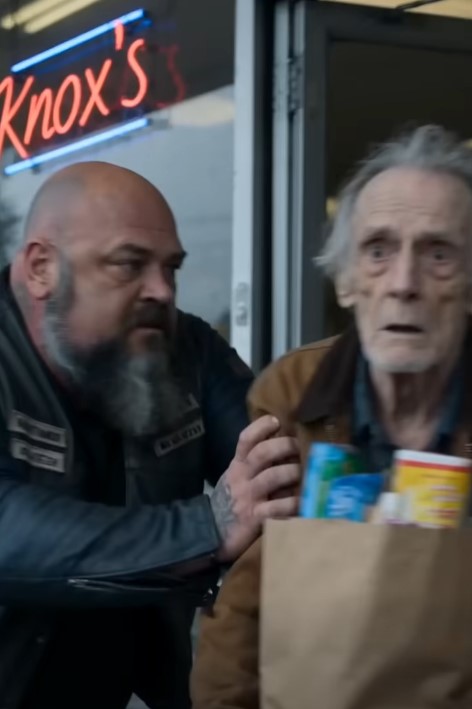
The paper bag struck the sidewalk before the man did.
His shoulder hit the pavement, followed almost immediately by the much larger man who had grabbed him. Inside the diner, coffee cups rattled and someone shouted for the stranger to get away from him.
Two police officers rushed toward the scene. A waitress stood beneath the awning, frightened by what appeared to be an unprovoked attack on a homeless man who had only been asking for somewhere to sit.
But what the crowd saw in those first seconds was only part of what had happened.
The man on the ground had begun jerking, and the person who appeared to have knocked him down was actually trying to keep him away from something far more dangerous.
The Man Everyone Blamed
Ray Dawson was fifty-six that spring. At six-foot-four and nearly 285 pounds, with tattooed forearms, a shaved head, and a beard turning gray, he was not difficult to notice.
Ray owned a diesel repair shop outside Knoxville. The men he rode with called him Hammer, and that morning his black Harley sat between a delivery van and a pickup with a broken taillight.
He had stopped at the diner for eggs.
The man lying on the pavement was wearing a brown coat with one sleeve repaired using darker material. His shoes had different-colored laces, and he had been carrying a grocery bag with the top folded carefully closed.
Now the bag had fallen open near the curb.
A purple paper placemat slid toward a puddle, and Ray immediately told one of the officers not to let it get wet.
The officer holding Ray’s wrist ordered him to remain where he was. A woman beneath the awning was already recording the incident.
Everyone had witnessed the shove.
Almost nobody had witnessed what came immediately before it.
The Damaged Entrance
The diner, called the Copper Kettle, sat beside a service road outside Knoxville. Trucks passing nearby could make the sugar dispensers shake.
That morning, the entrance had a dangerous problem.
A delivery cart had struck the old fixed sidelight beside the door, breaking the lower portion of the glass. Most of the shattered material had been swept away, but part of the damaged pane remained inside its frame.
The diner manager had contacted someone to repair it and placed yellow tape around two orange cones. One cone had later been moved so a delivery could pass through, and nobody had returned it to its original position.
From Ray’s booth, the broken glass was visible at an angle.
What remained was particularly dangerous because a sharp edge projected from the fixed frame at approximately the height of a falling person’s neck.
Ray had noticed it.
So had the man in the brown coat.
Samuel Arrives
The man’s name was Samuel Bell.
He approached the diner carrying his paper bag and stood beneath the awning. He did not cause a disturbance or bang on the windows. He simply checked the door and carefully smoothed the folded top of the bag.
A waitress named Abby opened the door.
Samuel asked whether he could sit inside.
The manager told him they were serving customers.
Samuel explained that someone was meeting him there.
The manager asked whether he intended to buy something. Samuel looked down at the few coins in his hand and said that someone was meeting him.
The manager told him he could wait outside.
Abby appeared ready to respond, but instead went to get clean menus after Samuel requested them.
Samuel moved away from the doorway.
Unfortunately, the place where he moved was directly beside the damaged glass.
What Ray Saw
Ray had been planning to speak with Samuel about breakfast. Instead, he noticed something change in the man’s expression.
Samuel had been looking toward the road. Then his eyes stopped following anything around him. His fingers tightened around the grocery bag, and his shoulders suddenly drew upward.
Ray recognized the possibility that something was wrong.
His younger brother Danny had experienced seizures when they were young. Ray did not know what was happening to Samuel, and he did not try to diagnose him, but he recognized that the man’s condition had changed suddenly.
Samuel’s body stiffened.
Then he began to fall toward the damaged sidelight.
There was no safe space for Ray to simply stand between Samuel and the frame. He moved quickly, grabbed Samuel from the side, and pushed his upper body away from the broken glass.
The movement was forceful.
It was also enough to send both men onto the pavement away from the doorway.
From inside the diner, however, the distinction was almost impossible to see.
A large man in leather had appeared to shove a man in a worn brown coat to the ground.
That was the moment the witnesses reacted.
The Police Step In
The older officer reached Ray and Samuel with one hand raised. His partner moved toward Ray’s shoulder and ordered him to back away.
Ray raised both hands and moved aside.
The officer immediately knelt beside Samuel while his partner held Ray’s wrist. A waitress stepped forward and stopped the purple placemat from sliding into the puddle.
Samuel continued jerking on the ground.
The officer noticed a narrow metal bracelet beneath his coat cuff and spoke into his radio.
Something about the situation had changed.
The officer’s attention moved from Samuel to the entrance, then toward the damaged pane and the place where Samuel had originally been standing.
He asked Ray whether Samuel had been coming in his direction.
Ray said yes.
The officer finally loosened his grip.
The crowd was told to move back and give Samuel room.
The emergency had become the priority.
The Question Samuel Asked
Ray remained nearby while the officers waited for an ambulance. He explained that Samuel had stopped responding, tightened his hand around the bag, and appeared to lose control of his balance.
Then the jerking stopped.
The officer continued speaking quietly to Samuel until the man eventually opened his eyes.
Samuel looked frightened by the people surrounding him.
The officer asked for his name.
After struggling to speak, Samuel finally whispered that his name was Samuel Bell.
Then he asked a question that immediately changed the atmosphere around him.
“Did I miss her?”
Abby lowered her eyes toward the purple placemat she had saved.
On the dry underside of the paper, beneath the flowers, someone had written a name and a time.
Samuel had not simply been waiting outside the diner.
He had somewhere he was supposed to be.
The Woman He Had Been Waiting For
Ten minutes before the incident, Ray had been inside the diner arguing with his friend Boone about toast. Boone believed white toast qualified as a food group, while Ray disagreed.
That ordinary conversation had ended the moment Ray noticed Samuel outside.
Samuel had told the diner staff that someone was meeting him.
That person was Grace.
After Samuel became conscious again, Abby asked whether Grace was the woman he had been waiting for.
He nodded.
She asked whether Grace was his daughter.
Again, Samuel nodded.
He had a telephone number in a small envelope inside his bag. Abby used it to contact Grace.
Grace was already on her way.
A Family History Hidden in a Paper Bag
Samuel’s grocery bag contained ordinary belongings, including socks and a small plastic container. The purple placemat had also been kept safely.
When Grace arrived, she immediately asked for her father.
She explained that she had been delayed by a wreck and had been running late.
Samuel answered simply that he had waited.
He had not left.
Grace then learned that Ray had moved him away from the broken glass.
She thanked him.
But there was another surprise waiting.
Grace explained that the purple placemat had been made by her daughter, Sophie. The child had drawn the flowers on it a year earlier.
Samuel had kept it with him.
The Diner Had Once Been His
Grace’s next revelation made the diner manager uncomfortable.
She explained that her father, Samuel Bell, had once owned the Copper Kettle.
Samuel and his wife, Elaine, had run the diner for twenty-three years. Samuel cooked breakfast, baked pies, repaired things around the building, and built the booths when the restaurant expanded into the neighboring space.
Elaine managed the books and remembered the families who came through the doors.
Eventually, the couple sold the restaurant after Elaine’s health changed and maintaining both the business and their home became too difficult.
The buyer was Martin’s father.
Martin, the current manager, had not recognized Samuel.
Grace told him that her father had built the booths.
Martin was stunned.
She told him to ask his father.
The old restaurant suddenly contained a history that Martin had never understood.
The Years Samuel Had Been Trying to Survive
Samuel’s life had changed dramatically after Elaine died.
He attempted maintenance work, but his seizures complicated the jobs he could safely perform. Losing steady employment made his financial problems more difficult, and his housing situation became increasingly unstable.
Eventually, temporary housing ended.
Grace had tried to help her father more than once. Samuel had allowed her to help, but he also admitted that he did not like her seeing him in need.
He had missed appointments and told her he had somewhere to stay when he did not.
Grace had been trying to reconnect him with regular care and help him find stable housing.
The meeting at the diner had been intended as a beginning.
Samuel had arrived early because he wanted to be there.
He had simply been trying not to ask too much from anyone.
What Happened After the Video Spread
A short video of the incident eventually appeared online. It showed the shove, Samuel’s fall, and the officers rushing toward the two men.
The footage did not show everything that had happened beforehand.
Ray’s friends wanted him to respond immediately, but Ray refused to turn Samuel’s situation into a public spectacle.
He agreed to provide a brief clarification about the immediate danger and cooperate with the police. He did not want Samuel’s private medical information or personal history turned into material for strangers.
The diner also preserved the relevant camera recording from the entrance.
The officers completed their follow-up, and Ray answered their questions about what he had seen.
The immediate misunderstanding eventually faded.
Help Without Taking Away Samuel’s Choice
Grace later brought an outreach worker named Nadine into the situation. Nadine already knew Samuel and was working to help him obtain stable housing and replace missing documents.
The group discussed practical ways to help.
Some people could provide transportation. Others could assist with paperwork. Ray offered temporary storage for Samuel’s belongings at his shop if Samuel wanted it.
But nobody decided Samuel’s future without him.
He asked what he was agreeing to, and Nadine went through the arrangements with him.
Samuel accepted some forms of help and rejected others.
He wanted assistance with practical barriers that made appointments and medications difficult to manage. He wanted a secure place where his belongings would remain safe.
He did not want strangers buying him clothes without asking his size, and he did not want his situation turned into a public display.
Slowly, the group established something more useful than a dramatic rescue.
They created practical support that Samuel could actually accept.
Learning to Make Smaller Promises
Grace also took care not to place responsibility for repairing the family relationship on Sophie.
Samuel began writing short notes that Grace could choose to share with her daughter. He remembered Sophie’s drawings and the purple cat cake she had once requested.
He also stopped making promises he could not be certain he could keep.
Instead, he focused on smaller commitments.
Eventually, Samuel received a modest room through a local program. It was not a complete solution to every problem, but it gave him a secure door, a bed, and a place where his belongings could remain while he was away.
Those changes mattered.
He continued working with Nadine and receiving the care he needed. Ray and his friends helped with the practical responsibilities they had agreed to handle.
Returning to the Copper Kettle
Martin eventually contacted Samuel and apologized.
He admitted that he would have treated him differently if he had known who he was, but Samuel reminded him that the man’s identity should never have determined whether he deserved a safe place to wait.
The broken sidelight was properly repaired.
Later, Samuel agreed to return to the diner.
Ray accompanied him.
Martin held the door open when they arrived.
He apologized for refusing Samuel a place to wait and for leaving the entrance in an unsafe condition.
Samuel listened before asking Martin to sit down.
They ate lunch together.
There was no public announcement and no attempt to turn the meeting into a photograph.
For Samuel, simply sitting at a table in the restaurant he had once helped build was enough.
The Purple Flowers Came Back
Grace eventually arranged for Samuel to spend a short amount of time with Sophie.
The meeting took place carefully and on terms that worked for the family.
Sophie had grown taller, and she brought Samuel another purple placemat.
This one had cats drawn around the edges.
Samuel admired the drawings.
The moment was small, but it carried the weight of the year that had passed.
The older placemat had survived the difficult period Samuel had experienced. The newer one represented the child who had continued growing while he was struggling to find stability.
Both could exist together.
A Birthday Cake and a New Beginning
When Sophie’s birthday approached, Grace arranged a small lunch at the Copper Kettle.
Samuel asked whether he could make the cake.
He prepared a round cake with purple frosting and a cat whose ears were uneven. When the frosting created an unexpected stripe across the cat’s forehead, Samuel turned the mistake into part of the design.
He called it a tabby.
On the day of the celebration, Samuel waited outside the diner before going in.
Ray found him there.
The repaired glass was now clear, and the dangerous broken edge was gone.
Samuel told Ray he knew he could enter through the door.
But this time, he was waiting because he wanted to.
When Grace arrived, Sophie approached her grandfather carrying another purple placemat.
She told him he should sit beside her.
Samuel looked at Grace, and she nodded.
He carried the cake inside.
Nothing Fell This Time
The table where Samuel sat with his granddaughter was one of the booths he had helped build years earlier.
He noticed the worn edge of the table and ran his finger along it.
When Sophie asked what he was doing, he told her he was remembering where things go.
There was no dramatic speech.
There was only a family sharing a meal, a grandfather cutting a birthday cake, and a child sitting beside him.
Later, Samuel placed the old purple placemat beside the new one.
One represented a year that had been difficult. The other represented the child who had continued growing during that time.
Neither erased what had happened.
There was simply room for both.
As the group prepared to leave, Samuel stopped near the repaired window and looked at Ray.
He thanked him for being hungry that morning.
Ray did not have an answer ready.
Samuel smiled and reminded him to use the door next time.
Outside, Ray’s Harley waited in the sunlight.
Grace asked Samuel whether he wanted a ride back, and this time he accepted without trying to make the request unnecessary.
Sophie held her grandfather’s hand and carried the empty cake box.
After everything that had happened outside the diner, nothing fell.