
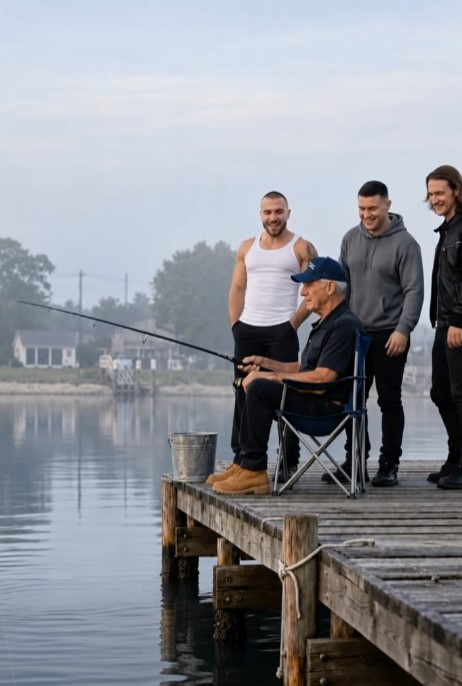
Three Young Men Threaten an Elderly Fisherman, Unaware of the Life He Lived Before That Morning
A Quiet Morning on the Lake
A thin layer of mist covered the cold water, making the opposite shore almost impossible to see. At the end of an old wooden pier, an elderly man sat alone on a folding chair.
He held a fishing rod between his weathered hands and watched the float move gently with the water. A metal bucket beside him contained two fish he had already caught.
The lake was completely still apart from the occasional movement inside the bucket. The old man appeared content to spend the morning in silence.
He had chosen a place far from noise and interruption. Nothing about his posture suggested that he wanted attention or conversation.
Then footsteps sounded across the wooden planks behind him.
Three Strangers Approach
Three young men walked along the pier while talking loudly. Their voices carried easily across the quiet water.
They exchanged amused glances as they moved closer to the fisherman. Their confidence suggested that they were accustomed to intimidating people without facing resistance.
The old man heard them but did not turn around immediately. He remained focused on the float and waited for them to reveal why they had approached.
One of the men stopped behind his chair and asked whether he came from the area. His mocking tone made the question sound more like a warning than an attempt at conversation.
The second asked whether the fisherman understood where he was sitting. Then the third claimed that the lake belonged to them.
If the elderly man wanted to remain and fish, they said, he would have to pay.
The Fisherman Refuses Their Demand
The old man slowly reeled in his line and inspected it. Only after finishing did he turn his head slightly toward the three men.
His response was calm. He explained that the lake belonged to everyone and that no payment was required to sit on the public pier.
He had the same right to be there as anyone else.
The young men looked at one another and laughed. They appeared entertained by the idea that an elderly stranger would challenge their authority.
One of them mocked him for attempting to explain their rights. Another repeated the demand with a much harder voice.
The fisherman could either pay or leave.
Silence Makes Them Angrier
The old man turned back toward the lake. He adjusted his fishing line and resumed watching the water as though the three strangers were no longer present.
His silence affected them more than an angry response would have. They had expected fear, an apology or a hurried effort to gather his belongings.
Instead, he gave them nothing.
The young men raised their voices and asked whether he could hear them. They moved closer, attempting to force him to acknowledge their threats.
The fisherman remained in his chair. His breathing stayed even, and his attention remained fixed on the float.
The men stopped laughing. Their attempt to entertain themselves had become a struggle to control someone who refused to participate.
The Bucket Goes Into the Water
One of the young men stepped beside the chair and kicked the metal bucket with all his strength.
The impact sent a hollow sound across the lake. The bucket slid over the edge of the pier and disappeared into the water with the fish still inside.
Ripples moved outward from the place where it landed. The quiet achievement of the fisherman’s morning was gone in seconds.
The old man did not jump or shout. He adjusted his grip on the rod and continued watching the water.
His refusal to react unsettled the three men. They could no longer tell whether he was frightened, indifferent or simply waiting.
A Final Threat
The man standing closest repeated the demand through clenched teeth. He told the fisherman to pay or leave immediately.
The old man offered no answer.
That silence was interpreted as defiance. The young man decided that words would no longer produce the submission he wanted.
He stepped closer and raised one hand. His fingers tightened into a fist as he prepared to strike the seated man.
The other two watched with confidence, apparently expecting the confrontation to end quickly.
They believed they had chosen an easy target: one elderly fisherman sitting alone at the edge of an isolated pier.
They did not know anything about the man’s past.
The Old Man Moves
The moment the attacker swung, the fisherman rose from the folding chair.
His movement was so quick that none of the young men had time to adjust. He caught the attacker’s arm and redirected the attempted blow.
With one controlled motion, he twisted the arm until the young man cried out. A second later, the attacker was lying across the wooden planks.
The movement did not resemble the desperate reaction of someone fighting from fear. It was precise, balanced and practiced.
The old man released the arm and immediately turned toward the second stranger.
The Second Man Rushes Forward
The second young man charged without considering how easily his friend had been stopped.
The fisherman waited until he entered reach and delivered one short, accurate strike to the body.
The young man stopped immediately. He folded forward, holding his stomach and struggling to breathe.
The old man did not continue attacking him. One defensive movement had been enough to remove the threat.
The third man finally recognized that the situation had changed. He attempted to create distance between himself and the fisherman.
The Third Man Falls From the Pier
While stepping backward, the final young man failed to notice the uneven edge of the wooden planks.
His foot slipped, and his body disappeared over the side. A heavy splash disturbed the quiet surface of the lake.
Seconds earlier, the three men had surrounded an elderly stranger and treated him as helpless. Now one was on the pier, another was doubled over and the third was pulling himself from the cold water.
The fisherman remained upright beside his chair. He appeared calm enough to have completed an ordinary task.
There was no anger in his movements and no desire to continue the confrontation. He had responded only after one of them attempted to strike him.
A Warning From the Fisherman
The old man looked at the three men and quietly told them that they still did not understand who they had confronted.
The first attacker attempted to rise but stopped as pain moved through his arm.
The fisherman’s voice became firmer as he revealed part of his past. He had spent 30 years serving in OMON.
During those decades, he had encountered hundreds of aggressive men who believed confidence and numbers made them powerful.
The three strangers had mistaken age for weakness. They never considered that the quiet fisherman might have spent most of his life training for dangerous confrontations.
Thirty Years of Experience
The old man’s movements had been shaped by decades of discipline. He did not waste energy, panic or lose control.
When the first fist came toward him, he responded with the exact action needed to stop it. When the second man charged, one carefully placed blow ended the advance.
He had no need to pursue the third stranger. The man’s own retreat carried him into the water.
The fisherman understood something his attackers did not. A confrontation is not decided by who makes the most noise or arrives with the largest group.
Experience, awareness and control can overcome arrogance before it understands the danger it has created.
The Arrogance Disappears
The old man took one step toward them. None of the three attempted to challenge him again.
He ordered them to leave while they remained capable of walking away without assistance.
Their mocking expressions had vanished. Fear and confusion replaced the confidence they displayed when approaching the pier.
They looked at one another, but no one offered another threat. The first held his injured arm, the second remained bent forward and the third stood soaked by the cold lake water.
Moments earlier, they had been entertained by the prospect of humiliating someone they considered defenseless. Now they wanted only to escape the pier.
The Young Men Leave
The three men moved away as quickly as their condition allowed. Their footsteps crossed the same planks that had carried them toward the fisherman with arrogant smiles.
No laughter followed them this time. They did not repeat the claim that the lake belonged to them or demand money from anyone else.
The old man watched long enough to confirm that they were leaving. He did not follow them or attempt to extend the conflict.
Once they reached the end of the pier, the silence returned.
A Return to the Fishing Chair
The fisherman straightened his folding chair and sat down again. He picked up the rod that had remained beside him during the confrontation.
The ripples created by the kicked bucket and the man who fell into the lake were already beginning to disappear.
Mist continued moving across the surface as though nothing unusual had happened.
The old man checked his line and returned his attention to the float. He showed no excitement about what he had done.
For him, stopping three attackers had not been a performance. It was simply a necessary response to a threat they had chosen to create.
The Mistake They Never Expected
The young men approached the pier because they believed the elderly fisherman would be easy to intimidate.
They judged him by his folding chair, quiet posture and gray age. Nothing about the fishing rod or metal bucket suggested he could defend himself.
Their first mistake was claiming ownership of a lake that belonged to everyone. Their second was treating calm resistance as weakness.
The final mistake came when one of them raised his fist.
They had chosen a man with 30 years of experience confronting people exactly like them. His age had not erased the discipline, timing or awareness developed during that service.
A Lesson Left on the Pier
The encounter lasted only a few minutes, but its meaning was clear. Strength is not always announced through loud voices, threats or superior numbers.
The old man never needed to boast before the confrontation. He stated his right to remain, ignored the intimidation and defended himself only when physical violence became unavoidable.
The three young men entered the pier expecting obedience. They left understanding that appearances can conceal a lifetime of experience.
The fisherman required no applause or recognition. When the danger ended, he returned to the reason he had come to the lake.
He sat alone beneath the cold morning mist, holding his fishing rod and watching the water as if nothing had happened.