
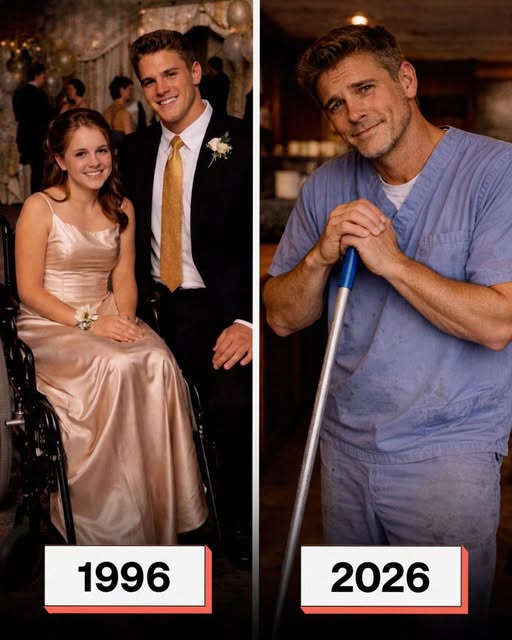
How a Prom Night Dance Became the Beginning of a Lifelong Turning Point
A Life Divided Into Before and After
At seventeen, Emily’s life changed in an instant. Before that night, her concerns were the ordinary worries of high school, including curfews, dresses, and the uncertainty of whether anyone would ask her to prom.
Then a drunk driver ran a red light, and everything shifted. What followed was a period defined by emergency sirens, broken bones, and conversations with doctors who spoke cautiously about damage and uncertainty.
The crash did more than leave physical injuries. It also altered the way Emily saw herself and the way she expected others to see her.
By the time prom arrived six months later, she no longer felt connected to the version of life she had known before. The event that once might have felt exciting had become something she wanted to avoid.
An Evening She Almost Refused to Attend
When prom night came, Emily told her mother she did not want to go. She did not want to be looked at, judged, or treated as if her presence required special attention.
Her mother still brought out the dress. She treated it with care, as though the moment itself still mattered, even if Emily could no longer believe it did.
With her mother’s help, Emily got dressed and prepared for the evening. She was helped into the chair and into a version of herself that still felt unfamiliar.
The process was not about confidence. It was about getting through the night.
When they arrived at the gym, Emily stayed close to the wall. It was the safest place she could find, a position that allowed her to be present without fully joining in.
That became her approach for the evening. She could smile when necessary, respond politely, and remain just outside the center of attention.
Classmates came by with kind words. They told her she looked wonderful. They said they were glad she had come. They asked to take pictures.
Then they returned to the dance floor. They went back to movement, rhythm, and a kind of normalcy that no longer felt available to her.
A Simple Question on the Dance Floor
For most of the night, Emily remained where she was. Then Marcus crossed the room.
At first, she assumed he must have been heading toward someone else. It did not occur to her that he was coming directly to her.
But he stopped in front of her and greeted her as though nothing about the moment required caution or ceremony. That normal tone stood out immediately.
He asked whether she was hiding over by the wall. Emily answered with a sharp honesty that reflected how exposed she already felt.
The exchange could have ended there. Instead, Marcus stayed.
Then he asked her to dance.
Emily told him she could not. In her mind, the answer was obvious and final. The limitations of the moment seemed too visible to ignore.
Marcus did not argue with her. He simply treated her answer as a problem that could be worked around rather than a reason to walk away.
He moved her chair onto the dance floor before she could fully process what was happening. Emily immediately felt tense and deeply aware of the people around them.
She worried that everyone was staring. Marcus answered with a calm directness that shifted the mood of the moment and, for the first time that evening, made her laugh.
A Moment That Changed the Meaning of the Night
What happened next stayed with Emily for decades. Marcus did not move around her as if she were separate from the dance. He included her in it.
He slowly spun the chair at first, paying close attention to whether she felt comfortable. When he saw that she was no longer afraid, he moved with more ease and confidence.
He held her hands as though the moment was entirely natural. He treated her presence on the floor as fully real and fully equal.
That was what mattered most. He did not make the dance feel like a gesture of pity or performance.
Instead, he made it feel like participation. For one brief stretch of time, Emily was not defined by the wheelchair or by the accident that had changed everything.
She was simply a girl at prom.
The dance did not erase the future she still had to face. It did not change the diagnosis, reverse the physical damage, or remove the uncertainty waiting beyond graduation.
But it restored something that had been slipping away. It gave her a moment of dignity and belonging at a time when both felt fragile.
The Difficult Work of Moving Forward
After graduation, life took Emily in a different direction. Her family moved so she could continue rehab, surgeries, and the long process of adapting to a body that no longer functioned as it once had.
Recovery was not a simple path. It was gradual, incomplete, and often less about returning to what had been lost than learning how to live differently.
Emily learned to stand again. Later, she learned to walk, first with braces and eventually without them.
Progress came slowly. It was imperfect, but it moved forward.
Through that process, she also became aware of how many spaces quietly excluded people. The barriers were not always announced, but they were everywhere for those who had to navigate them.
That realization shaped the direction of her life. Emily chose to study design and pushed through school with a clear sense of purpose.
She built a career focused on creating spaces that did not shut people out in the ways she had once experienced firsthand. Over time, that work became more than a profession.
Eventually, she founded her own firm. To others, that looked like professional success.
To Emily, it represented something deeper. It was survival transformed into meaningful work.
A Reunion No One Planned
Thirty years passed before Emily saw Marcus again. The meeting was accidental and completely ordinary in its setting.
She spilled coffee in a small café near a job site. A man with a slight limp came over with a mop and told her not to move because he would handle it.
At first, she noticed only that there was something familiar about him. Time had changed him. He looked older, tired, and marked by the kind of wear that comes from carrying too much for too long.
The next day, she returned. Then she went back again.
Finally, she said what had been on her mind. She reminded him that thirty years earlier, he had asked a girl in a wheelchair to dance at prom.
He stopped mid-motion. Then he looked at her closely and said her name.
In that instant, the distance of three decades collapsed.
The Weight of the Years Between Them
As they began talking again, Emily learned that life had not unfolded easily for Marcus. Right after high school, his mother became ill, and the future he had expected disappeared.
Plans involving football, college, and scholarships fell apart. Instead of following the path he had imagined, Marcus worked whatever jobs he could to support his family and care for his mother.
He also ignored his own injuries for too long. Over time, those untreated problems became permanent.
When he spoke about it, he did not sound bitter. He described it with the clarity of someone who had accepted how life narrowed without warning.
Emily realized that while she had remembered one important moment from her youth, Marcus had been carrying his own unfinished story all along.
They started rebuilding contact carefully. Their conversations were not dramatic or rushed. They developed slowly, shaped by honesty and recognition.
From Shared History to Shared Work
Emily wanted to help Marcus, but he refused direct assistance. She understood that pride and self-respect mattered to him.
So she approached it differently. Rather than framing it as help, she invited him into her professional world.
It began with one paid meeting and no promises beyond that. Marcus attended reluctantly, expecting little.
But once he was there, he stayed longer than planned. He saw details that others had missed.
He offered an observation that immediately changed the direction of the discussion. Making a place accessible, he said, was not the same as making it welcoming.
That distinction altered the way Emily’s team thought about its work. His experience gave language to something technical design alone could not fully address.
From there, the changes were steady rather than sudden. Marcus became part of the work in a way that felt earned and necessary.
There was physical therapy, difficult adjustments, setbacks, and progress that came in small, hard-won stages. There were also moments when purpose began returning to his life.
At the center they were building, he found a role that fit him. He trained people, mentored others, and spoke in a way that carried authority without sounding distant.
He did not talk like someone standing above the experience. He spoke as someone who had lived through it.
A Photo, A Memory, and A New Beginning
One day, Emily brought an old photo to the office. It showed the two of them on the dance floor at seventeen, smiling in the middle of a night that neither had forgotten.
Marcus was surprised she had kept it. For Emily, there had never been a reason to let it go.
Then he shared something she had never known. He told her that he had tried to find her after high school.
She had spent years believing she had simply been one brief moment in his life. He had spent years remembering her too.
By then, both of them had changed. They were no longer young, and neither had escaped hardship untouched.
But they had arrived at a place defined by honesty, patience, and presence. Marcus’s mother now had care, and he was working with Emily’s team full-time.
His work focused on helping others rebuild not only physical ability, but also their sense of identity and place in the world.
Then, at the opening of their center last month, music was playing.
Marcus walked over and held out his hand. He asked Emily to dance.
This time, they did not need to figure out what dancing looked like. They already knew.