
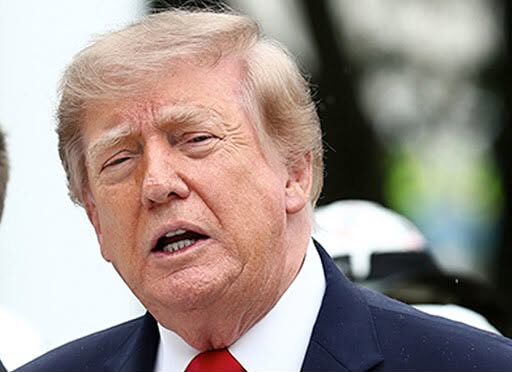
Trump’s Heated Exchange With White House Reporter Goes Viral as Questions About His Health Resurface
A Tense Oval Office Confrontation Sparks a Nationwide Debate
President Donald Trump is facing renewed public scrutiny after a heated exchange with a White House reporter spread rapidly across social media.
The confrontation took place on Tuesday, October 20, 2026, during an Oval Office event announcing a new federal initiative intended to encourage the reporting of government fraud.
What began as a discussion about whistleblower rewards turned into a tense argument between Trump and Andrew Feinberg, the White House correspondent for The Independent.
During the exchange, Trump repeatedly told the journalist to remain quiet and questioned whether something was wrong with him.
Video clips of the incident circulated widely, drawing reactions from people who disagreed about the president’s behavior.
Some viewers criticized the remarks as inappropriate treatment of a journalist, while others defended Trump’s response to persistent questioning.
The confrontation also prompted renewed online speculation about Trump’s cognitive health, although the footage itself provides no medical evidence of a neurological condition.
Within days, the controversy expanded beyond the original exchange when Feinberg was removed from a scheduled presidential press-pool assignment.
What Happened Inside the Oval Office?
Trump was joined by Vice President JD Vance and other administration officials for an announcement concerning a new Fraud Whistleblower Incentive Program.
The initiative was designed to encourage members of the public to report suspected fraud involving federal funds and government programs.
During the event, Trump described the possibility of providing financial rewards to people whose information helped uncover fraud.
He discussed a potential commission amounting to 1 percent of the fraudulent funds identified.
The Justice Department’s announced reward structure, however, included awards generally ranging from $10,000 to $30,000 for qualifying information.
The distinction between Trump’s description and the program’s stated terms became one of the subjects reporters wanted clarified.
Feinberg questioned the administration about the proposal and the relationship between its new incentives and existing federal fraud-reporting mechanisms.
Trump and Vance responded to questions during the event, but the interaction became increasingly contentious.
At one point, Trump asked who Feinberg was.
When the reporter attempted another question, believing the president had indicated that he could speak, the president interrupted him.
The exchange soon became one of the most widely discussed moments from the announcement.
The Remark That Drew Widespread Attention
According to the published transcript and video coverage of the event, Trump warned Feinberg after the reporter attempted to continue questioning him.
The president said he did not know who the journalist was and told him he had better be careful.
As Feinberg tried to ask about Trump’s golf courses, the president repeatedly interrupted him.
“Wait, wait. Quiet. Quiet. What’s wrong with you? Are you a sick person?” Trump said.
Feinberg replied that he was not aware of being sick.
Trump continued by saying he believed something was wrong with the reporter before moving on to another question.
The encounter attracted attention because it occurred during an official White House event where journalists were seeking clarification about a government policy.
Critics argued that the president’s language was unnecessarily personal and dismissive.
Supporters, meanwhile, viewed the exchange as another example of Trump’s confrontational approach to reporters.
The disagreement reflected broader divisions over how presidents should respond to challenging questions from the press.
Why the Reporter Was Questioning the New Fraud Program
The administration’s announcement concerned financial incentives for people who provide information about suspected misuse of government money.
Trump described the initiative as part of his administration’s broader effort to combat fraud and recover taxpayer funds.
He suggested that whistleblowers could receive substantial rewards when their information helped identify large amounts of fraud.
However, reporters sought clarification about how the program would operate in practice.
Questions included whether rewards would require criminal charges, how eligible information would be evaluated, and who would decide which individuals received payments.
Trump indicated that he expected to play a role in determining awards, while administration officials discussed the program’s legal and administrative framework.
Such questions are significant because federal whistleblower and fraud-recovery laws already provide mechanisms for reporting wrongdoing and, in certain circumstances, obtaining financial awards.
Understanding how a new initiative interacts with existing laws is an ordinary part of covering government policy.
But the discussion involving Feinberg quickly moved away from the program’s details and toward the president’s treatment of the journalist.
JD Vance Joins the Public Dispute
The controversy did not end when the Oval Office event concluded.
Vice President JD Vance subsequently shared footage of the encounter on X, the social media platform formerly known as Twitter.
Vance criticized Feinberg’s questioning and used the word “imbecile” to describe the reporter.
Feinberg responded publicly, suggesting that the vice president should at least tag his account when directing insults toward him.
The exchange added another layer to an already contentious episode.
Rather than remaining a brief disagreement during a press event, the confrontation developed into a wider public argument involving senior administration officials and a White House correspondent.
It also raised questions about the increasingly personal tone of political disagreements on social media.
For supporters of the administration, Vance’s response reinforced the view that the reporter’s questioning had been inappropriate.
For critics, it suggested that senior officials were escalating a dispute with a journalist rather than addressing the underlying questions.
The Reporter Was Removed From a Presidential Trip
The following day, the situation became more consequential for Feinberg.
On Wednesday, October 21, he learned that he would no longer serve as the print pool reporter for Trump’s scheduled trip to Iowa on Thursday.
The assignment would ordinarily have allowed him to travel with the president and provide reporting to other news organizations.
White House press pools are small groups of journalists who cover presidential activities when space or logistical restrictions prevent the full press corps from attending.
Their reports help ensure that news organizations can receive information about events they cannot directly observe.
Feinberg’s removal therefore became a separate controversy concerning journalistic access.
The decision followed his confrontation with Trump, prompting questions about whether the exclusion was connected to his questioning.
Press freedom advocates argued that reporters should not lose access because officials dislike their questions.
The White House disputed the suggestion that the decision violated a journalist’s rights.
White House Correspondents’ Association Condemns the Decision
The White House Correspondents’ Association publicly criticized the removal of Feinberg from the assignment.
Its president, Jacqui Heinrich, described the decision as retaliation against a journalist for challenging the president.
The association argued that independent reporting depends on journalists being able to ask difficult questions without fearing that their access will be withdrawn.
Its response placed the incident within a broader debate over press access and accountability.
White House officials rejected the association’s characterization.
A spokesperson argued that journalists do not possess an automatic constitutional entitlement to enter restricted government spaces such as the Oval Office or travel aboard Air Force One.
The disagreement highlights two related but distinct questions.
One concerns the government’s authority to manage access to secure presidential facilities and transportation.
The other concerns whether that authority should be exercised in response to a reporter’s questions or coverage.
Both issues became central to the debate following Feinberg’s exclusion.
Social Media Reactions Turn Toward Trump’s Age
As clips of the confrontation circulated, some social media users began discussing the president’s age and health.
Trump turned 80 in June 2026, making him the oldest person to have been inaugurated as president of the United States.
His age has been a recurring subject of public discussion, particularly as presidential responsibilities require sustained attention, travel, and decision-making.
Some viewers interpreted his irritation during the Oval Office exchange as unusual.
Others suggested that the behavior was consistent with his longstanding confrontational communication style.
A number of online commentators went further, speculating about possible cognitive decline or dementia.
Those claims were based on personal interpretations of publicly available footage rather than a clinical examination.
There is no reliable basis for diagnosing dementia or another neurological disorder from a brief exchange with a reporter.
Medical assessments require qualified professionals, appropriate examinations, and relevant clinical information.
An angry response, by itself, cannot establish whether someone has a cognitive disorder.
Why Online Diagnoses Can Be Misleading
Some social media commenters compared Trump’s behavior to experiences they said they had with people living with dementia.
Others named specific neurological conditions while discussing changes they believed they had observed in his expressions or demeanor.
Such comparisons may attract attention, but they should not be confused with medical evidence.
Dementia refers to a group of symptoms involving cognitive impairment that interferes with everyday functioning.
Different conditions can cause those symptoms, and their diagnosis depends on a detailed medical evaluation.
Behavior seen in a short video can have many possible explanations, including the immediate circumstances of the interaction.
For that reason, the Oval Office footage cannot confirm or rule out a medical diagnosis.
The public can reasonably discuss a president’s conduct, communication, and ability to respond to questions without treating unverified health speculation as established fact.
Keeping that distinction clear is especially important when political controversies spread quickly through social media.
Other Health Questions Have Attracted Attention
The latest controversy follows earlier public discussions about Trump’s physical health.
Observers have questioned images showing bruising on his hands and swelling around his ankles.
There have also been reports and commentary concerning occasions when the president appeared tired during public events.
In May, CNN medical analyst Dr. Jonathan Reiner publicly expressed concern about what he interpreted as significant daytime sleepiness.
Those observations generated debate, but they did not constitute a comprehensive medical evaluation of the president.
The White House has offered explanations for some of the visible physical symptoms.
Officials have attributed hand bruising to frequent handshakes and identified chronic venous insufficiency as the explanation for ankle swelling.
Chronic venous insufficiency occurs when veins have difficulty returning blood from the legs toward the heart, which can cause swelling.
It does not, by itself, establish a neurological or cognitive problem.
Public concern about visible symptoms and questions about cognitive function are separate medical issues that should not automatically be connected.
What the White House Says About Trump’s Health
The administration has repeatedly rejected suggestions that Trump is experiencing cognitive decline.
White House spokesperson Davis Ingle has defended the president’s health and described him in highly favorable terms regarding his energy and mental sharpness.
Ingle has also criticized medical professionals who publicly speculate about the president’s condition without examining him.
Trump himself has expressed confidence in his health following medical examinations.
After a physical examination in May, he said the results were excellent.
Those statements represent the administration’s position and the president’s own account of his health.
They do not eliminate public interest in presidential medical transparency, but neither do online allegations establish that the president has an undisclosed condition.
The available information supports reporting on what officials have disclosed and what medical professionals have publicly observed, while maintaining appropriate limits on conclusions.
Public Opinion Remains Divided
Questions about Trump’s age and cognitive fitness have become part of broader public discussion about presidential leadership.
An April 2026 YouGov poll, cited in coverage of the controversy, reportedly found that 48 percent of respondents believed Trump had experienced some degree of cognitive decline.
Such findings reflect respondents’ perceptions, not clinical diagnoses.
Poll results can also vary depending on the wording of questions, the sample surveyed, and the political environment at the time.
Supporters of Trump have frequently defended his energy and ability to manage a demanding schedule.
Critics have pointed to public appearances and statements that they believe deserve closer examination.
The disagreement illustrates how perceptions of a president’s health can become intertwined with existing political views.
Independent medical information is more useful for assessing health than partisan reactions or viral clips alone.
Trump’s Long History of Confrontations With Reporters
The confrontation with Feinberg also fits into a longer history of contentious exchanges between Trump and journalists.
Throughout his political career, Trump has frequently criticized news organizations and challenged reporters whose questions he considers unfair.
He has sometimes used personal insults during press conferences, interviews, and public appearances.
Supporters often interpret that style as directness and a willingness to challenge media institutions.
Critics argue that it can discourage scrutiny and undermine respectful communication between government officials and the press.
The October 20 incident became particularly controversial because it was followed by the removal of a journalist from a scheduled press-pool assignment.
That subsequent action gave the episode implications beyond the original exchange.
It raised the question of how disagreement between an elected official and a reporter should affect access to presidential activities.
Why the Press Access Dispute Matters
Journalists covering the White House play an important role in documenting presidential decisions and asking questions on behalf of the public.
Press-pool arrangements allow a limited number of reporters to observe events when larger groups cannot be accommodated.
Those journalists then share factual accounts with the broader press corps.
Because access is limited, decisions about who participates can affect the information available to the public.
The White House maintains responsibility for security and logistical arrangements involving presidential travel and restricted spaces.
News organizations and press advocates, however, emphasize the importance of administering those arrangements without punishing legitimate journalistic questioning.
The dispute involving Feinberg reflects that continuing tension.
It also demonstrates how a disagreement over a policy announcement can develop into a larger debate about the relationship between government power and independent reporting.
What the Viral Video Actually Establishes
The available footage documents a tense exchange in which Trump interrupted Feinberg, questioned his behavior, and warned him to be careful.
It also shows that the reporter continued attempting to ask questions during the event.
Subsequent reporting confirms that Feinberg was removed from a scheduled presidential travel-pool assignment and that the White House Correspondents’ Association objected.
Those are the central documented developments.
The video does not establish that Trump has dementia or another neurological condition.
Nor does the footage alone resolve whether the White House’s later press-access decision was legally improper.
Those broader questions require evidence beyond the short confrontation.
Separating documented events from interpretation is essential to understanding what happened.
A Controversy That Extends Beyond One Heated Exchange
What began as an Oval Office announcement about combating fraud has developed into a discussion about presidential conduct, press freedom, and public perceptions of health.
Trump’s exchange with Andrew Feinberg drew attention because of the president’s sharp language and the journalist’s attempts to continue questioning him.
The subsequent removal of Feinberg from a presidential trip intensified the controversy and prompted a formal objection from the White House Correspondents’ Association.
Meanwhile, online speculation about Trump’s cognitive condition introduced a separate debate that cannot be resolved through social media commentary.
The administration continues to defend the president’s health and its authority over access to presidential events.
Critics continue to question the treatment of the reporter and the implications for independent journalism.
For the public, the most important distinction is between what the video clearly shows, what officials and journalists have said about the incident, and what remains unproven.
The confrontation is documented. The press-pool removal is documented. The disagreement over those events is real.
Claims about an undisclosed medical diagnosis, however, remain speculation without supporting clinical evidence.
As the debate continues, the incident serves as another example of how quickly a brief presidential exchange can become a national controversy involving questions far beyond the event where it began.