
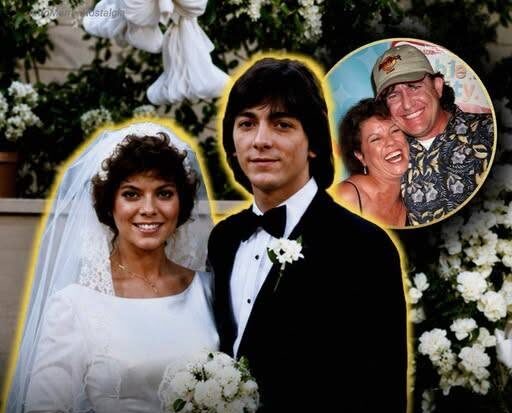
Erin Moran’s Life After Happy Days: Fame, Hardship, Love, and a Devastating Final Illness
The Television Role That Made Her Famous
At the peak of her career, Erin Moran was recognized by millions as Joanie Cunningham, the cheerful and affectionate younger sister at the center of one of television’s most successful family sitcoms.
Her appearances on Happy Days brought her national fame while she was still growing up. To viewers, she seemed to have achieved the kind of success that could provide security and opportunity for the rest of her life.
Behind the familiar television image, however, Moran’s life eventually moved in a much more difficult direction. The decades after her greatest professional success included relationship troubles, financial instability, substance-related struggles, housing problems, and a serious illness that ended her life at the age of 56.
Her story remains closely connected to the character that made her famous, but it also reflects the challenges that can emerge when childhood stardom fades and the support surrounding a successful television career disappears.
A Childhood Spent in Entertainment
Erin Marie Moran was born on October 18, 1960, in Burbank, California. She entered the entertainment industry at a young age, making acting a central part of her childhood long before she was old enough to understand the lasting effects of fame.
Her career changed dramatically when she was selected to play Joanie Cunningham on Happy Days. The sitcom premiered in 1974 and quickly became one of the most recognizable television programs of its era.
The series attracted audiences with its nostalgic setting, family-focused storylines, humor, and memorable group of characters. Moran appeared alongside Henry Winkler, Marion Ross, Tom Bosley, Don Most, Anson Williams, and Ron Howard.
As the show’s popularity grew, Moran matured in front of a national audience. Viewers watched Joanie develop from a young girl into a young woman, making the actress feel like a familiar member of their own households.
Happy Days remained a major television success for more than a decade. During those years, Moran received attention, professional opportunities, and financial rewards that appeared to establish a promising foundation for her future.
Several members of the cast continued working steadily after the series ended, building long careers through acting, directing, producing, and other entertainment projects. Moran’s experience after the program was considerably less stable.
Life After the Sitcom Ended
When the regular structure of Happy Days disappeared, Moran faced the challenge of building a life beyond the role that had defined her since childhood.
Although she had been widely recognized and celebrated, long-term security did not follow automatically. The transition away from a famous television character became part of a prolonged period of personal and financial difficulty.
The smiling and confident image associated with Joanie Cunningham remained strong in the minds of viewers, but Moran’s private circumstances became increasingly complicated.
Professional fame had given her public recognition, yet it did not protect her from emotional strain, difficult relationships, addiction, or the loss of financial stability.
A Troubled First Marriage
Several years after achieving television success, Moran married Rocky Ferguson. The relationship was initially viewed as a possible beginning to a happier and more settled period in her life.
Instead, Moran later described the marriage as deeply unhappy and emotionally isolating. She felt that she was being asked to distance herself from the identity and career that had made her known to the public.
When fans recognized her, Ferguson wanted her to deny that she was Erin Moran. This placed her in the painful position of being expected to hide a major part of her life whenever someone remembered her from television.
For an actress who had spent much of her childhood and early adulthood in front of cameras, denying that history created additional emotional pressure.
The marriage eventually ended after years of strain. Moran and Ferguson divorced in 1993, closing a difficult chapter but leaving her to rebuild her personal life again.
A Lasting Relationship With Steve Fleischmann
Moran had already met Steve Fleischmann in April 1992. After her divorce was finalized, their relationship developed further, and the couple married later in 1993.
The marriage became one of the most stable parts of Moran’s later life. She and Fleischmann remained together for more than two decades, staying devoted to each other through financial problems, public scrutiny, unstable housing, and her final illness.
The couple did not have children together, but their partnership continued until Moran’s death in 2017.
At various points, rumors circulated about problems within the marriage. Tabloid stories focused on an alleged incident at a social gathering involving alcohol, an argument, and claims about Moran’s behavior with another woman.
The allegations attracted public attention, but they were never conclusively established. Neither Moran nor Fleischmann publicly confirmed the speculation.
While those stories gradually faded from public discussion, the couple faced much more serious difficulties in their daily lives.
Financial Problems and Personal Struggles
Moran experienced significant financial hardship during the years following her television success. The money and opportunities associated with Happy Days did not provide permanent stability.
After her first marriage ended, much of the financial settlement she received was eventually spent. Starting a new life with Fleischmann did not eliminate the couple’s economic problems.
Moran also faced personal struggles involving addiction and alcohol abuse. These difficulties added further pressure to a life already affected by the loss of steady acting work and declining financial resources.
The contrast between her public image and private reality became increasingly dramatic. Fans continued to remember the lively young performer from television, while Moran and her husband struggled to maintain a secure home.
By 2010, they were no longer able to afford their California residence. The property was sold, and the couple moved to Indiana.
There, they stayed in a trailer owned by Fleischmann’s mother. The arrangement offered temporary housing but did not provide lasting stability.
Eventually, reports indicated that Moran and Fleischmann went through periods without a permanent residence. They stayed in low-cost hotels while attempting to manage their limited finances and rebuild their lives.
For longtime viewers, the situation was difficult to reconcile with the success Moran had experienced during the height of Happy Days.
She had once been part of a television phenomenon, yet years later she was facing the uncertainty of unstable housing and serious financial distress.
The Emotional Cost of Early Fame
After Moran’s death, her brother Tony reflected on the decline he had witnessed. He believed his sister never fully recovered from the emotional effects of her years in Hollywood.
Her childhood had been shaped by work, public attention, and the pressures of being recognized by millions. When the success faded, the adjustment was neither simple nor painless.
Tony viewed fame as something that had placed a heavy personal burden on his sister. The public saw opportunity and glamour, but those closest to her understood that the experience also carried emotional consequences.
He later acknowledged that he had not understood how seriously ill she had become. Discovering the extent of her condition only when little could be done made her death even more devastating for him.
Although Moran’s later years were often discussed through stories about money, housing, addiction, and rumors, the final months of her life were dominated by a rapidly advancing disease.
The First Sign of a Serious Illness
Near the end of 2016, Moran and Fleischmann marked another wedding anniversary. At that point, there was no obvious indication that their lives were about to change so dramatically.
Only days later, Moran woke and noticed a small bloodstain on her pillow. She initially believed she had bitten her tongue during the night.
The bleeding did not stop. Additional spots appeared, and they gradually became larger.
Realizing the problem required medical attention, Moran and her husband visited an ear, nose, and throat specialist.
A biopsy revealed that she had squamous cell carcinoma, an aggressive cancer that would soon progress despite immediate treatment.
The diagnosis introduced a new and overwhelming crisis. After years of emotional and financial struggle, Moran now faced a life-threatening illness requiring an exhausting schedule of medical care.
Intensive Treatment and Worsening Health
Treatment began without delay. Moran received chemotherapy once a week and underwent radiation therapy on nearly every weekday.
The demanding routine placed severe strain on her body, but Fleischmann remembered her as remaining hopeful and positive during much of the process.
She continued communicating with friends through text messages and made efforts to remain active. Even as the illness progressed, she tried to preserve a sense of normal life.
The cancer continued spreading, and her ability to eat and drink became increasingly limited.
By February, taking in food and fluids had become nearly impossible. Doctors inserted a feeding tube so that she could continue receiving nourishment.
The medical support helped address her immediate nutritional needs, but it could not stop the disease. Moran’s breathing became more difficult as the cancer advanced through her body.
Her health declined rapidly, and the treatments were unable to reverse the progression.
Her Final Day Beside Her Husband
On April 22, 2017, Fleischmann briefly left their home to purchase tissues. When he returned, Moran was in bed watching television.
He joined her, held her hand, and remained beside her as they fell asleep.
Approximately one hour later, Fleischmann woke and realized that Moran had died.
She had passed away peacefully in bed next to the husband who had remained with her through more than two decades of marriage and hardship.
Medical officials later determined that stage four squamous cell carcinoma caused her death. The cancer had spread extensively and affected multiple parts of her body.
Fleischmann was informed that hospitalization or additional aggressive medical intervention would not have changed the outcome at that advanced stage.
Although the loss was devastating, he found some comfort in knowing that Moran had not spent her final moments alone. She died at home while holding the hand of the person who had supported her through the most difficult years of her life.
A Legacy Beyond Her Personal Struggles
Erin Moran’s life is remembered through two sharply different images.
For generations of television viewers, she remains Joanie Cunningham, the warm, lively, and lovable character whose presence contributed to the enduring popularity of Happy Days.
Her performances captured an important period in American television and helped make the Cunningham family one of the most familiar fictional households of the era.
For her relatives, friends, and husband, Moran was also a woman who endured profound difficulties after the cameras stopped.
She experienced an unhappy first marriage, the fading of professional opportunities, financial hardship, addiction, alcohol abuse, unstable housing, public rumors, and an aggressive illness.
Her story demonstrates that public recognition does not guarantee personal security. A performer can be surrounded by fame and opportunity during one part of life while later facing hardships that remain largely hidden from the audience.
The character of Joanie Cunningham continues to bring Moran to new viewers as Happy Days remains part of television history.
Although her later life was marked by painful challenges, her contribution to the series has not disappeared. Her work continues to preserve the bright screen presence that first made millions of people welcome her into their homes.
Erin Moran died far too soon, but the role that defined her career continues to connect her with audiences who remember the laughter, warmth, and family stories that made Happy Days a lasting success.