
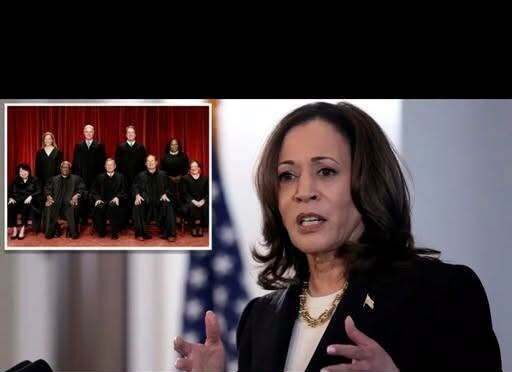
Kamala Harris Sparks Fierce Debate Over America’s Political Rules
Private Call Ignites National Political Firestorm
Kamala Harris has triggered a sharp political backlash after remarks from a private call placed her at the center of a widening argument over the future of American power.
The former vice president did not simply criticize Republicans or object to conservative strategy. Her comments raised the possibility of major institutional changes, including expanding the Supreme Court, eliminating the Electoral College, and reshaping the balance of influence between states.
Those ideas immediately turned the call into a flashpoint. Within hours, Republican critics accused Harris of attacking the foundations of the political system, while some Democrats reacted with visible unease over how far the debate had moved.
The controversy grew quickly because the proposals touched some of the most sensitive questions in national politics. At the center of the dispute is a larger argument over who holds power, how that power is protected, and whether the rules themselves have become part of the conflict.
A Challenge To Longstanding Institutions
Harris’s remarks focused on institutions that have shaped American politics for generations. Supreme Court expansion, the Electoral College, and statehood for D.C. and Puerto Rico are not narrow policy ideas. Each one would affect the structure of national power.
For conservatives, those institutions are often seen as essential barriers against sudden political overreach. Many Republicans view them as safeguards that prevent one party from dominating the country through population centers alone.
That is why Harris’s comments landed with such force. To her opponents, the proposals were not presented as routine reforms, but as an attempt to alter the rules after difficult political defeats.
Republicans quickly framed the discussion as a warning sign. They argued that Harris and her allies were willing to “blow up the system” in pursuit of short-term political advantage.
The phrase reflected the intensity of the response. It suggested that the fight was not only about one politician or one private call, but about whether one side was prepared to dismantle norms that the other side considers vital.
Republicans Move Quickly To Define The Moment
Republican reaction was swift and severe. Harris was branded an “institutional arsonist,” a label intended to portray her not as a reformer, but as someone willing to burn down established limits on political power.
The accusation placed her comments inside a broader conservative argument. In that view, proposals such as court expansion and Electoral College abolition are not democratic corrections, but partisan weapons aimed at weakening Republican influence.
Conservatives argued that the courts, the Electoral College, and state-based representation help preserve balance in a large and divided country. Any attempt to change those systems, they claimed, would deepen distrust rather than solve it.
The strongest Republican criticism centered on the idea that Harris had moved beyond complaint and into structural confrontation. Her critics said the call revealed a willingness to rewrite institutions rather than compete within them.
That framing gave the controversy immediate political power. It turned the discussion from a technical debate about reform into a moral argument about legitimacy, restraint, and democratic trust.
Democratic Unease Adds To The Tension
The reaction was not limited to Republicans. Some Democrats also appeared uncomfortable with the scale of the ideas being discussed.
That unease reflected a complicated reality inside the party. Many Democrats share frustration over courts, maps, and electoral rules, but not all are prepared to embrace sweeping institutional changes as the answer.
For those Democrats, the political risk is clear. Even if the reforms are framed as a response to unfairness, opponents can easily describe them as power grabs.
The backlash also shows how difficult it is for Democrats to discuss structural change without inviting accusations of hypocrisy. Calls to defend democracy can become politically vulnerable when paired with proposals to change the systems that determine power.
Harris’s remarks therefore exposed a divide not only between the two parties, but within the Democratic coalition itself. The question is not simply whether the party wants reform, but how far it is willing to go.
The Electoral College At The Center Of The Fight
One of the most explosive ideas tied to the call was the possibility of scrapping the Electoral College.
The Electoral College has long been one of the most disputed parts of American politics. Its defenders argue that it protects the role of states and prevents national elections from being decided only by large urban areas.
Its critics argue that it can weaken the influence of densely populated communities and allow candidates to win power without reflecting the broader national vote.
In the dispute surrounding Harris’s comments, the Electoral College became more than a procedural issue. It became a symbol of how each side understands democracy itself.
For Republicans, eliminating it would remove a central constitutional balance. For Democrats who support change, keeping it in place can feel like accepting a system that reduces the power of urban and nonwhite voters.
Supreme Court Expansion Raises Another Political Alarm
The proposal to expand the Supreme Court added another layer to the controversy.
For conservatives, the court has become one of the most important institutions in national politics. Changes to its size would be seen as a direct challenge to its current balance and authority.
Republicans used that point to strengthen their criticism of Harris. They argued that court expansion would turn the judiciary into another battlefield for partisan control.
Supporters of reform see the issue differently. They view the court as part of a larger structure that has already shaped political outcomes in ways they consider deeply unfair.
That disagreement explains why the phrase “institutional arsonist” gained traction among critics. To them, expanding the court would not repair trust in the system. It would accelerate the collapse of confidence in neutral institutions.
D.C. And Puerto Rico Statehood Enter The Debate
Harris’s comments also included support for statehood for D.C. and Puerto Rico, another issue with major consequences for national power.
Statehood would change representation and alter the balance between political parties. That possibility makes the issue intensely controversial, especially in a closely divided country.
Supporters frame statehood as a matter of representation and democratic fairness. Opponents view it as a political move that could permanently shift power in Washington.
In the current backlash, Republicans placed statehood alongside court expansion and Electoral College abolition as part of one larger strategy. They argued that the proposals were connected by a single goal: weakening conservative influence.
That interpretation gave the controversy a broader narrative. Harris was not being criticized for one isolated idea, but for a package of reforms that opponents said would transform the political system.
Race, Redistricting, And The Struggle Over Maps
The deeper emotional force behind the dispute comes from the issue of representation.
Harris’s allies and many on the left argue that existing political structures do not treat voters equally. They point to redistricting, court decisions, and the Electoral College as mechanisms that can reduce the influence of nonwhite and urban communities.
Harris sharpened that argument by accusing Republicans of “back-dooring racism through politics.” The phrase linked map-drawing and institutional rules to a broader concern about racial power.
That language immediately raised the stakes. It suggested that the argument over political structure is not merely technical or partisan, but connected to civil rights, identity, and historical exclusion.
Republicans rejected that framing and treated it as an escalation. They argued that Democrats were using accusations of racism to justify changes that would benefit their own side politically.
Ocasio-Cortez And Escalating Political Language
Alexandria Ocasio-Cortez added to the intensity by invoking Civil War language.
That choice of language reflected how severe the debate has become. The argument is no longer limited to procedure, legislation, or election strategy. It is increasingly being framed as a struggle over the survival and meaning of democracy.
For the left, that language signals urgency. It suggests that the rules are not neutral if they repeatedly produce outcomes that mute certain communities.
For the right, the same language appears reckless and inflammatory. Conservatives see it as proof that Democratic leaders and allies are preparing the public for drastic institutional confrontation.
The result is a political environment where each side believes the other is escalating first. That belief makes compromise increasingly difficult.
A Broader Crisis Of Trust
The controversy surrounding Harris’s call reveals a larger collapse of confidence in shared rules.
Republicans believe Democrats want to change the system because they dislike recent outcomes. Democrats believe Republicans are using the existing system to preserve power despite demographic and political shifts.
Both sides see themselves as defending democracy. Both accuse the other side of manipulating the rules. That mutual suspicion is what makes the current debate so volatile.
Harris’s comments became powerful because they gave each side evidence for what it already feared. Conservatives heard a threat to institutional stability. Progressives heard a demand to confront structural inequality.
The dispute also shows that arguments about courts, maps, and elections are no longer separate. They have merged into one larger battle over legitimacy.
The Question Moving Forward
The central question raised by the firestorm is not only whether the rules of American politics will change.
The deeper question is who will control the process if change comes, and whether the public will still trust the outcome afterward.
Harris’s remarks placed that question in unusually direct terms. By raising court expansion, Electoral College abolition, and statehood, she challenged institutions that conservatives consider essential to their political survival.
At the same time, the anger on the left reflects a belief that those same institutions have already distorted representation and weakened the voices of key communities.
That is why the reaction was so immediate and so intense. The controversy is not simply about Kamala Harris, Republicans, or one private call. It is about a country increasingly divided over whether its political rules are fair, and whether changing them would save democracy or damage it further.
In that atmosphere, every proposal becomes a threat to one side and a necessity to the other. The struggle over rules has become a struggle over power, identity, and trust.
The real question is not whether the debate will continue. It is whether either side can still accept a system controlled by the other.