
Homeowner Spots Terrifying Human-Like Growth Sprouting From Log Furniture
An Ordinary Patio Discovery Took an Unexpected Turn
A homeowner looking across an outdoor patio was stunned after noticing something deeply unusual emerging from a piece of wooden furniture.
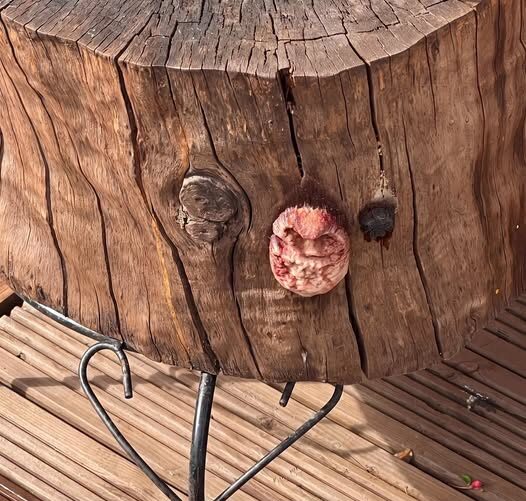
At first glance, the object appeared to be nothing more than an old, weathered tree trunk that had been repurposed as a rustic side table. But a closer look revealed a strange growth pushing through the wood, creating an appearance that seemed almost disturbingly human.
The unusual discovery quickly attracted attention after photographs were shared online. The images showed a textured, flesh-colored mass emerging from a natural opening in the log, surrounded by darker and hardened areas of wood.
What made the discovery especially unsettling was the way the growth appeared to form recognizable facial features.
Depending on the angle, the folds and shadows seemed to resemble sunken eyes, the bridge of a nose, and even a mouth twisted into an expression.
The homeowner initially had no clear explanation for what was growing from the wooden table.
The Strange Growth Quickly Captured Online Attention
Close-up photographs revealed just how unusual the formation looked.
The rounded growth appeared to push outward from a crevice or knot in the timber. Its uneven surface contained multiple ridges, folds, and areas of discoloration.
Those natural irregularities combined to create the illusion of a distorted human face embedded inside the wood.
After the photographs were shared with the online community r/whatisit under the caption “What The Hell is Growing here?”, people quickly began reacting to the bizarre appearance.
Many focused less on the biological explanation and more on how much the growth resembled something from a horror film.
The strange combination of weathered timber, darkened wood, and pale folded material gave the object an appearance that seemed almost deliberately designed to frighten anyone who happened to notice it.
But despite the unsettling appearance, the formation did not necessarily indicate anything mysterious.
A Natural Process May Explain the Unusual Shape
The most likely explanation involves fungal growth and the gradual biological breakdown of the wood.
Even after a tree has been cut, pieces of untreated timber can continue to contain fungal spores or fungal material hidden deep inside the wood.
When the timber remains outdoors, changing weather conditions can create the moisture needed for those organisms to become active.
Rain, humidity, and repeated exposure to damp conditions can penetrate untreated wood over time.
Once enough moisture becomes trapped inside the timber, fungi that had remained inactive can begin growing again.
The process is especially common in pieces of natural wood that have not been fully sealed against outdoor conditions.
A tree trunk turned into patio furniture may therefore look decorative on the outside while still containing the biological material needed for decomposition to continue internally.
The Growth May Have Forced Its Way Through a Weak Point
Fungal growth developing inside wood eventually needs somewhere to emerge.
Natural cracks, damaged areas, knot holes, and softer sections of timber can provide convenient pathways toward the surface.
In this case, the unusual mass appeared to emerge through an existing opening in the log.
As material pushes through a narrow space, the surrounding fibers can affect its final shape.
Instead of developing into a perfectly smooth or symmetrical form, the growth may become twisted, compressed, and folded as it moves through the dense grain.
That pressure can produce extremely irregular shapes.
When combined with different shades of brown, black, beige, and flesh-like coloring, those shapes can become visually dramatic.
The result can look far stranger than the natural process that created it.
Why the Growth Appears to Have a Human Face
Part of what made the patio discovery so memorable was the immediate impression that something was staring back from the log.
That effect can occur because human beings are extremely sensitive to patterns resembling faces.
When random shapes contain features that roughly resemble two eyes, a nose, and a mouth, the brain may automatically organize them into a familiar facial pattern.
This effect is commonly known as pareidolia.
It explains why people sometimes see faces in clouds, rocks, walls, tree bark, food, or other completely unrelated objects.
The patio growth created especially strong conditions for this illusion.
Its folds appeared in locations where facial features might normally be expected, while shadows added depth around the darker sections.
The surrounding wood also framed the growth in a way that made it appear even more face-like.
Once the resemblance was noticed, it became difficult not to see it.
The Log’s Outdoor Environment May Have Encouraged Growth
The piece of timber involved in the discovery had been used outdoors as furniture.
That environment can expose natural wood to repeated cycles of moisture and drying.
Rain may soak into the surface before warmer weather begins drying it again.
Seasonal humidity can also allow moisture to remain inside deeper areas long after the outside appears dry.
If the wood has not been treated or sealed effectively, these conditions can create an environment where fungal organisms continue breaking down the timber.
The process may remain hidden for a considerable period.
From the outside, a log can still appear relatively solid while changes are taking place inside.
A visible fungal formation can therefore be one of the first obvious signs that decomposition has progressed beyond the surface.
Natural Wood Furniture Can Continue Changing Over Time
Rustic furniture made from tree trunks, reclaimed timber, and unfinished slabs has become common in outdoor spaces.
These pieces are often chosen because their knots, cracks, irregular edges, and natural grain give them a distinctive appearance.
Those same natural features, however, can also provide entry points for water.
Unlike heavily processed materials, a decorative log still retains many of the structural characteristics of the tree from which it came.
Small cavities can collect moisture, while deeper cracks may remain damp even after the visible surface dries.
That means the furniture can continue changing after it has been placed outside.
Weathering may darken the wood, cracks can expand, and fungal growth can eventually become visible.
In rare cases, those changes can create shapes as unusual as the face-like formation that attracted attention in this case.
Different Types of Fungi Can Develop on Decaying Timber
Wood-decaying fungi can take many different forms depending on the species involved and the conditions surrounding the timber.
Some produce familiar shelf-like structures extending outward from a trunk.
Others develop thicker masses, irregular conks, or dense formations that appear to be part of the wood itself.
Fungi such as Inonotus, Ganoderma, and various other wood-decay organisms can survive in timber under suitable conditions.
Their visible structures may vary considerably in shape, texture, and color.
When growth occurs freely on an open surface, the resulting formation can sometimes develop in a relatively predictable way.
When it must squeeze through a knot hole or narrow crack, however, the resulting form may become distorted.
That distortion is one reason natural fungal growth can occasionally produce objects that look surprisingly familiar or even unsettling.
The Growth Can Also Signal Internal Decay
While the face-like appearance may be more strange than dangerous, visible fungal activity can still provide important information about the condition of the wood.
Fungi associated with decaying timber survive by breaking down components inside the material.
As that process continues, the wood can gradually lose strength.
A solid-looking exterior does not always mean that the inside remains equally strong.
By the time a substantial fungal body becomes visible, decomposition may already have affected areas deeper within the timber.
That is particularly important when natural logs are being used as stools, tables, supports, or other furniture expected to hold weight.
The strange growth may therefore be more than an unusual visual curiosity.
It can also indicate that the furniture is reaching a more advanced stage of deterioration.
The Viral Appearance Made the Discovery Difficult to Ignore
What transformed the backyard oddity into an attention-grabbing online image was the combination of biology and visual illusion.
Without the apparent facial features, the growth might have looked like an ordinary example of fungus emerging from old timber.
Instead, the folds lined up in a way that encouraged viewers to interpret the formation as something almost human.
The darker area surrounding the center added to the effect, making the pale material stand out sharply from the weathered surface.
From certain angles, the formation appeared to have an expression.
That gave an otherwise normal process of decay the appearance of something far more dramatic.
It also explains why so many people found the photographs difficult to forget.
An Unsettling Reminder That Wood Remains Part of Nature
The unusual patio discovery demonstrates that natural wood does not immediately become biologically inactive simply because it has been turned into furniture.
When logs and untreated timber remain exposed to outdoor conditions, moisture can allow fungi and other decay processes to continue.
Those processes are normally gradual and largely unnoticed.
Occasionally, however, nature produces something unusual enough to attract widespread attention.
In this case, fungal growth emerging from a knot in an old log created folds, shadows, and textures that strongly resembled a human face.
The frightening appearance may have looked like something from a horror story, but the explanation is far more ordinary.
Moisture, aging timber, fungal activity, and the human tendency to recognize faces in random patterns can together create something remarkably strange.
For the homeowner who first noticed the formation, however, the scientific explanation probably did little to change the surprise of looking across the patio and realizing that an old piece of wood appeared to be staring back.