
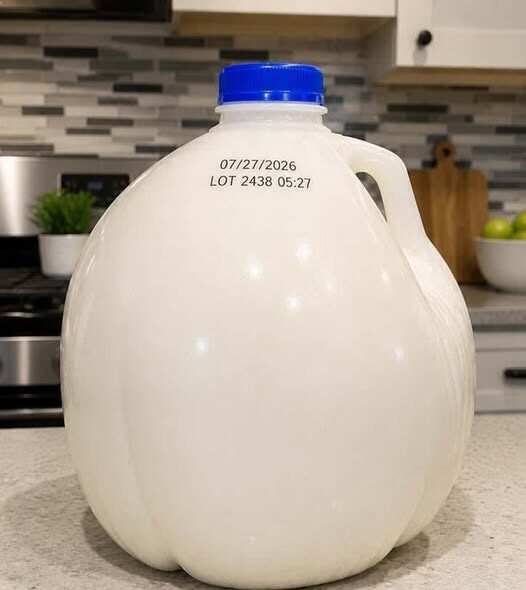
If Your Milk Container Looks Swollen, Don’t Ignore It — Here’s What It Could Mean
A Puffed-Up Carton or Jug Can Be an Important Warning Sign Even When the Printed Date Has Not Passed
Most people check the expiration date before pouring milk and assume that if the date looks fine, the product should be fine too.
But the container itself can sometimes provide an important warning.
If a milk carton, bottle, or jug suddenly appears swollen or unusually puffed up, it deserves attention.
A change in the shape of the packaging can indicate that something is happening inside.
Why a Milk Container Can Begin to Swell
Milk is a perishable food.
When microorganisms multiply inside spoiled milk, some can produce gases as part of their activity.
If those gases accumulate inside a sealed package, pressure can increase.
The result may be a container that looks inflated, expanded, or unusually firm.
That visible change should not simply be dismissed as a packaging oddity.
Swelling Can Appear Before the Printed Date
A date printed on a milk container does not mean the product is protected from every possible storage problem until that exact day.
Temperature conditions and packaging integrity still matter.
If milk has become too warm during transportation or storage, its condition may deteriorate more quickly than expected.
A damaged seal or container can also create problems.
That is why checking the actual product is useful in addition to checking the date.
Look at the Container Before You Open It
A quick inspection only takes a few seconds.
Look at the sides and top of the package.
Does it appear unusually expanded?
Is the carton bulging?
Does the bottle look as though pressure has built up inside?
If something seems noticeably different from an ordinary unopened container, it is worth being cautious.
Check for Leaks and Damage Too
Swelling is not the only packaging issue that deserves attention.
Look for cracks, punctures, leaking liquid, or other visible damage.
Inspect the seal as well.
A broken or disturbed seal means the product may no longer have the protection intended by the original packaging.
When several unusual signs appear together, taking a chance makes little sense.
Do Not Assume a Normal Date Means Everything Is Fine
Printed dates are useful, but they cannot tell you everything that happened to the milk after it was packaged.
The container may have spent time outside proper refrigeration.
It could have been exposed to temperature changes during transportation.
Packaging may have been damaged after leaving the production facility.
Those circumstances can affect freshness regardless of what the label says.
Opening the Container Provides More Clues
If the package appears normal and you open it, pay attention to what you see and smell.
Fresh milk has a familiar appearance and consistency.
When those characteristics change noticeably, the milk may no longer be suitable to use.
FDA guidance recommends discarding food that looks or smells suspicious.
Unusual Separation Can Be a Warning
Milk that appears unexpectedly separated deserves attention.
Changes in texture can occur as milk deteriorates.
Instead of looking smooth and uniform, the liquid may develop an unusual consistency.
When that appearance is accompanied by other signs of spoilage, the safest response is to avoid using it.
Curdling Is Another Obvious Sign
Visible lumps or curdling are difficult to miss.
If ordinary drinking milk that should be smooth has developed clumps or an obviously altered texture, something has changed.
There is little reason to experiment with it.
Discarding questionable milk is safer than trying to find a way to use it.
Color Changes Matter
The appearance of milk should also be familiar.
If you notice an unexplained change in color, examine the product carefully.
A combination of discoloration, unusual consistency, swelling, or odor provides even more reason not to drink it.
Your Nose Can Provide an Important Warning
Spoiled food often develops noticeable changes in odor, flavor, or texture, according to FDA food-safety guidance.
Milk is no exception.
If the smell is unpleasant or clearly different from what you expect, do not ignore it.
You do not need to drink the milk to confirm that something is wrong.
Do Not Taste Questionable Milk to Test It
This is an especially important habit.
If you already suspect milk has spoiled, tasting it is unnecessary.
You can use the condition of the package, appearance, storage history, and odor to decide whether the product should be discarded.
When safety is uncertain, throwing it away is the more cautious choice.
A Swollen Container at the Store Is a Reason to Choose Another One
If you notice an inflated container before purchasing it, leave it on the shelf and select a normal package instead.
If you discover swelling after you return home, consider taking the product back to the retailer rather than opening it to investigate.
A visibly abnormal package is not worth taking an unnecessary chance with.
Returning the Product May Be the Simplest Solution
Keeping the receipt can make the process easier.
Taking a photograph of the swollen or damaged packaging can also provide a record of what you noticed.
Depending on the store, the milk may be eligible for a refund or replacement.
This allows you to address the problem without consuming a product you already suspect may be spoiled.
The Cold Chain Matters More Than Many People Realize
Milk depends on consistent refrigeration.
From production to transportation, the store cooler, and eventually the refrigerator at home, keeping milk properly chilled helps preserve it.
If that chain is interrupted for too long, the milk may deteriorate more quickly.
That is one reason a date printed on the package cannot serve as an absolute guarantee.
Your Refrigerator Should Be 40°F or Colder
The article recommends keeping milk at “40°F (4°C) or below,” which matches FDA and FoodSafety.gov refrigeration guidance.
Maintaining that temperature is one of the simplest ways to protect perishable foods.
A refrigerator thermometer can help confirm that the appliance is actually staying within the recommended range.
Refrigerator Temperature Can Vary by Location
Not every part of a refrigerator experiences exactly the same conditions.
The temperature changes most frequently in areas repeatedly exposed to warmer room air.
This is why where you keep frequently used perishables can matter.
Consistent cold storage is the goal.
Milk Is Often Better Toward the Back
Keeping milk farther inside the refrigerator can expose it to fewer temperature fluctuations than storing it in a frequently opened door compartment.
Every time the refrigerator door opens, items positioned there encounter warmer surrounding air.
Storing milk in a consistently cold area can help maintain its quality.
Do Not Leave Milk Sitting Out Unnecessarily
Milk should be returned to refrigeration promptly after use.
It can be easy to leave the carton on a breakfast table or kitchen counter while doing something else.
But because milk is perishable, unnecessary time outside refrigeration should be avoided.
Keeping cold foods cold is a basic part of food-safety guidance.
Repeated Warming and Cooling Is Not Ideal
Taking the milk out briefly to pour a glass is normal.
Leaving it sitting in a warm kitchen for extended periods is different.
The goal is to minimize unnecessary temperature changes.
Returning the container promptly to the refrigerator is an easy habit that requires almost no additional effort.
Check Refrigerator Temperature Instead of Guessing
A refrigerator can feel cold without necessarily remaining at the recommended temperature.
Using a refrigerator thermometer removes the guesswork.
FoodSafety.gov recommends using one to make sure the appliance remains at 40°F or below.
This is especially useful if food seems to be spoiling earlier than expected.
A Swollen Package Is Different From Normal Packaging Variation
Containers are manufactured in different shapes and materials.
Some cartons naturally feel firmer than others.
What matters is an obvious abnormal change.
A package that looks substantially puffed up compared with similar containers deserves closer attention.
Pressure Inside the Package Is the Concern
The important question is why the shape has changed.
If gas is accumulating inside because microorganisms are active, the package can expand.
The visible swelling is therefore useful because it gives you a clue before you consume what is inside.
Ignoring that warning removes an opportunity to avoid a questionable product.
The Same Basic Principle Applies to Other Packaged Foods
Food-safety authorities treat abnormal swelling as an important warning in sealed packaged foods.
USDA materials identify swelling as an obvious potential indicator of spoilage in certain processed foods.
The safest response to unexpectedly swollen food packaging is caution rather than curiosity.
Do Not Let the Expiration Date Override Your Senses
Consumers often place enormous confidence in the printed date.
But actual storage conditions matter.
If a carton is swollen, leaking, smells wrong, or contains visibly abnormal milk, the fact that the printed date is several days away should not convince you to drink it.
The condition of the food in front of you matters.
Likewise, Do Not Throw Milk Away Based Only on Panic
The lesson is not that every carton should be treated suspiciously.
Most properly refrigerated milk in intact packaging will look completely normal.
The point is simply to notice clear warning signs rather than automatically ignoring them.
A quick visual check can become part of an ordinary kitchen routine.
Start With the Package
Before opening the milk, look at it.
Check whether the container appears normal.
Make sure it is not leaking.
Check for visible cracks or damage.
Make sure the seal appears intact.
These steps take only seconds.
Then Check the Milk Itself
Once opened, notice whether the milk looks the way it normally does.
Pay attention to unexpected clumps, unusual separation, or color changes.
Then notice the smell.
If multiple warning signs are present, there is no benefit in trying to prove the milk is still usable.
When in Doubt, Discarding It Is the Safer Choice
A container of milk is replaceable.
Taking a risk with obviously questionable food is unnecessary.
If the product looks or smells abnormal, FDA guidance supports throwing suspicious food away.
That simple decision can prevent a small kitchen question from becoming a much larger problem.
Good Storage Starts at the Grocery Store
Take a moment to inspect dairy products before placing them in the cart.
Avoid packages that appear damaged, leaking, open, or unusually swollen.
Once home, refrigerate the milk promptly.
Those simple habits reduce the likelihood of discovering a problem later.
Keep an Eye on Problems That Repeat
If milk repeatedly seems to spoil unusually quickly in your home, refrigerator temperature is worth checking.
A thermometer can show whether the appliance is remaining at “40°F (4°C) or below.”
If it is warmer than recommended, other refrigerated foods may also be affected.
Freshness Depends on More Than One Factor
No single check can tell the entire story.
The printed date is useful.
Packaging condition is useful.
Storage temperature matters.
Appearance and odor matter too.
Considering all of these together provides a much better picture than relying on the label alone.
The Container Can Be an Early Warning System
Packaging is usually thought of as nothing more than a way to hold milk.
But an unexpected physical change can provide information about what may be happening inside.
A visibly swollen carton is not something that needs to be opened and tasted simply to satisfy curiosity.
It is a reason to stop and evaluate the product.
A Few Seconds of Attention Can Prevent a Bad Decision
Most people pour milk automatically.
They open the refrigerator, grab the carton, and use it without thinking.
Usually, that routine causes no problem.
But noticing an abnormal package before opening it gives you a chance to make a safer choice.
Remember the Basic Warning Signs
Watch for swelling.
Look for leaks or cracks.
Check the seal.
Notice unusual curdling or separation.
Pay attention to unexpected changes in color or odor.
And do not taste questionable milk merely to determine whether it has spoiled.
Keeping Milk Cold Is One of the Most Important Habits
Proper refrigeration remains one of the simplest protective measures.
Keep the refrigerator at “40°F (4°C) or below.”
Store milk where the temperature remains reliably cold.
Return it to refrigeration promptly after pouring.
Those ordinary habits can help preserve both freshness and safety.
The Safest Response to a Swollen Milk Container Is Simple
If you open the refrigerator and notice that a milk container has unexpectedly puffed up, do not ignore it simply because the printed date has not arrived.
Inspect the package carefully.
If it was already swollen when purchased, return it if practical.
If the milk looks or smells abnormal, discard it.
There is no need to taste-test a product that is already giving you reasons for concern.
A swollen milk container may look like a minor packaging issue, but it can be an important warning.
When something about a perishable food seems clearly wrong, replacing it is usually a much better choice than taking an unnecessary risk.