
Homeowner Finds Strange “Creature” Wriggling in Swimming Pool — Then Learns What Its Long Tail Really Is
The Bizarre Discovery Looked Like a Parasite at First, but Its True Identity Was Far Less Frightening
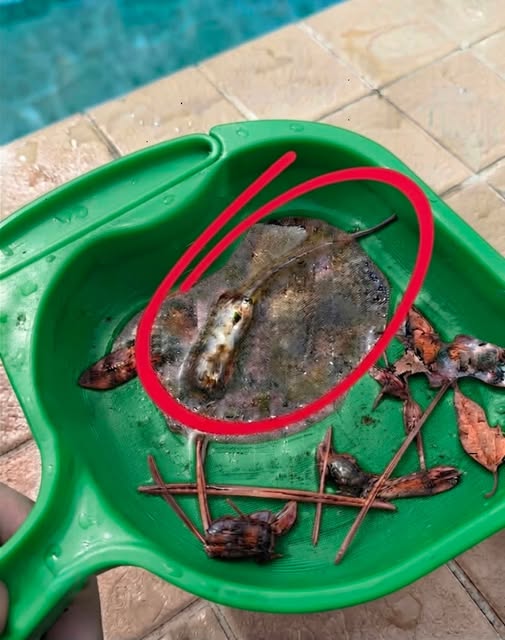
A routine swimming pool cleaning suddenly became much more interesting when a homeowner noticed an unfamiliar creature floating near the surface.
It was small, pale, and wriggling through the water.
But the feature that immediately caused concern was an extremely long, thin structure trailing behind its body.
At first glance, it looked like the kind of creature most people would want nowhere near a swimming pool.
The homeowner had no idea what it was.
The Long “Tail” Made the Creature Look Especially Disturbing
The body itself was unusual enough.
But the thin appendage extending behind it made the animal appear far stranger.
It seemed almost too long for such a small creature.
Because it was moving in the water, the first instinct was to wonder whether it might be some type of parasite.
Other possibilities quickly came to mind as well.
An Internet Search Made the Situation Feel Worse
Instead of immediately solving the mystery, searching online created even more uncertainty.
For nearly an hour, different images and descriptions suggested increasingly alarming possibilities.
Parasites.
Dangerous larvae.
Unusual aquatic organisms.
Potential invasive species.
The more possibilities appeared, the more threatening the small creature seemed.
Then the Correct Identification Changed Everything
Eventually, the mysterious pool visitor was identified.
It was a rat-tailed maggot.
Despite the unsettling name and appearance, the creature was far less alarming than the homeowner had feared.
A rat-tailed maggot is the larval stage of a hoverfly.
And the strange “tail” that made it appear so frightening was not really a tail at all.
The Long Appendage Is Actually a Breathing Tube
The thin structure functions much like a snorkel.
The larva can remain submerged while extending the tube toward the water’s surface.
This allows it to access air even when the surrounding water contains relatively little oxygen.
Once that purpose becomes clear, the creature’s bizarre appearance suddenly makes much more sense.
Its Environment Explains the Unusual Adaptation
Rat-tailed maggots can live in stagnant or oxygen-poor water containing decaying organic material.
Those environments can be difficult for many organisms because oxygen levels may be low.
The breathing tube gives the larva a practical solution.
Instead of depending entirely on oxygen dissolved in the water, it can reach the surface while keeping the rest of its body submerged.
What Looks Like a Tail Works More Like a Snorkel
That comparison helps explain one of the strangest features of the animal.
A snorkeler can keep most of the body underwater while a tube reaches the air above.
The larva uses a remarkably similar principle.
Its body remains in the water while the narrow breathing structure extends upward.
The result may look alarming, but it serves a straightforward biological purpose.
The Creature Was Not the Dangerous Parasite Initially Feared
Once properly identified, much of the earlier panic disappeared.
The homeowner had spent considerable time worrying about whether the pool contained something dangerous.
Instead, the strange animal was simply an insect larva with an unusual adaptation.
The dramatic appearance had created far more fear than the actual creature deserved.
The Name “Rat-Tailed Maggot” Does Not Help
Even after identification, the common name can sound intimidating.
Neither “rat-tailed” nor “maggot” is likely to make someone feel immediately comfortable about finding one in a swimming pool.
But the name describes appearance rather than danger.
The elongated breathing tube resembles a tail, while the larval body has the soft form associated with many fly larvae.
The Adult Insect Is a Hoverfly
The strange aquatic-looking larva eventually develops into a completely different-looking adult insect.
Hoverflies are beneficial insects commonly associated with flowers.
This creates a surprising contrast.
The unusual creature wriggling through murky water is simply an earlier stage of an insect that later spends its time flying above the ground.
Its Presence Can Reveal Something About the Water
Finding a rat-tailed maggot can also offer a clue about the environment in which it was discovered.
The larvae are adapted to water containing decaying organic matter and relatively low oxygen.
That makes areas with accumulated debris or stagnant water suitable places for them to appear.
In a pool, leaves or other organic material can create small pockets of conditions that attract unexpected organisms.
Swimming Pools Can Temporarily Attract Wildlife
A backyard pool may feel completely separate from the natural environment surrounding it.
But insects and other small creatures do not recognize that boundary.
Water attracts wildlife.
Leaves fall into pools.
Organic material accumulates.
Small animals can sometimes find suitable temporary conditions in places homeowners never intended to become habitats.
The Creature’s Movement Made It Seem More Threatening
A motionless unfamiliar object might have been dismissed as debris.
This one wriggled.
Watching the small body move while a long thin structure followed behind immediately created the impression of something more sinister.
Movement has a powerful effect on how people interpret unknown objects.
Once something appears alive, curiosity and caution naturally increase.
Fear Filled the Gaps Before Facts Could
When an unfamiliar animal appears unexpectedly, people tend to search for an explanation immediately.
Until that explanation arrives, imagination can easily move toward worst-case scenarios.
The homeowner’s fears about parasites and invasive species were understandable because the creature did not resemble anything familiar.
But appearance alone was not enough to identify it accurately.
A Correct Name Turned Panic Into Curiosity
The moment the creature was identified as a rat-tailed maggot, the experience changed.
Instead of asking whether it was dangerous, the homeowner could begin asking how it lived.
Why was its breathing tube so long?
Why did it live in water?
What would it eventually become?
Fear had been replaced by a small lesson in biology.
The Larva Was Simply Trying to Survive
Nothing about the animal’s appearance was designed to frighten people.
The unusual body shape exists because it helps the larva survive in its preferred environment.
The breathing tube allows access to atmospheric oxygen.
The soft body allows movement through water containing organic material.
What appears bizarre from a human perspective is simply practical for the organism itself.
The Pool Was Not Where the Homeowner Expected to Learn Biology
Many encounters with wildlife happen unexpectedly.
A person may be cleaning a yard, moving firewood, opening a shed, or checking a swimming pool when an unfamiliar organism suddenly appears.
Those moments can be startling precisely because they occur during ordinary routines.
In this case, regular pool maintenance became an introduction to an insect life cycle most people rarely notice.
The Long Tube Is the Key to Understanding the Animal
Without knowing what the appendage does, it is easy to see why someone might imagine a worm-like parasite.
Once the breathing function is understood, however, the shape stops seeming random.
The larva needs oxygen.
The water where it lives may not provide enough.
So its body has a structure capable of reaching the air above.
It is a simple solution expressed through an unusual appearance.
Nature Frequently Produces Strange-Looking Solutions
Animals survive by adapting to the conditions around them.
Some develop unusual body shapes.
Others use camouflage.
Some live underground or underwater.
The rat-tailed maggot’s extended breathing tube is another example of how an organism can develop a highly specialized feature that makes perfect sense within its environment.
The Creature Was Safely Removed
Once the identification was clear, there was no longer a need for panic.
The small larva could simply be removed from the swimming pool.
The disturbing encounter ended without the dramatic measures that might have seemed necessary during the first few minutes.
The homeowner was left with relief and an unusual story.
The Experience Also Demonstrated the Limits of Quick Internet Searches
Searching an unfamiliar creature online can be useful.
It can also create unnecessary anxiety when visual similarities lead to the wrong possibilities.
A small aquatic organism with a long appendage may resemble several completely unrelated creatures in photographs.
Without the right identifying features, it is easy to move from one alarming explanation to another.
Close Observation Eventually Solved the Mystery
The important characteristics were its larval body, aquatic behavior, and exceptionally long breathing tube.
Together, those features pointed toward the correct identification.
Once they were viewed as parts of a single adaptation rather than evidence of something dangerous, the animal became much easier to understand.
Hoverflies Have a Very Different Reputation
The adult stage makes the discovery even more surprising.
Hoverflies are generally regarded as beneficial insects.
The dramatic-looking larva and the familiar adult fly seem so different that many people would never guess they were stages of the same life cycle.
That transformation is another reason the discovery can become an interesting educational moment.
One Creature Can Look Completely Different Throughout Its Life
Insects frequently undergo major changes as they mature.
The larval stage may be specialized for feeding and growth.
The adult stage may have an entirely different form and lifestyle.
The rat-tailed maggot is an especially memorable example because its aquatic larval appearance seems so disconnected from the flying adult it eventually becomes.
The Initial Panic Was Understandable
Most homeowners do not expect to find unfamiliar larvae floating in their swimming pools.
Seeing one for the first time, especially with such a dramatic breathing tube, can naturally produce concern.
The safest response to an unfamiliar organism is not to handle it unnecessarily before knowing what it is.
But once identification is established, the situation often becomes much less frightening.
Understanding Changes the Way We See Strange Creatures
Before identification, the animal seemed grotesque and threatening.
Afterward, the same features became interesting.
The “tail” was no longer an ominous appendage.
It was a breathing tube.
The wriggling body was no longer evidence of a dangerous parasite.
It was simply an insect larva adapted to aquatic life.
Unfamiliar Does Not Automatically Mean Dangerous
This is one of the most useful lessons from unexpected wildlife encounters.
Humans naturally become cautious around organisms they cannot immediately recognize.
That caution can be valuable.
But appearance alone does not determine whether an animal represents a threat.
Some of the strangest-looking creatures are simply ordinary parts of the local ecosystem.
The Natural World Is Full of Things We Rarely Notice
Many small organisms spend their entire lives outside normal human attention.
They live in soil, standing water, rotting vegetation, beneath bark, or among leaves.
People may encounter them only when those habitats overlap with homes and gardens.
A swimming pool can become one of those unexpected meeting points.
A Frightening Discovery Became a Biology Lesson
What began with panic eventually ended with fascination.
The homeowner had not discovered a terrifying invasive monster or a mysterious parasite.
The strange animal was a rat-tailed maggot using its long breathing tube exactly as nature intended.
It was removed safely, and the pool cleaning continued.
Sometimes the Truth Is Far Less Scary Than the Imagination
The experience is a reminder of how quickly unfamiliar things can trigger fear.
A strange shape moves through the water.
The mind supplies a dangerous explanation.
An internet search adds even more possibilities.
Then one accurate identification changes everything.
The creature itself never became less strange.
Only the understanding of it changed.
And once the homeowner knew that the frightening “tail” was simply a tiny biological snorkel, the pool visitor stopped looking like a nightmare and became something much more interesting: an unexpected example of how inventive the natural world can be.