
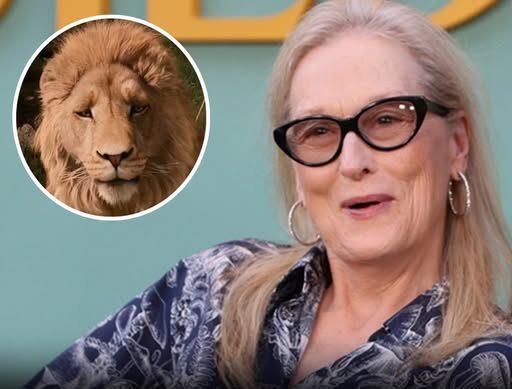
Meryl Streep’s Casting as Aslan in Greta Gerwig’s New Narnia Film Sparks Heated Backlash
Greta Gerwig’s Choice for Aslan Has Divided Longtime Narnia Fans
Meryl Streep’s casting as the voice of Aslan in Greta Gerwig’s upcoming Narnia movie has sparked an intense debate among fans, particularly those who view the famous lion as one of the most important Christian figures in C.S. Lewis’s fantasy world.
The decision has generated criticism from religious commentators and longtime readers who argue that Aslan’s identity as a male lion is inseparable from the character’s meaning within the books.
Others have defended Gerwig’s creative freedom and questioned why the gender of the performer providing the voice should automatically change the nature of the fictional character.
The disagreement has quickly become one of the most controversial discussions surrounding Gerwig’s adaptation.
Aslan Has Always Carried Deep Religious Meaning
For generations of readers, Aslan has represented far more than a powerful talking lion.
Throughout C.S. Lewis’s seven-book Chronicles of Narnia series, Aslan serves as a protector, guide, creator and moral force within the magical world.
He is compassionate toward those who seek his help, but he is also portrayed as powerful and impossible to control.
His role becomes especially significant because of the Christian themes woven throughout Lewis’s stories.
Lewis was a devoted Anglican, but he resisted describing Narnia as a simple Christian allegory.
Instead, he described the religious framework as a “supposition,” imagining “what might Christ become like, if there really were a world like Narnia.”
That distinction has remained central to discussions of Aslan for decades.
Aslan Was Written as a Christ-Like Figure
Aslan’s role in the books includes several events that strongly reflect Christian themes.
In The Lion, the Witch and the Wardrobe, he sacrifices his own life to save Edmund and later returns from the dead.
Those events have long been interpreted as closely connected to the death and resurrection of Christ.
In The Magician’s Nephew, which Gerwig is adapting for Netflix, Aslan plays an even more fundamental role.
He is the creator of Narnia itself.
The lion brings the world and its creatures into existence through song, establishing him as one of the most powerful beings in Lewis’s fictional universe.
Because Lewis consistently referred to Aslan as male, some readers believe changing the voice behind the character carries greater significance than an ordinary casting decision.
Previous Narnia Films Used a Male Voice
Earlier screen adaptations maintained Aslan’s traditional male presentation.
Liam Neeson voiced the character across the three Narnia films released between 2005 and 2010.
His deep voice became closely associated with Aslan’s combination of authority, warmth and danger.
Gerwig has chosen a very different approach for her adaptation.
Meryl Streep, one of the most celebrated actors of her generation, will reportedly provide Aslan’s voice.
The casting reunites Streep with Gerwig seven years after the actor appeared in Gerwig’s 2019 adaptation of Little Women.
Gerwig Explained What She Wanted From Aslan
Gerwig has explained that she was looking for a performer who could express both Aslan’s enormous authority and his sense of warmth and wonder.
She said the role required someone capable of communicating seriousness without becoming overly solemn.
“I wanted someone who was profound but not pretentious, who had gravitas but not morose self-seriousness. Someone who could communicate depth and pathos as well as joy and delight,” Gerwig said.
Age and experience also played a role in her search.
“I wanted someone who was older than 70, so there was a wisdom of experience, but who also had the capacity of fresh wonder, like a child. And also, to be one of the greatest actors to ever do it. That list is not a long one,” she added.
Streep, 77, fits that description through a career spanning nearly five decades.
Meryl Streep Brings Decades of Acting Experience
Streep has long been regarded as one of Hollywood’s most accomplished performers.
She has won three Academy Awards for Kramer vs. Kramer, Sophie’s Choice and The Iron Lady.
Her ability to move between drama, comedy and deeply emotional roles appears to have been one of the qualities that attracted Gerwig to her for Aslan.
But the actor’s reputation has not prevented the casting decision from becoming controversial.
For some Christian fans of Lewis’s novels, the concern is not whether Streep is capable of delivering the performance.
The concern is whether a female voice changes something fundamental about a character Lewis consistently described as male.
Critics Say Aslan’s Gender Is Not Interchangeable
Texas preacher David Fairchild strongly criticized the decision and argued that Aslan was deliberately created as a male representation of Christ within Narnia.
He argued that Lewis “explicitly conceived of Aslan as what Christ might be like if the Son of God entered a world like Narnia.”
Fairchild rejected the idea that changing the voice was simply a bold interpretation.
“Giving Aslan a female voice isn’t daring or profound or some brilliant act of creative genius – it’s an act of creative vandalism,” Fairchild wrote.
His criticism focused heavily on Lewis’s repeated use of male language for Aslan.
“Aslan isn’t some generic figure with an interchangeable identity. He’s male. Lewis wrote him as male. He’s repeatedly called ‘he.’ He’s a king, not a queen. He’s the Son of the Emperor-Beyond-the-Sea,” Fairchild said, adding that Gerwig’s adaption is “ideological slop.”
Gerwig Is Also Giving Aslan a New Visual Style
The controversy extends beyond Streep’s voice.
Gerwig has reportedly redesigned Aslan with visual inspiration drawn from David Bowie.
The lion is said to have heterochromic eyes and a red stripe across his face.
Those visual choices suggest Gerwig is not attempting to recreate previous film versions of Aslan exactly.
Instead, she appears to be developing a distinct interpretation of the character for her version of Narnia.
That broader creative approach has further divided readers who want the adaptation to remain closely aligned with Lewis’s original description.
Another Religious Commentator Criticized the Decision
Evangelical influencer Jackie Chea also attacked Gerwig’s casting decision.
Chea accused the director of attempting to “turn Jesus into a feminist statement,” and claimed that Gerwig “favours a pagan, mother-based view of religion.”
The comments reflected the deeper religious concern driving much of the backlash.
For these critics, Aslan is not merely a fictional lion whose voice can be altered without consequence.
They view him as a character deliberately shaped by Lewis to reflect Christ, making any major change to his gender presentation especially sensitive.
Fans Took the Argument Even Further Online
Social media quickly filled with reactions after Streep’s casting became widely discussed.
Some users focused simply on the idea of a male lion having a female voice.
“It doesn’t even make sense why a MALE LION would sound like Meryl Streep! It’s ridiculous!” one person wrote.
Another connected the casting directly to Aslan’s religious symbolism.
“So Aslan, the male lion C.S. Lewis wrote in as the metaphorical representation of God, is being played by a woman. They want to make God trans. Run as far away from Hollywood as you can.”
A third user expressed frustration with broader changes in modern entertainment.
“Is there anything left out there that’s not been, isn’t and will not be ruined by the orcs of the Era of Woke?”
Not Everyone Believes the Casting Is a Problem
The backlash has also produced a strong counterreaction.
Some people have argued that casting choices do not necessarily alter a fictional character’s identity.
One commenter pointed to the history of theater, where performers have long portrayed characters of different genders.
“All you butthurt folks would spontaneously combust if you were sent back to Shakespeare’s time and saw who played Juliet in that plays first performance,” the commenter wrote.
The comparison referred to Elizabethan England, when women were not permitted to perform on public stages and female characters were commonly portrayed by men or boys.
For defenders of the casting, the performer supplying Aslan’s voice does not automatically mean that Aslan himself has been rewritten as female.
The Debate Is About More Than Meryl Streep
The intense response shows that the controversy extends beyond one actor.
Streep’s casting has become part of a larger discussion about how much freedom filmmakers should have when adapting beloved literary works.
Some viewers welcome new interpretations and believe adaptations should be allowed to distinguish themselves from earlier versions.
Others believe certain aspects of a character are so closely tied to the author’s intent that changing them alters the meaning of the original work.
Aslan sits directly at the center of that disagreement because his identity carries both narrative and religious significance.
The Magician’s Nephew Gives Aslan a Particularly Important Role
The choice may feel especially significant because Gerwig is adapting The Magician’s Nephew rather than simply retelling The Lion, the Witch and the Wardrobe.
In that story, Aslan is not merely guiding characters through an existing world.
He is responsible for creating Narnia.
His song brings the world to life and establishes him as the central spiritual force in the story.
That role places enormous importance on the character’s voice.
The voice will help define how audiences experience the creation of Narnia and how they understand Aslan’s authority from the beginning.
A Reported $280 Million Production Carries Huge Expectations
Gerwig’s adaptation reportedly carries a budget of approximately $280 million.
With that level of investment, expectations surrounding the project are already extremely high.
Gerwig also arrives at Narnia following the enormous attention surrounding Barbie, meaning every major creative choice in her new project is likely to receive close scrutiny.
Casting Streep as Aslan ensures that the film already has one of the most recognizable performers in Hollywood attached to one of fantasy literature’s most recognizable characters.
It also guarantees that the debate over how faithfully Gerwig intends to interpret Lewis’s work will continue long before audiences actually see the finished film.
🚨WORLD-EXCLUSIVE FIRST LOOK 🚨
Greta Gerwig opens the doors to Narnia: The Magician’s Nephew in the new issue of Empire – detailing her revolutionary rock’n’roll adaptation.
Here’s your first look at Aslan – and he’s voiced by the legendary Meryl Streep.
On sale Thurs September 24.
Read more: https://t.co/kJe087Ettd
— Empire (@empiremagazine) September 17, 2026
Aslan Remains One of Fantasy Literature’s Most Sensitive Characters to Adapt
Unlike many fictional characters, Aslan carries different meanings for different audiences.
Some readers primarily see him as the powerful guardian of a magical kingdom.
Others view him through the explicitly Christian framework that shaped Lewis’s writing.
For that second group, decisions involving Aslan can carry spiritual significance in addition to artistic significance.
That is why a casting decision that might seem minor in another fantasy series has become such a heated issue here.
The Controversy Is Unlikely to Disappear Soon
Gerwig has clearly described the qualities she believes Streep can bring to the role: wisdom, authority, emotional depth, joy and wonder.
Her critics remain equally clear that they believe Aslan’s male identity should remain unchanged in every aspect of the adaptation.
Between those positions are viewers who simply want to see how the performance works before deciding whether the decision succeeds.
Streep’s casting has therefore become an early test of how audiences will respond to Gerwig’s broader interpretation of Narnia.
Whether the controversy fades once the film is released or grows as more details emerge remains to be seen.
For now, one thing is clear: Greta Gerwig’s Aslan already has people debating faith, literature, creative freedom and adaptation long before the lion has spoken his first line on screen.