
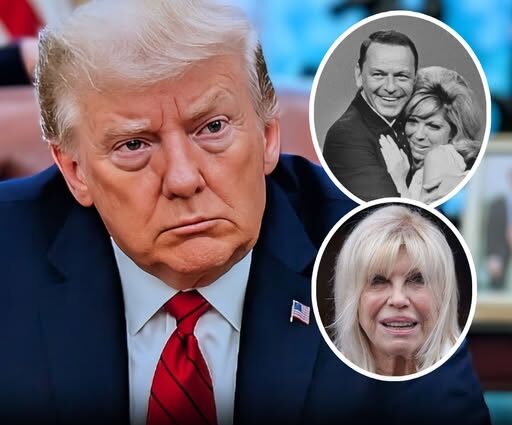
Nancy Sinatra Responds After Frank Sinatra’s “My Way” Appears in Donald Trump Video
Unexpected Post Sparks Immediate Attention
A video shared online drew widespread attention after it appeared without any explanation, caption, or added context. The clip featured Frank Sinatra performing “My Way” while Donald Trump watched on screen, creating an immediate wave of reactions across social media.
Because the post arrived with no description, viewers quickly began offering their own interpretations. Some believed it carried a symbolic message, while others viewed it as a dramatic gesture designed to provoke discussion.
The lack of explanation became a major part of the story. Instead of focusing only on the music itself, many users concentrated on what the video might have meant and why it had been shared in that particular format.
Online Speculation Grows Rapidly
Within minutes, discussion surrounding the clip expanded across multiple platforms. Reactions ranged from confusion to curiosity, with many users debating whether the song choice represented a personal statement, a political message, or simply a reference to a famous classic.
“My Way” has long been associated with independence, determination, and personal legacy. Because of those themes, the song often carries added meaning whenever it is used in public settings.
That history helped intensify the reaction. Many viewers felt the track selection was deliberate, while others argued it was impossible to know the intent without a direct explanation.
Nancy Sinatra Enters the Conversation
As the online debate continued, Nancy Sinatra responded publicly. Her reaction immediately became one of the most discussed parts of the story.
She described the use of her father’s signature song as “sacrilege,” a brief but powerful statement that shifted attention from speculation about the video’s meaning to a debate about artistic legacy and family perspective.
For many observers, those words carried significant weight because they came from someone closely connected to Frank Sinatra’s life and career.
A Personal and Public Objection
Nancy Sinatra’s criticism suggested that her concern went beyond politics alone. To her, the issue involved how one of her father’s most recognized performances was being presented in a modern political setting.
“My Way” remains one of Frank Sinatra’s most enduring songs, strongly linked to his public image and musical legacy. As a result, any high-profile use of the recording can generate strong reactions from longtime fans and family members.
Her response reflected the view that certain works carry meanings shaped by the artist’s life and values, and that those meanings can be challenged when reused in unexpected ways.
Further Comments Add to Debate
After the initial reaction, Nancy Sinatra made additional remarks that drew even more attention. She stated that while Trump may admire Frank Sinatra, “Sinatra did not love Trump.”
That comment deepened the divide between supporters and critics discussing the post. It also moved the conversation beyond the single video and into broader questions about legacy, reputation, and who has the authority to interpret a public figure’s beliefs after their death.
Her statements made clear that she did not view the clip as a harmless tribute.
No Legal Challenge, But a Clear Position
Nancy Sinatra also acknowledged that she does not have the legal power to prevent the use of the song in this situation. Even so, she emphasized that she still had the ability to speak publicly about how she viewed it.
That distinction became important in the wider conversation. While legal rights often determine whether music can be used, public reaction frequently shapes how that use is perceived.
In this case, her comments ensured that the discussion centered not only on permission, but also on respect and intent.
Why “My Way” Carries Special Meaning
Few songs are as closely tied to a performer as “My Way” is to Frank Sinatra. Over time, it became one of the defining pieces of his catalog and is often associated with confidence, reflection, and living life on one’s own terms.
Because of that reputation, the song is regularly interpreted as more than entertainment. It can be seen as a statement about identity, ambition, and personal history.
When such a recognizable track appears in a political or controversial setting, reactions are often stronger than they would be for an ordinary song.
Legacy in the Digital Era
The episode also highlighted how quickly historic works can be pulled into modern disputes through social media. A brief clip lasting only moments can trigger national discussion when it involves a famous figure, a well-known song, and a controversial context.
In earlier eras, debates over music use might have unfolded through interviews or print coverage over several days. Today, reactions can develop instantly and spread globally within minutes.
That speed means family members, fans, and critics often respond in real time, adding new layers to stories as they unfold.
Supporters and Critics React
People responding to the controversy took sharply different positions. Some defended the use of the song as a form of expression and argued that public figures often reference classic music for symbolic reasons.
Others agreed with Nancy Sinatra, saying iconic recordings should not be used in ways that appear to conflict with the values they believe the artist represented.
The disagreement showed how music can become a cultural battleground, especially when connected to politics and legacy.
A Song Larger Than the Moment
Despite the immediate controversy, many observers noted that the enduring power of “My Way” is part of the reason the post generated such attention. Songs with lasting emotional and cultural significance often take on new meanings across generations.
At the same time, those evolving meanings can create tension between public interpretation and family memory.
That balance is difficult to resolve, particularly when the artist is no longer present to explain how the work should be understood.
Continuing Conversation
What began as a silent video post quickly transformed into a broader debate about ownership, symbolism, and respect for artistic history.
Nancy Sinatra’s reaction ensured that the moment would not be remembered only as another online controversy. Instead, it became a discussion about who gets to define the meaning of a famous song decades after it first entered popular culture.
Whether viewed as tribute, provocation, or simple performance, the clip demonstrated how powerful music remains in public life—and how quickly it can reopen questions about identity, memory, and legacy.