
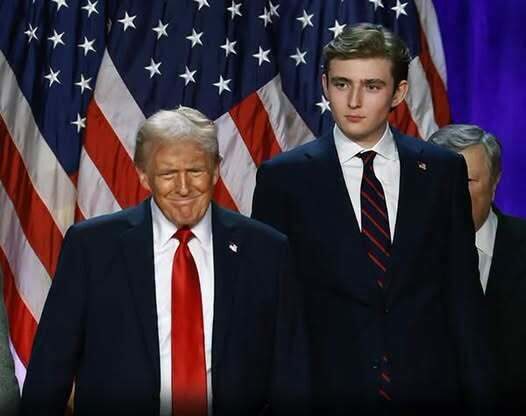
Barron Trump Poll Fuels Debate Over Whether the Family’s Political Influence Could Continue
The president’s youngest son has remained largely outside public politics, but growing Republican interest is raising questions about the future of “Trumpism” and the constitutional limits surrounding a possible candidacy.
Barron Trump spent much of his childhood away from the center of the political battles surrounding his family. While his father dominated rallies, television coverage, elections, and national debate, Barron was generally seen only during carefully selected public appearances.
That distance helped create an unusual level of curiosity around him. Unlike other members of the Trump family who became active campaign figures, business representatives, or political voices, Barron remained a quieter presence whose opinions and long-term ambitions were rarely discussed publicly.
Now, a poll suggesting that a significant portion of Republican voters could imagine him eventually becoming president has placed him in a very different kind of spotlight. The results do not make him a candidate, nor do they establish that he has any intention of seeking office, but they reveal the strength of the Trump name within the Republican Party.
The conversation is especially striking because Barron is still only 20 years old. He is studying business and has not announced a formal political career, yet some supporters are already discussing a future that would place him at the highest level of American government.
A Quiet Figure Becomes a Political Symbol
For years, Barron was largely treated as the protected child of a highly public family. He appeared at major ceremonies and family events, but he was not regularly sent onto campaign stages or television programs to defend his father’s political agenda.
That separation allowed him to remain less defined than his older relatives. Without a long record of speeches, interviews, or public policy positions, voters were left to form impressions based on limited appearances and occasional details about his private interests.
His relative silence has contributed to what some supporters view as a sense of mystery. Rather than weakening interest in him, the lack of constant exposure may have encouraged people to imagine what kind of political figure he could eventually become.
To some Republican voters, Barron represents the possibility of continuity without simply repeating the same personalities who have already occupied prominent roles. He carries the Trump name, but he has not yet developed the political record that would invite the same level of controversy or criticism.
That combination has made him a symbolic figure for people who want the movement associated with his father to survive beyond Donald Trump’s own time in office.
The Poll Reveals Loyalty to the Trump Brand
The most important meaning of the poll may not be whether Barron Trump will actually run for president. Its greater significance lies in what it suggests about the Republican Party’s connection to the Trump family.
Nearly half of Republicans can already imagine Barron occupying the Oval Office in the future. That level of openness toward a young man with no established public political career demonstrates how powerfully the family name continues to shape expectations within the party.
The results indicate that many Republican voters do not see Donald Trump as an isolated political phenomenon. Instead, they appear to view his influence as something that could continue through another generation.
This does not mean all Republicans support a future Barron Trump candidacy. It also does not mean the party has formally begun preparing him for office. The poll reflects an attitude among voters rather than an organized campaign plan.
Still, the numbers suggest that the idea is no longer completely unimaginable. A possibility that might once have been dismissed as speculation has entered serious public conversation because of the loyalty surrounding the Trump political identity.
Why Barron Attracts Interest From Younger Voters
Barron’s age places him much closer to young voters than most national political figures. That generational connection has become especially relevant as political campaigns search for new ways to reach audiences who receive much of their information through podcasts, online personalities, and social media.
His behind-the-scenes role in encouraging his father to appear on youth-focused podcasts attracted attention inside Republican circles. Those appearances gave Donald Trump access to audiences who may not regularly watch traditional political interviews or televised campaign coverage.
The strategy suggested that Barron understood how younger people consume media. Rather than relying only on conventional news programs, the campaign expanded into conversational formats followed by millions of younger listeners.
Some Republicans interpreted that involvement as evidence of useful political instincts. Although recommending podcasts is very different from managing public policy or leading a national campaign, it showed an awareness of changing communication habits.
That limited role helped shift the way some supporters viewed him. He was no longer seen only as the president’s youngest son standing quietly beside his parents. He appeared to be contributing ideas that influenced how the campaign connected with an important section of the electorate.
Supporters See a Possible Future for “Trumpism”
The growing attention surrounding Barron reflects a larger question about what happens to “Trumpism” after Donald Trump is no longer the central figure in Republican politics.
For many supporters, the movement is tied not only to a list of policies but also to a style of leadership, communication, and confrontation. Donald Trump transformed the party around his personality, making the future of that political identity difficult to separate from his family.
Barron’s name gives him immediate recognition that most aspiring politicians spend years trying to build. He would enter any future political discussion with an established national profile, even though he has rarely spoken publicly about government or elections.
His youth could also allow supporters to imagine a much longer political timeline. A 20-year-old has decades in which to complete his education, build a career, develop public positions, and decide whether politics is a path he wishes to pursue.
That long horizon gives voters room to project their own hopes onto him. Because he has not defined his ambitions, supporters can picture him as a future candidate without confronting a detailed record that might complicate their expectations.
The Constitution Creates a Clear Barrier
The discussion faces an unavoidable constitutional reality. A presidential candidate must be at least 35 years old, which means Barron Trump cannot currently seek the office regardless of how much support he might attract.
The age requirement creates a timeline that cannot be shortened through an ordinary campaign decision. He would need to wait many years before becoming eligible under the existing constitutional rules.
Some Republicans have expressed willingness to consider changing those rules so that a younger candidate could run. That possibility has added another layer to the debate because amending the Constitution would involve far more than enthusiasm for one potential contender.
The Constitution’s presidential qualifications were designed to apply broadly, not to accommodate one individual or one political family. Altering those requirements would change the eligibility standards for every future candidate.
Most Americans remain cautious about such a move. Even people who are open to Barron entering politics later may not support changing a foundational rule simply to accelerate that possibility.
Why Changing the Age Requirement Would Be Controversial
A constitutional amendment would represent a major national decision. The debate would not be limited to whether Barron Trump appears mature, intelligent, or politically promising.
It would require Americans to reconsider whether the minimum age of 35 remains appropriate for the presidency. Supporters of a lower age could argue that younger adults are capable of leadership and better connected to modern concerns.
Opponents could respond that the presidency requires extensive experience, judgment, and preparation. They may view the current threshold as a safeguard intended to ensure that candidates have spent enough time in public or professional life before seeking extraordinary power.
The fact that some Republicans would consider changing the Constitution for Barron demonstrates the depth of their loyalty to the Trump political brand. It also risks creating the impression that national rules are being treated as obstacles to a preferred family succession.
That perception could produce resistance even among voters who admire Donald Trump. Supporting a political movement does not automatically mean supporting constitutional changes designed around one person’s possible future.
Barron Has Not Declared a Political Ambition
Much of the current conversation is being driven by voters and political observers rather than Barron himself. He has not publicly launched a campaign, presented a policy agenda, or declared that he wants to become president.
His business studies may lead him toward a career outside government. He could choose entrepreneurship, private investment, management, or another professional path that does not require elected office.
He could also decide to remain involved in politics indirectly. Advising candidates, shaping communication strategies, supporting family campaigns, or working behind the scenes would allow him to influence political activity without becoming a candidate.
The intense attention may therefore be far ahead of his personal plans. Public expectations can create a political identity for someone before that person has chosen one independently.
Barron’s eventual decision may be shaped by factors that are not yet visible. Education, business experience, public scrutiny, family responsibilities, and his own interests will all influence whether he embraces or rejects the role others are imagining for him.
A Political Dynasty or Voter Speculation
The possibility of another Trump presidency naturally raises questions about political dynasties. American voters have repeatedly seen prominent families produce multiple candidates, officeholders, and national figures across different generations.
A famous surname can provide access to donors, media attention, experienced advisers, and a loyal voter base. It can also create pressure, high expectations, and immediate opposition.
Barron would benefit from near-universal name recognition, but he would also inherit every division associated with his father. Supporters would likely embrace him quickly, while critics could oppose him before he delivered his first major political speech.
The poll does not prove that the United States is moving toward another Trump candidacy. It shows that many Republicans are emotionally and politically open to the idea.
That distinction matters. Voters may enjoy imagining a future candidate without committing to supporting that person in a real primary, especially after years of public scrutiny and policy debate.
His Youth Is Both an Advantage and a Limitation
Barron’s age contributes to much of the fascination around him. At 20, he represents a generation that has grown up with digital platforms, online political culture, and rapidly changing forms of communication.
That familiarity could eventually help him speak to younger audiences in ways that feel natural rather than carefully manufactured. His reported podcast recommendations already support the perception that he understands emerging media spaces.
At the same time, youth means he has not had the opportunity to build the experience expected of a serious presidential contender. He has not served in government, led a public institution, or developed a long record of decision-making under national scrutiny.
Those limitations are not unusual for someone his age. They simply demonstrate why speculation about a presidential run remains highly premature.
Over the next 15 years, Barron could build a substantial professional and public record. He could also choose to avoid political life entirely, making today’s discussion little more than an example of voter fascination with the Trump family.
The Poll Says More About the Party Than the Candidate
For now, the poll may provide more insight into Republican voters than into Barron Trump. It reveals a party in which the Trump name remains powerful enough to generate presidential interest before a potential candidate is legally eligible or politically active.
That loyalty suggests the movement has become larger than one election cycle. Supporters are already thinking about how its influence could be extended, transferred, or reinvented in the years ahead.
Barron offers an appealing answer because he combines family continuity with generational change. He is connected to Donald Trump but has not yet been fully shaped by the conflicts that defined his father’s public career.
Whether that combination would survive the realities of campaigning is unknown. Political popularity based on potential can change quickly once a person begins taking positions on controversial issues.
A real candidacy would require Barron to move beyond symbolism. He would need to explain his beliefs, defend his record, face opponents, and convince voters that he offered more than a familiar surname.
The Next Chapter Remains Unwritten
Barron Trump’s future cannot be determined by one poll. The results capture a moment of Republican interest, but they do not establish a campaign or guarantee lasting support.
He remains years away from meeting the constitutional age requirement for the presidency. During that time, the Republican Party, the Trump family, and the national political environment could all change substantially.
What the poll clearly demonstrates is that many supporters are already searching for a possible successor who could carry the Trump movement into another generation. Barron’s youth, family name, and quiet involvement in campaign strategy have made him a natural focus for that speculation.
The willingness of some voters to consider changing constitutional rules shows how strongly they identify with the possibility. It also highlights the tension between personal political loyalty and the stability of long-established national requirements.
Barron may eventually embrace public life, or he may choose a private future far removed from electoral politics. Until he defines his own direction, the idea of a Barron Trump presidency will remain a projection created largely by supporters.
Whether he becomes a political leader, a business figure, an adviser, or someone who avoids the spotlight entirely will depend on decisions that are still his to make. For now, the poll has ensured that his name is no longer discussed only as that of the quiet youngest son standing beside a powerful political family.