
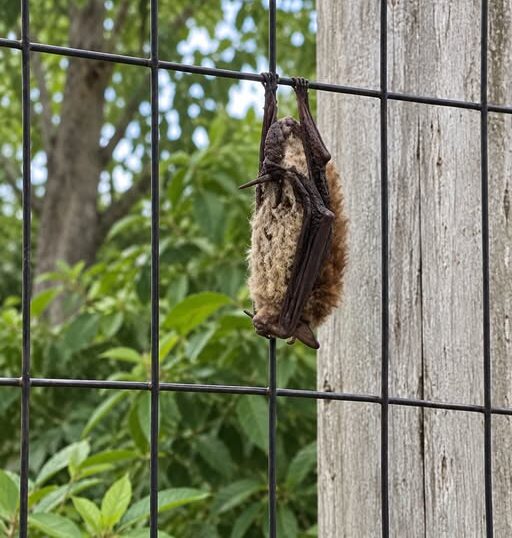
Aging Bat Found Clinging to Fence After Storm Gets a Second Chance
A Small Figure Remained After the Storm Had Passed
The storm was over, the rain had eased, and daily life had already begun returning to normal.
But on a cold metal fence in Gilbertsville, Pennsylvania, one small animal was still struggling to survive.
An aging brown bat clung quietly to the fence, soaked by the weather and too weak to find shelter.
For three days, she remained there largely unnoticed.
Cars passed. People continued with their routines. The world around her moved on while she held tightly to the metal and tried to survive the wind, rain, and exhaustion.
Her condition might easily have gone unnoticed until it was too late.
Then one homeowner looked closely enough to realize that something was wrong.
A Second Look Changed the Bat’s Fate
At first, the small shape on the fence could easily have been mistaken for leaves, debris, or something caught during the storm.
But the homeowner looked again.
That hesitation proved important.
Instead of walking away, the person recognized that the animal had remained in the same exposed position for far too long.
The homeowner contacted Pennsylvania Bat Rescue and reported the stranded bat.
That single decision changed the direction of her story.
Rather than remaining exposed until her strength disappeared completely, the bat was brought into experienced care.
She would eventually become known as Bea Arthur.
Bea Arthur Was Already a Senior Bat
Bea was identified as an older brown bat whose condition reflected more than the effects of one difficult storm.
Age had already made life in the wild more challenging.
The days spent clinging to an exposed metal fence left her even weaker.
Rain had soaked her body, while wind and changing temperatures provided little opportunity for rest.
A healthy bat would normally seek protected spaces where it could remain hidden from harsh weather and predators.
Bea, however, had become too weak to find the shelter she needed.
Her decision to remain on the fence was not a comfortable choice.
It was a sign that she was struggling.
Three Days Outside Had Taken Their Toll
Survival for a small bat depends heavily on conserving energy.
Remaining exposed for several days can quickly become exhausting, especially for an older animal already facing physical limitations.
Bea had nowhere to hide from the rain and wind.
She had little opportunity to recover her strength.
By the time help arrived, she was no longer simply a wild animal resting in an unusual location.
She was an animal in need of intervention.
The homeowner’s decision to seek assistance gave rescuers a chance to move her from the cold fence into a protected environment where she could finally rest.
The Rescue Did Not End With Picking Her Up
Bringing Bea to safety was only the beginning.
Once she arrived at the sanctuary, caregivers could observe her condition and determine what kind of future remained possible for her.
They soon learned that Bea’s age and physical condition meant returning her to the wild would not be safe.
A releasable bat needs to be able to fly effectively, hunt successfully, locate shelter, avoid danger, and survive changing weather without assistance.
Bea could no longer reliably do those things.
Her injuries and age meant that releasing her would likely place her back into the same kind of danger from which she had just been rescued.
For that reason, she became one of the sanctuary’s non-releasable residents.
A Different Kind of Rescue Began
Not every wildlife rescue ends with an animal returning to the wild.
Sometimes recovery reveals that independence is no longer realistic.
That does not mean the rescue has failed.
For Bea, survival began to mean something different.
She no longer had to face storms alone.
She no longer needed to spend her remaining strength searching for insects or finding a safe place to sleep.
Instead, she was given a calm environment where her needs could be met and where her declining physical abilities no longer placed her in constant danger.
Her Personality Slowly Became Clear
Once Bea was safe and recovering, the people caring for her began seeing more than a frightened animal that had been found on a fence.
They discovered a shy but gentle personality.
She was cautious, as many wild animals naturally are, but gradually became comfortable within the protected environment surrounding her.
Her small size contrasted with the attention her story would eventually receive.
The bat that had almost disappeared unnoticed after a storm became an individual with a name, familiar habits, and a place within the sanctuary.
She was no longer simply an unidentified animal in distress.
She was Bea Arthur.
A Favorite Hammock Became Part of Her New Life
Among the comforts available to Bea was a hammock where she could rest safely.
For an animal that had spent days gripping a cold outdoor fence, the protected resting area represented a dramatic change.
She could hang comfortably without being battered by rain or exposed to strong wind.
She no longer needed to use precious energy simply trying to stay in place.
Her hammock became one of the familiar parts of her sanctuary life.
For caregivers, such details also revealed how much personality can exist inside an animal many people might otherwise overlook.
Bea Found Company Among Other Bats
Bea’s permanent care also meant she was no longer alone.
She lived alongside other bats that could not safely return to the wild.
Each had reached the sanctuary for different reasons, but they shared the need for long-term protection.
Their presence created an environment where Bea could live among members of her own kind while still receiving human care.
For an aging animal that had nearly died alone outdoors, the change was significant.
Her remaining life would not be defined by the metal fence where she was found.
Instead, it would be defined by warmth, shelter, routine, and safety.
Why the Homeowner’s Decision Mattered
Bea’s survival began with an ordinary act of attention.
The person who noticed her did not perform a dramatic rescue alone.
There was no complicated equipment involved and no extraordinary event needed to make the difference.
The homeowner simply recognized that the bat’s behavior did not look normal and chose not to ignore it.
That observation led to contact with people who knew how to provide appropriate care.
Without that decision, Bea might have remained on the fence until exhaustion, exposure, or another danger ended her life.
The difference between those two outcomes was one person deciding to look twice.
Small Wildlife Can Easily Go Unnoticed
Stories like Bea’s are especially striking because small animals can disappear into the background of everyday surroundings.
A bat clinging to a fence may not immediately attract the same attention as a larger injured animal.
Its size allows it to blend into shadows, tree bark, metal structures, or other outdoor surfaces.
That makes it possible for an animal in distress to remain visible yet unnoticed.
Bea spent several days in exactly that situation.
She was not hidden deep inside a forest.
She was right beside a home, hanging where someone could eventually see her.
The challenge was recognizing that she needed help.
Her Story Was About More Than Survival
Bea’s rescue could easily be reduced to a simple story about an animal being saved from bad weather.
But what happened afterward gave the story greater meaning.
She was not restored to perfect health and released into the night.
Age and injury had permanently changed what she could do.
Her future required protection rather than independence.
Accepting that reality allowed rescuers to provide the kind of care she actually needed instead of forcing an outcome that would have placed her at risk.
Her life at the sanctuary therefore became another form of successful rescue.
Not Every Second Chance Looks the Same
Wildlife rehabilitation often carries the hope that an animal can eventually return to its natural environment.
When that is possible, release can be the ideal ending.
But some animals arrive with injuries, age-related limitations, or other conditions that make survival in the wild unlikely.
For them, long-term sanctuary care can provide a different kind of second chance.
Bea’s life demonstrates that survival itself can still have value even when complete independence is no longer possible.
She could remain comfortable, protected, and surrounded by appropriate care.
A Quiet Animal Became a Memorable Rescue
There was nothing dramatic about the way Bea first appeared.
She did not make noise to attract attention.
She did not approach people for help.
She simply held onto the fence because that was all she still had the strength to do.
Her silence made the situation easier to overlook.
But once someone noticed her, the small bat became impossible to forget.
Her story moved from a cold metal fence to a place where she had a name, a favorite resting spot, and people watching over her.
The Storm Was Not the End of Her Story
For Bea Arthur, the storm could easily have become the final chapter.
She was old, exhausted, exposed, and alone.
For three days, her survival depended on continuing to hold on.
Then a stranger noticed.
That person did not know whether Bea could recover or whether she would ever return to the wild.
They only knew that leaving her there was not the right choice.
That was enough to begin the rescue.
Sometimes Rescue Begins by Refusing to Look Away
Bea’s journey ended very differently from the way it began.
Instead of disappearing unnoticed after days of exposure, she found a protected home among other bats that also needed permanent care.
She had warmth instead of cold metal.
She had a hammock instead of an exposed fence.
She had caregivers instead of silence.
Her age and injuries meant she could not safely return to the wild, but those limitations did not make her life less worthy of protection.
Bea’s story became a reminder that rescue does not always require a dramatic act.
Sometimes it begins with something much simpler.
Someone notices an animal everyone else has passed by.
They stop.
They look again.
And instead of continuing on, they decide not to leave that small life behind.