
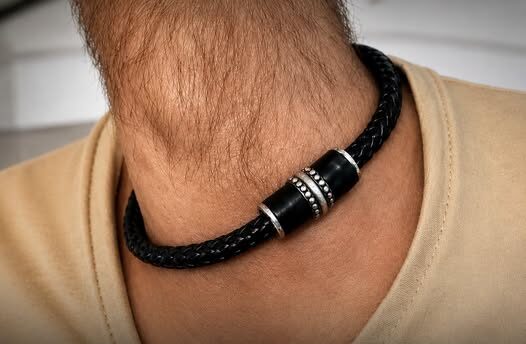
Viral Optical Illusion Photo Leaves Millions Seeing a Bizarrely Long Neck That Isn’t Really There
An Innocent Photo Creates Massive Online Confusion
A seemingly ordinary photograph has left millions of people questioning what they are actually seeing.
At first glance, the image appears disturbing. Many viewers believe they are looking at a person with an unusually long, extremely thin and hairy neck.
The strange appearance is so convincing that people have zoomed in, studied individual details and argued over possible explanations.
Yet the truth behind the photograph is surprisingly simple.
There is no bizarre neck at all.
The unsettling shape is actually the result of an ordinary man placing his hand inside the pocket of his trousers while the photograph is tightly cropped.
The unusual framing causes different parts of his arm, clothing and accessories to line up in exactly the wrong way, creating an optical illusion that can be remarkably difficult to stop seeing once the brain has accepted it.
The Photo Looks Completely Different at First Glance
The confusion begins with the man’s forearm.
Because the photograph hides much of the rest of his body, the arm appears to extend upward from what viewers initially interpret as his shoulders.
The shape immediately resembles a narrow neck.
Hair on the forearm strengthens the strange impression, making the supposed neck appear unusually hairy as well as dramatically elongated.
Once the brain decides that the arm is a neck, the remaining details begin falling into place around that interpretation.
Instead of questioning the unusual anatomy, many viewers automatically begin searching the image for features that confirm what they think they are seeing.
That is where the illusion becomes especially effective.
A Wrist Bone Looks Like an Adam’s Apple
One of the most convincing details is the man’s wrist.
Within the tightly cropped image, the natural shape of the wrist creates a raised area that can easily be mistaken for an Adam’s apple.
That single feature makes the supposed neck appear even more realistic.
Once viewers interpret the wrist bone as part of a throat, the image becomes considerably harder to understand correctly.
The brain now has what appears to be a recognizable piece of human anatomy positioned exactly where it expects to find it.
Instead of seeing an arm and wrist, viewers begin seeing a neck and throat.
The illusion then becomes self-reinforcing.
A Bracelet Creates Another Convincing Detail
The man is also wearing a braided bracelet around his wrist.
Under normal circumstances, there would be nothing particularly remarkable about it.
Inside the illusion, however, the bracelet appears to be a dark choker wrapped around the base of the strange neck.
This detail contributes heavily to the confusion because it gives the apparent neck a clear lower boundary.
Viewers can easily interpret the bracelet as an accessory sitting between the supposed neck and the clothing beneath it.
With the wrist bone appearing to be an Adam’s apple and the bracelet resembling a choker, the mind has several visual clues supporting the same incorrect interpretation.
That is why simply staring harder at the image often fails to solve the puzzle.
The Trousers Complete the Illusion
The final important piece comes from the man’s clothing.
A beige section around the waistband of his trousers appears in just the right position to resemble the collar of a shirt.
Once interpreted that way, the entire visual arrangement suddenly appears logical.
The forearm becomes a long neck.
The wrist becomes the throat.
The bracelet becomes a choker.
The beige waistband becomes a shirt collar.
With all four details working together, an ordinary pose becomes something that looks almost impossible.
The brain is effectively handed several familiar shapes and encouraged to assemble them into the wrong person.
Thousands Were Convinced Something Was Seriously Wrong
The tightly framed image quickly caused confusion because many people could not identify what they were seeing.
Some viewers focused immediately on the apparent proportions of the neck.
Others searched for signs of editing or tried to understand whether the image showed an unusual medical condition or a manipulated photograph.
The more people examined it, the more difficult the illusion sometimes became.
Zooming in did not necessarily help because the individual pieces remained visually compatible with the incorrect interpretation.
The arm still looked like a neck.
The bracelet still appeared to wrap naturally around it.
The waistband still looked like clothing positioned beneath a head.
Instead of revealing the solution, closer inspection often strengthened the initial misunderstanding.
The Zoomed-Out Version Finally Reveals the Truth
The illusion collapses only when viewers see the photograph from a wider perspective.
In the uncropped image, the man’s actual position becomes obvious.
He is simply standing with his hand resting inside the pocket of his trousers.
What appeared to be an impossibly long neck is his forearm extending downward toward the pocket.
The supposed Adam’s apple is part of his wrist.
The dark choker is merely the bracelet.
The apparent collar belongs to the waistband area of his trousers rather than a shirt positioned around a neck.
Nothing unusual is happening at all.
The entire mystery depends on perspective and cropping.
The Explanation Feels Almost Too Simple
For many viewers, learning the answer produces another unexpected reaction.
After spending so much time attempting to understand the strange image, the explanation can feel almost absurdly obvious.
Once the complete photograph is visible, it becomes difficult to understand why the cropped version caused so much confusion.
Every part of the illusion has an ordinary explanation.
There is no complicated editing technique required and no strange physical feature that needs to be explained.
It is simply a collection of ordinary body parts and clothing details aligned in an unusually deceptive way.
Yet knowing the answer does not necessarily eliminate the illusion.
Many People Still Cannot “Unsee” the Long Neck
One of the most fascinating parts of the image is how persistent the incorrect interpretation can become.
Even after seeing the uncropped photograph and understanding exactly how the illusion works, many people find themselves immediately seeing the strange neck again when returning to the original image.
The brain appears to fall back into its first interpretation almost instantly.
Instead of automatically recognizing the forearm, viewers continue seeing a neck until they deliberately remind themselves what is actually in the photograph.
That lingering effect is one reason the image became so widely discussed.
The puzzle is not difficult because the solution is complicated.
It is difficult because the incorrect explanation is visually convincing enough to survive even after the correct one is known.
The Brain Tries to Make Sense of Incomplete Information
The illusion highlights how quickly the mind attempts to interpret incomplete visual information.
When people look at an image, they do not necessarily examine every object independently before deciding what they are seeing.
Instead, the brain rapidly combines shapes, shadows, textures and familiar patterns into a recognizable scene.
Most of the time, this process is extremely useful.
It allows people to understand their surroundings almost instantly without consciously analyzing every detail.
But unusual photographs can exploit that speed.
When key information is missing because of cropping, the brain may fill in the gaps using the most convenient explanation available.
In this case, that explanation happens to be completely wrong.
Once the Brain Chooses an Interpretation, It Can Be Hard to Replace
The photo becomes especially effective after someone first identifies the forearm as a neck.
From that point onward, every detail is interpreted through the same assumption.
The wrist is no longer simply a wrist because the brain expects to find features associated with a throat.
The bracelet stops looking like something worn around an arm because its position makes sense as a choker.
The trousers become part of an imagined shirt because the brain needs something beneath the apparent neck.
Each incorrect interpretation supports the next one.
By the time the viewer has studied the entire image, the illusion can feel more believable than the real explanation.
Cropping Plays a Crucial Role
The photograph would likely cause far less confusion if viewers could immediately see the man’s complete body position.
The tight crop removes the contextual information needed to identify his forearm correctly.
Without the rest of his arm, shoulder and posture clearly visible, the mind searches for another explanation.
The unusual alignment happens to provide one.
This demonstrates how dramatically the meaning of an image can change when surrounding information is removed.
A small change in framing can transform a completely normal scene into something that appears physically impossible.
The photograph does not need to be altered beyond that.
The missing context does most of the work.
Why Zooming In Does Not Solve the Puzzle
When people encounter a confusing photograph, one of their first instincts is often to enlarge it.
That usually helps reveal details.
In this case, however, zooming can make the problem worse.
The illusion is constructed from real details rather than hidden digital manipulation.
Looking more closely at the bracelet simply reveals a bracelet-shaped object exactly where the viewer believes a choker should be.
Examining the wrist reveals genuine contours that resemble a throat when seen from the wrong perspective.
Studying the forearm reveals real hair, which only makes the apparent neck seem stranger.
The answer requires more context rather than more magnification.
The Image Shows How Easily Perspective Can Mislead
The photograph became compelling because it creates a visual contradiction.
Viewers know that the proportions they appear to be seeing are highly unusual, yet the individual details look realistic enough that they struggle to reject the overall image.
That tension keeps people looking.
They understand that something must be wrong, but they cannot immediately determine what.
The final explanation is satisfying precisely because it changes every part of the photograph at once.
The moment the arm is correctly recognized, the Adam’s apple disappears.
The choker disappears.
The strange shirt collar disappears.
The entire disturbing figure vanishes and is replaced by an ordinary man with his hand in his pocket.
A Harmless Snapshot Became a Psychological Puzzle
Nothing about the original situation appears to have been unusual.
A man was simply standing in a natural pose with one hand placed inside his trousers pocket.
The strange effect came entirely from the way his body was positioned and how the photograph was presented.
Once cropped, those ordinary details became disconnected from their normal context.
The result was a picture capable of making large numbers of people doubt what they were seeing.
That transformation helped the image spread rapidly.
People were not simply looking at a funny photograph.
They were attempting to solve something their own visual system seemed determined to misunderstand.
The Real Surprise Is How Strong the Illusion Remains
The most memorable element may not be the solution itself.
After all, once explained, the answer is remarkably straightforward.
The more surprising part is how difficult it can be to replace the original interpretation.
Someone can know with complete certainty that the supposed neck is an arm and still temporarily see the neck first.
This creates the strange experience of knowing that one’s own eyes are delivering the wrong interpretation while still being unable to prevent it.
The image therefore becomes more than a visual joke.
It provides a simple demonstration of how perception can be influenced by expectation.
Why the Photo Became So Difficult to Ignore
The viral appeal of the photograph comes from several elements working together.
It provides an immediate visual shock, a mystery that appears difficult to solve, and an explanation simple enough for viewers to share with others.
It also encourages repeated viewing.
People look once and see the strange neck.
They examine it again after learning the truth.
Then they return to the cropped version to test whether they can finally see the forearm correctly.
For many, the illusion still wins.
That cycle of confusion and discovery made the photograph especially effective at holding attention.
The Truth Was Hidden in Plain Sight
There was never anything disturbing about the person in the photograph.
No impossible anatomy needed explaining.
No extraordinary transformation had occurred.
A forearm, wrist, bracelet and waistband had simply aligned in a way that encouraged the brain to build an entirely different image.
The zoomed-out photograph restored the context that had been missing and immediately revealed what viewers had overlooked.
Yet the original illusion remained powerful enough that many still struggled to see the ordinary pose without first seeing the bizarrely thin neck.
That is ultimately what made the image so memorable.
It turned an innocent photograph into a reminder that people do not always see exactly what is in front of them.
Sometimes the brain makes a decision before all the information is available, fills in the missing pieces and creates something that never existed at all.
And once that imagined version becomes convincing enough, even knowing the truth may not be enough to make it disappear.