
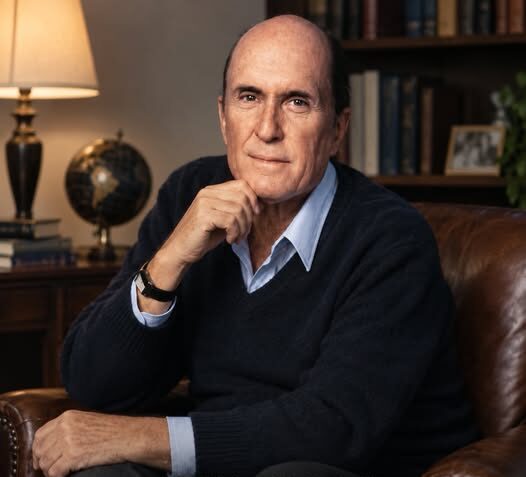
Robert Duvall Dies at 95—The Godfather and Tender Mercies Star Leaves Behind an Extraordinary Legacy
The Oscar-Winning Actor Died Peacefully at His Home in Virginia, Closing a Career That Spanned More Than Six Decades
Robert Duvall, one of the most respected actors in American film history, died on February 15, 2026, at the age of 95.
His wife, Luciana Duvall, said he died peacefully at home in Middleburg, Virginia, surrounded by love and comfort. His representative also confirmed the death.
There was no elaborate final public appearance.
No grand farewell.
In keeping with Duvall’s wishes, no formal service was planned.
For an actor whose greatest performances were often built on restraint, stillness and carefully observed behavior, the quiet ending felt fitting.
He Began Far From Hollywood
Robert Selden Duvall was born on January 5, 1931, in San Diego, California.
He did not immediately look destined for movie stardom.
His father was a career Navy officer, and Duvall later studied acting seriously at the Neighborhood Playhouse in New York.
There he trained in an environment that emphasized listening, behavior and emotional truth rather than flashy performance.
That approach would define almost everything he did on screen.
His Film Debut Was Quiet but Unforgettable
Duvall made his film debut as Boo Radley in the 1962 adaptation of To Kill a Mockingbird.
The role contained relatively little dialogue.
But even then, his stillness drew attention.
He did not need long speeches to create presence.
A look, a pause or a slight physical adjustment could communicate more than pages of dialogue.
That quality became one of his signatures.
The Godfather Made Him Part of Film History
In 1972, Duvall appeared as Tom Hagen, the calm and controlled consigliere of the Corleone family in The Godfather.
The role placed him alongside Marlon Brando, Al Pacino, James Caan and Diane Keaton in one of the most celebrated films ever made.
He returned as Hagen in The Godfather Part II in 1974.
While other characters exploded with anger, ambition or violence, Duvall often played the quiet center of the room.
He listened.
He watched.
And when he spoke, the restraint made the words carry more weight.
Apocalypse Now Gave Him One of His Most Famous Roles
Seven years later, Duvall worked again with director Francis Ford Coppola in Apocalypse Now.
As Lieutenant Colonel Bill Kilgore, he created one of the most recognizable characters of his career.
The role was larger, louder and more theatrical than Tom Hagen, but Duvall still grounded it in complete conviction.
The performance became one of the defining supporting roles of 1970s American cinema.
Tender Mercies Finally Brought Him the Oscar
Duvall won the Academy Award for Best Actor for his performance in the 1983 film Tender Mercies.
He played Mac Sledge, a fading country singer trying to rebuild his life.
The performance was quiet, internal and almost completely free of showiness.
It was also exactly the kind of work Duvall had spent his career perfecting.
The Television Academy notes that he even wrote the songs performed by his character in the film.
He Could Play Almost Anyone
Across more than six decades, Duvall moved easily between genres.
He played soldiers.
Lawmen.
Preachers.
Criminals.
Fathers.
Judges.
Cowboys.
He appeared in films and television projects including The Great Santini, Network, Lonesome Dove, The Apostle, Crazy Heart, Get Low and The Judge.
His range was enormous, but the performances rarely felt like displays of technique.
He seemed more interested in disappearing into behavior than announcing how much acting he was doing.
Lonesome Dove Became One of His Favorite Roles
Duvall played Augustus “Gus” McCrae in the celebrated television miniseries Lonesome Dove.
The Television Academy notes that Duvall considered Gus his favorite role.
The character allowed him to combine humor, toughness, warmth and melancholy.
For many viewers, it remains one of the performances that best captures what made Duvall special.
He Continued Working Into His 90s
Duvall never formally turned himself into a retired legend.
He continued appearing on screen well into old age.
One of his final film appearances came in The Pale Blue Eye, released in 2022.
Director Scott Cooper later wrote that Duvall remained deeply engaged with acting and film even late in life.
Cooper described speaking with him frequently about cinema and remembered Duvall as a mentor who encouraged him to trust restraint and simplicity.
Mentoring Younger Filmmakers Became Part of His Later Life
Duvall’s influence extended beyond his own performances.
Scott Cooper described him as far more than a colleague, saying Duvall had helped shape his life and career.
He encouraged Cooper to write and create his own opportunities when acting work felt uncertain.
That relationship eventually came full circle when Cooper directed Duvall in The Pale Blue Eye.
He Never Stopped Talking About Acting
Even in his later years, Duvall remained fascinated by scenes, actors and the mechanics of performance.
Cooper remembered conversations about filmmakers, international cinema and the importance of trusting silence.
Duvall was interested not only in what actors said but in what happened between the lines.
That philosophy can be seen throughout his career.
Virginia Became His Refuge
Away from Hollywood, Duvall made his home in Virginia.
He spent many of his later years on a horse property in Fauquier County near Middleburg and The Plains.
It became a place where he could remain connected to film without living inside the machinery of Hollywood.
He loved horses.
He loved conversation.
And he loved tango, a passion he shared with his wife, Luciana.
His Final Months Were Surprisingly Personal
Even shortly before his death, Duvall remained connected with fans.
In late 2025, he appeared in video messages thanking people for supporting him over the years.
He also shared glimpses of his routine, including a video of himself exercising in December.
People reported that these became some of his final public messages before his death.
His Wife Announced His Death With a Simple Message
Luciana Duvall described her husband not primarily as an Oscar winner or film legend, but as the person who meant everything to her.
She wrote that his love for his work was matched by his love of characters, food and conversation, and said he gave himself fully to the people he portrayed.
Hollywood’s Tributes Came Quickly
After news of Duvall’s death became public, major figures across the film industry paid tribute.
Francis Ford Coppola, Al Pacino, Robert De Niro, Viola Davis, Jamie Lee Curtis and others honored his work and the influence he had on generations of performers.
The tributes repeatedly returned to the same qualities.
Authenticity.
Discipline.
Humility.
Truthfulness.
He Never Needed to Look Like a Traditional Movie Star
Duvall’s power rarely came from glamour.
His face looked lived-in.
His movements often felt ordinary.
He could appear stubborn, vulnerable, dangerous or exhausted without changing much at all.
That made him unusually convincing.
He could stand quietly beside a more visibly dramatic performer and still pull attention toward himself.
Silence Was One of His Greatest Tools
Many of Duvall’s best performances are remembered for what he did not say.
He understood how to let a moment breathe.
He trusted the audience to notice small reactions.
That restraint became part of his influence on younger actors and filmmakers.
Cooper recalled Duvall advising him not to force emotion, but instead to trust stillness.
He Also Created His Own Films
Duvall was not satisfied simply appearing in other people’s projects.
He wrote, directed and starred in The Apostle, released in the late 1990s.
The film was intensely personal and earned him another Academy Award nomination.
It reflected his willingness to build roles himself when Hollywood did not offer the kind of material he wanted.
His Career Spanned Several Different Hollywood Eras
Duvall worked through enormous changes in American filmmaking.
He began in the studio era’s final years.
He became central to the New Hollywood movement of the 1970s.
He remained relevant through the blockbuster era.
And he continued appearing in major films well into the streaming age.
Few performers remained respected for that long without becoming predictable.
He Was Still Being Considered for New Roles
Scott Cooper revealed after Duvall’s death that they had recently discussed another possible role for him.
The project involved an elderly blind man in a Civil War story.
Duvall immediately understood the character, according to Cooper.
The film was never made.
But the conversation showed that even near the end of his life, Duvall still thought like a working actor rather than a retired icon.
He Died Where He Had Chosen to Live
Duvall died at home in Middleburg, Virginia, with Luciana beside him.
There was no reported public spectacle surrounding his final hours.
His family described the ending simply: peaceful, private and surrounded by love.
The Performances Remain
For audiences, Robert Duvall’s death closes one of the longest and most distinguished careers in American cinema.
But film creates a strange kind of permanence.
Tom Hagen is still sitting quietly beside Don Corleone.
Gus McCrae is still riding across the plains.
Mac Sledge is still trying to rebuild a life.
And Lt. Col. Kilgore is still charging into one of cinema’s most unforgettable sequences.
The Quiet Actor Became One of the Loudest Influences
Duvall rarely seemed interested in celebrity for its own sake.
He seemed interested in the work.
That may explain why actors and directors spoke about him with unusual reverence after his death.
His influence did not come from creating an image of Robert Duvall.
It came from disappearing into other people.
Robert Duvall’s Final Legacy Is Larger Than Any Single Role
He was an Oscar winner.
An Emmy winner.
A director.
A producer.
A mentor.
And one of the defining actors of his generation.
Robert Duvall died on February 15, 2026, at 95.
But the most fitting tribute may be the simplest one.
Watch the work.
Watch the pauses.
Watch what happens when he says almost nothing.
That was where Robert Duvall often did his best acting.
And that is why, long after the headlines fade, his performances will continue to feel alive.