
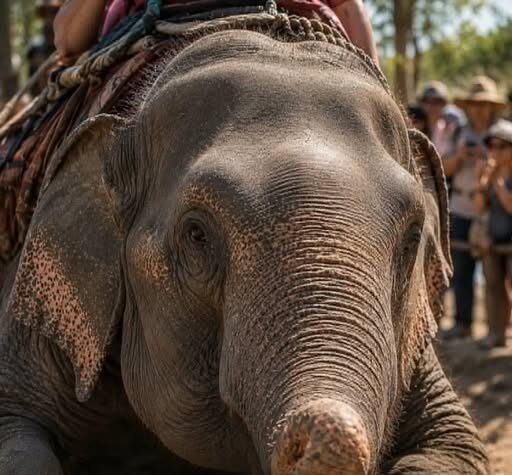
Elephant’s Severely Curved Spine Reveals the Lasting Cost of Years Spent Carrying Tourists
Pai Lin Spent Years Carrying Tourists on Her Back
For many travelers, riding an elephant can appear to be an unforgettable vacation experience.
The animal looks enormous and powerful.
The ride may last only a short time.
And from the tourist’s perspective, the activity can seem harmless.
But Pai Lin’s body tells a very different story.
Years of Heavy Loads Left a Permanent Mark
For years, Pai Lin was used to carry tourists.
Again and again, heavy weight was placed across her back.
Over time, that repeated burden changed the shape of her body.
Her spine gradually developed a severe curve.
The deformation became permanent.
Her Size Did Not Protect Her From Injury
Elephants are among the largest land animals in the world.
That size can create the mistaken impression that they can comfortably carry almost anything.
Pai Lin’s condition shows why that assumption can be misleading.
Being large and powerful does not mean an animal is protected from long-term physical strain.
The Damage Developed Slowly
There was no single moment when Pai Lin’s back suddenly changed.
The problem developed over years.
Each ride added another period of pressure.
Each heavy load became part of a pattern that eventually altered her spine.
That slow progression is one reason tourists may never realize the harm being done.
Visitors Usually See Only a Few Minutes of an Animal’s Life
A tourist may climb onto an elephant, take photographs, complete a short ride, and leave.
What that person does not necessarily see is what happens before and after.
They do not see how many rides the same animal has already completed that day.
They do not see how many years the animal has spent carrying people.
They may never see the physical effects that appear later.
Pai Lin Continued Working Despite the Growing Damage
Her back became increasingly distorted.
Yet the work continued.
The burden placed on her did not disappear simply because her body was changing.
That is what makes her story so difficult to look at.
The shape of her spine became evidence of years of repeated strain.
Then Everything Changed in 2006
Pai Lin was rescued.
She was taken to the Wildlife Friends Foundation Thailand.
For the first time in years, the rides stopped.
The heavy loads were removed from her life.
She no longer had to spend her days carrying tourists.
Rescue Could Not Reverse Every Injury
Freedom from work did not restore her spine to its original shape.
The curvature remained.
That permanence is part of what makes Pai Lin such a powerful example.
Some forms of physical damage cannot simply be undone once the source of the harm is removed.
But Rescue Changed What Her Future Looked Like
Pai Lin no longer had to carry anyone.
She could walk without being used for rides.
She could rest.
She could move at her own pace.
She could spend her days without the same demands that had shaped so much of her earlier life.
That Difference Matters
Rescue is not always about making an animal physically perfect again.
Sometimes it is about stopping further harm.
It is about allowing the animal to live with greater comfort, dignity, and security.
For Pai Lin, the end of tourist rides meant the end of the burden that had damaged her body.
Her Curved Spine Became a Visible Warning
Pai Lin’s body shows something tourists may never see when they purchase an animal experience.
Entertainment can have a physical cost.
That cost may accumulate slowly.
It may be hidden beneath saddles, blankets, platforms, or distance.
By the time the damage becomes obvious, it may already be permanent.
The Problem Is Easy to Miss From the Outside
An elephant may continue walking.
It may continue following instructions.
It may appear calm.
Those things do not automatically mean the activity is comfortable or harmless.
Pai Lin continued functioning even as her spine changed dramatically.
Animals Cannot Explain What Repeated Work Is Doing to Them
Pai Lin could not tell visitors that her back was under strain.
She could not explain whether the load was uncomfortable.
She could not ask tourists to consider what years of repeated rides might mean for her body.
Her condition eventually communicated what words could not.
The Damage Became Part of Her Appearance
Instead of the naturally shaped back people might expect to see on an elephant, Pai Lin developed a deep and unmistakable curve.
It became impossible to separate her physical appearance from the years she spent carrying heavy loads.
Her body preserved the history of that work.
That History Continued Even After the Work Ended
The tourists were gone.
The rides were over.
But the physical evidence remained.
This is what makes long-term animal welfare issues different from temporary discomfort.
The consequences can follow an animal for the rest of its life.
Tourism Can Hide Those Consequences
Animal attractions are often designed around the visitor’s experience.
The emphasis is on photographs, novelty, and entertainment.
That can make it easy to forget that the animal has a life outside the few minutes a tourist spends with it.
Pai Lin Represents That Larger Story
Her experience is not simply about one ride or one visitor.
It is about years of repetition.
The same task.
The same burden.
The same body absorbing the pressure again and again.
A Short Experience for a Tourist Can Be a Full-Time Reality for an Animal
That contrast is important.
A visitor may remember an elephant ride as a single afternoon activity.
The elephant may perform that activity repeatedly over many years.
The scale of exposure is completely different.
Her Story Challenges the Idea That Tradition Makes Something Harmless
Elephant rides have been offered to tourists in many places for years.
Longevity, however, does not guarantee that a practice is safe for the animal involved.
Pai Lin’s spine offers a visible reason to question activities simply because they have become familiar.
People Often Judge Animal Experiences by What They Can See
If the elephant is standing, the experience may appear acceptable.
If the animal is walking, visitors may assume it is healthy enough to work.
If it does not visibly resist, people may interpret that as comfort.
Pai Lin’s condition shows why outward compliance is not enough to judge welfare.
The Most Serious Effects May Take Years to Appear
Repeated physical strain can accumulate quietly.
A single ride may not visibly alter the animal.
Thousands of rides over time can tell a very different story.
Pai Lin’s permanently curved spine represents that accumulated burden.
Her Rescue Gave Her Something She Had Been Missing
Choice.
She no longer existed primarily to provide an experience for visitors.
She could simply be an elephant.
She could move without carrying a load.
She could rest without waiting for the next group of tourists.
Rest Became Part of Her Recovery
The shape of her spine could not be erased.
But the demands placed on it could stop.
That made her new life fundamentally different from the one she had known before 2006.
The Wildlife Friends Foundation Thailand Became Her Safe Place
After her rescue, Pai Lin was no longer treated as a ride.
She was treated as an animal deserving care.
That change in purpose matters.
Her value was no longer tied to how many people she could carry.
Her Body Did Not Need to Earn Its Right to Rest
For years, her physical strength had been used as a resource.
After rescue, she could exist without performing.
That is one of the central differences between entertainment and sanctuary.
The Curve in Her Back Is Difficult to Ignore
It is striking because elephants are often imagined as nearly indestructible.
Pai Lin shows the opposite.
Powerful animals can still be vulnerable.
Large animals can still suffer permanent physical damage.
Strength Should Not Be Confused With Unlimited Capacity
An elephant’s size may allow it to perform tasks a smaller animal could never do.
That does not mean every task is harmless.
The body still has limits.
Repeatedly exceeding those limits can have consequences.
Pai Lin’s Story Makes Those Limits Visible
Many welfare concerns remain abstract until people can see the result.
Her spine turns the issue into something tangible.
The damage is not theoretical.
It is written into the shape of her body.
The Tourist Experience and the Animal’s Experience Can Be Very Different
For the rider, the memory may be excitement.
For the elephant, the same activity may mean repeated physical pressure.
Those two experiences happen at the same time but are not equal.
That Is Why Animal Entertainment Deserves Closer Examination
People may participate without intending to cause harm.
They may simply assume that an attraction being offered means it is safe.
Pai Lin’s story suggests that visitors should look beyond that assumption.
The True Cost May Not Be Included in the Ticket Price
A tourist pays money for an experience.
The animal may pay in physical wear.
That cost can remain invisible until years later.
By then, the tourist is long gone.
Pai Lin Was the One Who Had to Live With the Consequences
Her passengers changed every day.
Her body remained the same body carrying every load.
That simple fact explains why repeated entertainment work can have such serious long-term effects.
Her Rescue Stopped the Cycle
After 2006, there were no more tourist loads.
No more constant carrying.
No more need for her back to support the same repeated burden.
The damage remained, but it was no longer being continually reinforced.
That Is What Safety Meant for Pai Lin
Safety did not mean forgetting the past.
It meant ensuring the past would not continue happening every day.
It meant providing a future without the same exploitation.
Dignity Became as Important as Physical Care
Animal welfare is not only about treating visible injuries.
It is also about allowing animals to live without unnecessary demands being imposed on them for entertainment.
Pai Lin’s later life reflects that difference.
She No Longer Had to Be Useful to People
She could walk because she wanted to move.
She could rest because she was tired.
Her daily life no longer revolved around what tourists wanted from her.
That Is a Simple Change With Enormous Meaning
For an animal that spent years carrying people, being allowed to carry nothing can itself represent freedom.
Pai Lin’s story is powerful because the rescue did not need to transform her into something new.
It allowed her to stop being used.
Her Condition Encourages Tourists to Ask Better Questions
Before participating in an animal attraction, people can consider what the experience requires from the animal.
How often does it perform?
How much weight does it carry?
What happens when visitors leave?
What does retirement look like?
Those Questions Shift Attention Away From Entertainment Alone
Instead of asking only whether an activity will produce a memorable photograph, visitors can also consider whether it respects the animal involved.
Pai Lin’s spine offers a strong reason for that shift.
The Most Responsible Experience May Be the One That Asks Nothing From the Animal
Observing an elephant walking, socializing, feeding, or resting naturally can provide a very different kind of experience.
It places the animal’s behavior at the center rather than the visitor’s desire for a ride.
Pai Lin’s Life After Rescue Shows Why That Matters
She did not need to perform to be worth seeing.
She did not need to carry people to deserve protection.
Her life had value on its own.
The Permanent Curve in Her Spine Tells a Story Without Words
It tells of years of heavy loads.
It tells of repeated work.
It tells of physical consequences that outlasted the rides themselves.
And it tells of a rescue that finally stopped the burden.
Her Story Is Not About Blaming Every Tourist
Many visitors may not understand what happens behind the scenes.
They may have been told that elephants are strong enough to carry people without difficulty.
They may never have seen an animal like Pai Lin years later.
Awareness Can Change Future Choices
Once people understand that animal attractions can have lasting consequences, they can make different decisions.
They can support experiences centered on observation, rehabilitation, and genuine care instead of physical performance.
Pai Lin Cannot Change What Happened to Her
The years of carrying tourists are already part of her history.
The shape of her spine remains evidence of that period.
But her later life demonstrates that circumstances can still change.
Rescue Gave Her Peace
No one could give her an undamaged back again.
They could give her relief from further carrying.
They could give her a safer environment.
They could give her the right to rest.
That Difference Is Worth Remembering
Not every rescue ends with visible physical restoration.
Sometimes success means an injured animal is finally allowed to live without being harmed again.
Pai Lin’s life after 2006 reflects that quieter kind of success.
Her Story Leaves a Clear Message
Animals used for entertainment may carry physical consequences long after visitors have gone home.
The damage may remain hidden for years.
It may eventually become permanent.
Pai Lin Deserved More Than to Be Treated as a Tourist Attraction
She deserved safety.
She deserved rest.
She deserved care that recognized her as a living animal rather than a means of entertainment.
After her rescue, that is finally what she received.
Her Curved Spine Remains a Quiet Reminder
Tourists may remember a ride for a few minutes or preserve it in a photograph.
The animal providing that ride may carry the consequences for years.
Pai Lin’s body makes that invisible cost impossible to ignore.
Her story asks people to look beyond the attraction and consider the life of the animal underneath it.
And above all, it reminds us that strength does not make an animal immune to suffering, and that dignity, safety, and genuine care should matter more than entertainment.