
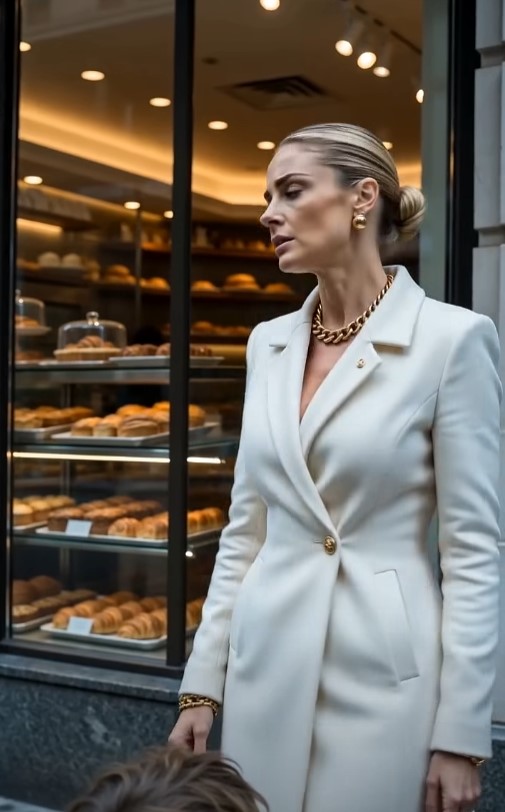
Hungry Boy’s Necklace Leads a Grieving Woman to the Son She Never Stopped Searching For
An Unexpected Encounter Outside a Bakery
The sidewalk outside the small bakery was wet from recent rain, and shallow puddles had formed along the curb. People moved quickly past the storefront, protecting their purchases and avoiding the dirty water beneath their feet.
Near the entrance stood a young boy wearing clothes that offered little protection from the cold. He appeared nervous, hungry, and ready to run at the slightest sign of trouble.
A crushed loaf of bread lay on the pavement between him and a well-dressed woman. Moments earlier, the boy had apparently been focused only on finding something to eat. Now his attention had shifted entirely to the necklace resting against his chest.
The woman had noticed it immediately.
Something about the small piece of jewelry caused her to stop in the middle of the sidewalk. The expensive coat she wore and the bakery customers passing behind her suddenly seemed unimportant.
When she moved closer, the boy reacted with fear.
The boy stepped back so quickly his heel slipped in the puddle.
“Don’t touch it,” he whispered. “It’s mine.”
His response was not aggressive. It sounded protective, as though the necklace was one of the few possessions in his life that truly belonged to him.
The Necklace That Changed Everything
The woman did not reach for the jewelry again. Instead, she lowered herself until she was at the boy’s level.
The woman dropped to her knees in front of him, not caring that her expensive coat brushed the dirty sidewalk.
Her eyes never left the necklace.
It was more than simple curiosity. Her expression carried recognition, disbelief, and a growing fear that she might be standing in front of an answer she had spent years trying to find.
She studied the boy’s face carefully. His guarded eyes and tense posture suggested that he was accustomed to protecting himself. He did not appear to understand why a stranger was suddenly so interested in him.
The woman asked the question that had been building inside her from the moment she saw the necklace.
“What’s your name?”
The boy hesitated before answering. Rather than looking directly at the woman, he glanced toward the narrow alley beside the bakery.
Hidden behind a stack of boxes was a little girl. She remained silent and watched the conversation from a distance, apparently waiting to see whether it was safe to come closer.
Only after checking on her did the boy respond.
“Noah,” he said quietly.
The woman covered her mouth.
The sound she made was not rich or proud.
It was broken.
The name appeared to confirm something she had not yet allowed herself to believe. The stranger in the expensive coat was no longer simply looking at a hungry child. She was facing the possibility that the boy might be connected to the greatest loss of her life.
“My son’s name was Noah.”
A Painful Distance Between Them
The boy did not immediately respond with recognition. He did not step toward her or accept the emotional meaning behind her words.
Instead, he looked at the woman’s clothing, her appearance, and the obvious difference between her life and his own. To him, she seemed to belong to a world that had never included him.
The boy shook his head.
“I don’t have a mother like you.”
The words were simple, but they exposed the distance between them more clearly than any explanation could have done.
The woman appeared deeply affected. Her coat, financial comfort, and social position could not protect her from the possibility that her own child had grown up hungry and afraid while she searched for him elsewhere.
The words hit her harder than any slap.
She looked down at the crushed bread beneath her shoe, then at the little girl watching from the alley, shivering in a thin jacket.
The bread represented an immediate need. Whatever mystery surrounded the necklace and the boy’s identity, both children were clearly hungry.
The little girl’s clothing was not warm enough for the weather. She stayed close to the boxes as though the alley had become a familiar hiding place.
The boy noticed the woman looking at her.
The boy followed her eyes.
“That’s my sister,” he said. “She’s four. She hasn’t eaten today.”
Even while frightened and confused, Noah’s first concern remained his younger sister. His protective behavior suggested that he had taken responsibility for her despite being only a child himself.
The woman’s hands began to shake.
The Story Noah Had Been Told
The woman needed to understand how the boy had received the necklace and why he was living under such difficult conditions.
She did not challenge him or attempt to force an immediate connection. She asked about the person who had cared for him.
“Who raised you?”
Noah’s answer revealed that he had grown up believing the woman who cared for him was not his biological mother.
“My mom,” he whispered. “Not my real one. She found me near a bus station. She said someone stole me from a woman who cried for me.”
The explanation connected several important details. Noah knew that he had been separated from another woman, but he apparently had no clear memories of the event.
The person who raised him had told him that he had been found near a bus station. She had also told him that someone had taken him from a mother who desperately wanted him back.
For the woman kneeling on the sidewalk, those words transformed hope into something much more immediate.
The woman’s tears fell before she could stop them.
The story did not remove every question surrounding Noah’s past. However, it offered an explanation for why the child had grown up away from the woman who now believed she was his mother.
It also suggested that the necklace might have remained with him throughout that separation.
The Secret Inside the Locket
The woman turned her attention back to the necklace. It was not merely a decorative object. It contained something that could connect the boy’s present life to his earliest days.
She opened the tiny locket with shaking fingers.
Inside was a faded baby photo.
The image had aged, but it remained clear enough to carry emotional meaning. It showed a baby from a time Noah was too young to remember.
The woman carefully examined the back of the photograph.
On the back was one word.
Noah.
The boy stared at it, his lips trembling.
For Noah, the discovery appeared to challenge everything he understood about his identity. The necklace he had protected as a personal possession now seemed to hold evidence of a life that began before the bus station and before the woman who raised him found him.
For the grieving woman, the name inside the locket carried years of unanswered questions. She had not forgotten her child, accepted his disappearance, or abandoned the hope that he might still be found.
The woman looked at him and whispered, “I never stopped looking.”
The statement did not demand that Noah immediately accept her as his mother. It simply explained that his absence had remained at the center of her life.
Her search had continued even though Noah had grown old enough to stand in front of her without recognizing her.
A Child Faced With an Overwhelming Truth
Noah remained still as he tried to process what he had heard.
For a long moment, he didn’t move.
The woman’s tears, the baby photograph, the matching name, and the story he had been told about being stolen created a truth too large to absorb immediately.
Noah had approached the bakery as a hungry boy trying to care for his younger sister. He had not expected to meet someone claiming to have searched for him for years.
His hesitation was understandable. The necklace could explain his beginning, but the woman standing before him was still a stranger.
The little girl finally left the alley.
Then his little sister came out from the alley and held his hand.
Her gesture brought the moment back to the children’s immediate reality. Whatever Noah’s history might be, the little girl standing beside him was his family too.
She trusted him, depended on him, and followed his decisions. Noah did not have to face the discovery alone.
The woman looked at both children and understood that finding Noah did not mean separating him from the sister he had protected.
The woman broke completely.
A Promise That Included Both Children
The emotional discovery was followed by a practical response to the children’s hunger.
The woman entered the bakery and purchased all the bread available. Her action was not presented as a display of wealth. It was an immediate attempt to make sure neither child remained hungry.
She bought every loaf in the bakery, wrapped both children in her coat, and whispered through tears, “I lost you once. I will not lose either of you again.”
The promise included Noah’s little sister without hesitation.
The woman did not suggest that only Noah mattered because of their possible biological connection. She recognized that the little girl was part of his life and that protecting Noah meant protecting the child who depended on him.
Wrapping both children in her coat became a gesture of warmth, safety, and acceptance. The same expensive coat that had brushed the dirty sidewalk now covered two children who had been standing outside in the cold.
The crushed bread and the wet pavement remained behind them, but the circumstances surrounding the children had changed.
A Search Ending Where No One Expected
The encounter began with a hungry boy protecting a necklace. It ended with a woman believing she had found the son she had never stopped searching for.
Noah’s name, the faded baby photograph, the locket, and the story of a child found near a bus station all pointed toward a painful separation in his earliest years.
The woman’s response showed that the discovery was not only about recovering the past. It was also about accepting the life Noah had built during the years they were apart.
His loyalty to his younger sister remained one of the clearest parts of his character. Before learning anything about the woman’s identity, he had made sure his sister stayed hidden and safe.
He explained that she was hungry before asking for anything for himself. Even while confronting the possibility that he had found his birth mother, he kept holding responsibility for the little girl beside him.
The woman’s final promise acknowledged that bond. She had searched for one child, but the moment she found him, she opened her arms to two.
The necklace had survived the years of separation and remained close to Noah even when he did not fully understand its meaning.
What first appeared to be a small object around the neck of a frightened boy became the key to a long-hidden connection.
Outside the bakery, the woman finally encountered the child whose name had remained with her through years of grief.
Noah, meanwhile, learned that the mother he believed had once cried for him might have been standing directly in front of him.
The moment did not erase the hardship he and his sister had experienced. It did, however, create the possibility of food, shelter, protection, and a family no longer divided by uncertainty.
After years of searching, the woman’s reunion began not in a grand home or official setting, but on a wet sidewalk beside a crushed loaf of bread.
Her promise made the meaning of the encounter clear: she intended to protect Noah, honor the bond he shared with his sister, and ensure that neither child would be abandoned again.
:::writing{variant=”document” id=”58317″}