
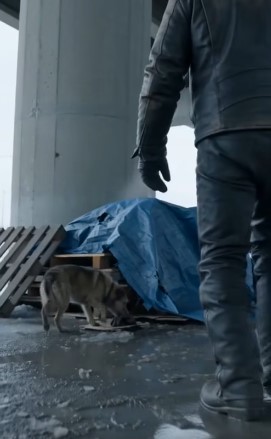
A Stray Dog Stole a Biker’s Glove and Led Him to Two Children Hidden Beneath a Freezing Overpass
A Bitter Stop Along Route 30
The engine of my 2004 Harley continued to tick as it cooled at an isolated Indiana rest stop. November had arrived with the force of midwinter, leaving my fingers numb and the pavement covered with frozen slush.
I had pulled off Route 30 because I could barely feel my left foot against the gear shifter. Two semi-trucks idled in the rear parking area, but otherwise the rest stop appeared deserted.
I removed my heavy riding gloves and placed them on a weathered picnic table beside the vending machines. They had once belonged to my father, who had died two winters earlier, and the worn leather still carried dark stains from years of tractor work.
I turned away briefly to collect paper towels and warm my hands with my breath. When I looked back, one of the gloves had vanished.
At first, I assumed the wind had blown it across the cracked asphalt. Then I noticed movement near a rusted guardrail.
A painfully thin dog was crossing the dirty snow with my father’s glove held firmly between his jaws. His brown coat was tangled with mud and burrs, and one of his hind legs dragged as he moved.
“Hey! Drop that!”
The dog stopped but did not run. He looked back at me with bloodshot eyes filled with an urgency I could not understand.
When I stepped toward him, he turned and descended a steep embankment leading beneath the highway overpass. He slipped several times on the icy weeds, yet he refused to release the glove.
The Dog’s Strange Invitation
I followed him down the slope, using a chain-link fence to keep my balance. Traffic thundered overhead while the air beneath the bridge smelled of damp concrete, exhaust, and river mud.
The dog stood near a pile of soaked wooden pallets. Instead of chewing the glove, he carefully placed it on a flattened piece of cardboard.
He nudged it toward me with his nose, moved backward, and sat trembling in the mud. A weak whine escaped his throat.
My frustration disappeared when I saw how exhausted and malnourished he was. I approached slowly, speaking quietly so I would not frighten him.
As I reached for the glove, I noticed a blue plastic tarp stretched between two concrete supports. Heavy stones held its edges down, while empty bottles and a crushed cracker box lay nearby.
I lifted one corner of the tarp.
Two children were curled together on a stained foam mattress.
A girl of about six had wrapped herself around a toddler boy in an attempt to keep him warm. She wore an oversized coat with its sleeves rolled repeatedly so that her hands could emerge.
Her bright pink boots were splitting apart at the toes and had been repaired with several layers of gray tape. The boy shook uncontrollably while clutching a broken plastic horse against his chin.
The girl did not scream when she saw me. She pressed herself against the concrete and used her small body to cover her brother.
“Hey, it’s okay. I’m not going to hurt you.”
I removed my leather riding jacket and extended it toward them. Cold air immediately cut through my shirt, but the children needed the coat far more than I did.
Children the Town Believed Were Dead
As the girl lifted her face, a heart-shaped red birthmark appeared beneath her left eye. Recognition struck me instantly.
Her name was Lily. The little boy beside her was Leo.
Six months earlier, a woman named Sarah had arrived in the small town of Elm Creek with a devastating story. She claimed that an electrical fire had destroyed her home and killed her two children in an upstairs bedroom.
Residents had gathered around her as she described funeral arrangements and two small caskets. My aunt Martha had comforted her outside the local diner while Sarah wept.
The town responded with remarkable generosity. A church organized a bake sale, donation jars appeared in local businesses, and my motorcycle club contributed money from its charity fund.
More than twelve thousand dollars was collected to help Sarah recover from the supposed tragedy. She remained at a local motel for several weeks before leaving town in a newer vehicle.
Everyone believed Lily and Leo had been buried in another state.
Yet both children were alive beneath an Indiana bridge, exposed to temperatures near eighteen degrees.
“Lily?”
She recoiled when she heard her name.
“How do you know my name?”
I explained that I had met her mother in Elm Creek. The news did not comfort her.
Instead, she pushed Leo farther into the shadows.
“She told us to stay quiet. She said if the police or nice people find us, they’ll take Leo away and put him in a dark box.”
I told her the warning was untrue and asked where Sarah had gone.
Lily said her mother had crossed the highway to buy chicken soup.
“When did she leave?”
“Before the sun went down yesterday.”
Sarah had been gone for almost an entire day. Leo’s lips had turned blue, his eyes were barely open, and each breath was shallow.
Sarah Returns to the Overpass
I told Lily that her brother needed immediate medical care. She panicked, insisting that their mother had ordered them not to leave.
Before I could lift Leo, the dog raised his head and growled toward the embankment.
Heavy footsteps descended through the snow.
“Buster! Get away from them, you stupid mutt!”
Sarah appeared at the top of the slope carrying a plastic shopping bag and an expensive purse. Her warm black coat still had a store tag hanging from one sleeve.
When she entered the shadows and recognized me, she stopped.
I looked through the translucent bag she carried. It contained cigarettes, vodka, and lottery tickets rather than soup.
“Where’s the chicken soup, Sarah?”
She saw the Elm Creek Riding Club emblem on my vest and realized that I knew what she had done.
Her anger immediately changed into tears. She claimed that the children’s father had been pursuing them and that she had invented the fire to protect them.
I pointed toward Lily and Leo beneath the tarp. Whatever explanation she offered could not justify leaving two children beneath a bridge through a freezing night.
Buster limped forward and placed himself between Sarah and the children.
Sarah swung her purse and struck the dog across the muzzle. He staggered, but instead of running, he returned to his position.
I pulled the purse from her hand.
When it hit the ground, bundles of cash, jewelry, and bottles of pills spilled into the mud. Thousands of dollars lay scattered across the slush.
Sarah demanded that I return the bag and insisted that no one could interfere because Lily and Leo were her children.
I reached for my phone and called emergency services.
“I need an emergency medical crew and police at the Route 30 overpass, mile marker 42. I have two severely hypothermic children living under the bridge. The little boy is barely breathing.”
A Second Suspect Arrives
Sarah tried to take the phone and then attempted to shove a wooden pallet toward me. As I asked the dispatcher to hurry, a damaged gray pickup stopped on the road above.
A large man carrying a steel lug wrench descended the embankment. I recognized him as Darren, the man who had accompanied Sarah during her stay in Elm Creek.
He had presented himself as her grieving brother while residents donated money.
Darren saw my phone and ordered me to end the call.
“Hang up the phone, biker. Hang it up right now, or you’re not leaving this bridge alive.”
I positioned myself in front of the tarp. Lily whispered that Darren had used a thick belt, revealing the fear she associated with him.
Darren announced that he and Sarah intended to take the children to Kentucky. He argued that the children were alive and had been given food and clothing.
Sarah admitted that the crackers near the tarp had been brought the previous day.
In the distance, police sirens became audible.
Sarah shouted for Darren to seize Leo and return to the truck. Darren lunged toward the shelter, but I drove my shoulder into his chest.
We fell onto the frozen ground, and the lug wrench rolled into the slush. Darren struck my face as we struggled.
Buster rushed forward and clamped his teeth onto Darren’s pant leg. Despite his injuries and weakness, the dog held on while I forced Darren against a concrete support.
Police lights soon flashed beneath the overpass. State troopers descended the embankment and ordered everyone to remain still.
Officers restrained Darren while another trooper caught Sarah as she attempted to escape toward the pickup.
A Desperate Fight to Save Leo
I returned to the tarp and found Buster guarding its entrance. Lily remained wrapped around her brother beneath my riding jacket.
Leo was no longer moving.
“Is he sleeping?”
I touched the child’s cheek. His skin was dangerously cold, and I could not see his chest rising.
Paramedics arrived and quickly identified a pediatric emergency caused by severe hypothermia. One began chest compressions while another prepared warming equipment.
Lily picked up Leo’s broken toy horse and held it toward me.
“He likes the horse. He… he doesn’t like the dark. Don’t let them put him in the box.”
As Sarah was escorted away, she shouted that she had hidden the children because they would not stop crying and might have attracted attention.
Moments later, a paramedic announced that Leo had a faint pulse.
The medical team wrapped him in insulated material and carried him toward the ambulance. A female trooper placed a blanket around Lily and lifted her from the frozen ground.
Lily reached toward Buster.
“Buster… Don’t leave Buster.”
The dog attempted to follow but collapsed when his injured leg gave way.
“I got him. I promise you, Lily. I’ve got him.”
I lifted the mud-covered animal and carried him up the slope.
As snow began to cover the highway, the heart monitor inside the ambulance produced a continuous tone. The paramedics resumed emergency treatment.
Lily stared into the open vehicle.
“Is Leo going to the box now?”
A Heartbeat Returns
Trooper Miller knelt in the snow and pulled Lily close, shielding her from the activity inside the ambulance.
The flat alarm suddenly stopped.
A heartbeat sounded, followed by another and then another.
A paramedic emerged long enough to announce that Leo had regained a weak rhythm and was breathing independently. The ambulance immediately departed for a pediatric intensive care unit.
Trooper Miller prepared to take Lily to the same hospital and asked what would happen to Buster because the shelter was closed.
“He’s coming with me.”
A nearby veterinarian agreed to open the clinic after hearing about the dog’s condition. Buster was found to have severe dehydration, two cracked ribs, and an old hip injury that had healed incorrectly.
Despite everything he had endured, the veterinarian believed he would survive.
At the hospital, Leo’s core temperature was measured at eighty-two degrees. The medical staff stabilized him with warming treatment, oxygen, and intravenous fluids.
His doctor explained that the child had avoided the organ failure and serious brain damage that could accompany such extreme hypothermia.
When I entered Leo’s room, he was sleeping beneath clean blankets. His lips had regained their natural color, and his breathing had become steady.
Lily sat beside the crib in oversized hospital pajamas. Her hair had been washed and arranged into two uneven pigtails.
She said Leo had taken several sips of warm juice.
Then she asked whether they would be returned to the car.
I told her they would never have to live in the vehicle or beneath the bridge again.
She did not ask for Sarah. She only asked about Buster.
I explained that the dog was resting beside a heater on a warm blanket and had been given chicken broth.
For the first time, the corners of Lily’s mouth lifted into a faint smile.
“He likes chicken. He found a piece of fried chicken in a box last week and he gave half of it to Leo.”
The Truth Behind the False Tragedy
The criminal case took nearly a year to reach trial. Residents from Elm Creek filled the county courthouse when Sarah and Darren appeared before a judge.
Investigators determined that the pair had repeated the false story in three towns. They had collected more than forty thousand dollars by claiming Lily and Leo had died while secretly moving the children between vehicles, bridges, and temporary hiding places.
Sarah and Darren faced charges that included aggravated child endangerment, criminal neglect, fraud, and grand larceny.
Each received a twenty-five-year prison sentence, with no possibility of parole for fifteen years.
My aunt Martha attended the sentencing. She did not confront Sarah or celebrate the punishment.
She sat quietly in the courtroom and cried for what the children had endured while an entire community believed they were gone.
A New Life at an Apple Orchard
Lily and Leo were eventually placed together with a foster family in southern Indiana. The middle-aged couple lived on an apple orchard surrounded by six acres of pasture.
Their home was modest but welcoming, filled with books, warm light, and the smell of toasted bread.
Several months after the trial, I rode my Harley up the orchard’s gravel driveway.
Leo, now four, ran through the grass after a red ball. His cheeks were healthy, his legs were strong, and his laughter carried across the property.
Buster sat on the porch steps watching him.
The dog still walked with a limp, and white fur had spread around his muzzle. However, his coat was clean and full, and his body no longer showed the sharp outline of every rib.
When my motorcycle engine stopped, Buster crossed the yard and pressed his head against my chest. His heartbeat felt strong beneath my hand.
Lily ran from the apple trees wearing new pink shoes without tape around the soles. She carried a paper bag filled with apples.
“You brought his glove?”
I removed my father’s leather glove from my pocket. It had been cleaned and softened, but I continued to carry it whenever I rode.
Lily touched the leather and then rested her hand on Buster’s white forehead.
“He knew where to go. He knew if he brought someone down there, Leo wouldn’t have to stay in the dark.”
The Dog Who Refused to Give Up
I often think about how easily I could have left that rest stop without discovering the shelter beneath the bridge.
I could have assumed the glove was lost, climbed back onto the motorcycle, and continued along Route 30 before the storm arrived.
Buster made sure that did not happen.
He had no way to speak or explain what he had witnessed. He was injured, starving, and barely able to walk, yet he found an object that mattered to a stranger and refused to release it until someone followed him.
The dog’s actions led emergency workers to two children who had been hidden from the world and left in conditions that nearly cost Leo his life.
By the time the sun lowered behind the orchard, Lily and Leo were safe, and Buster was resting beside them.
Some rescues begin with sirens, organized searches, or carefully planned operations. This one began when a forgotten dog carried an old leather glove into the cold and waited for someone to understand.
:::