
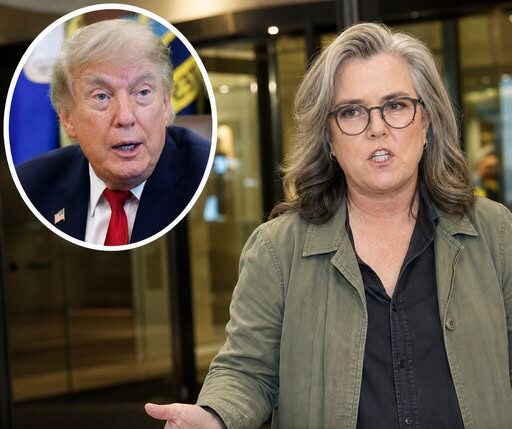
Rosie O’Donnell Fires Back After Donald Trump Raises the Idea of Revoking Her U.S. Citizenship
The longtime entertainer responded from Ireland with sharp criticism, personal attacks and a television appearance that turned their decades-old feud into another public confrontation
Rosie O’Donnell responded forcefully after Donald Trump publicly raised the idea of stripping her of U.S. citizenship.
Rather than answering with a legal argument, O’Donnell chose a highly personal and confrontational response.
She posted online, criticized Trump’s character and later carried the dispute onto Jimmy Kimmel Live!, where she addressed him directly from the stage.
The exchange quickly became about more than the relationship between two famous adversaries.
O’Donnell framed it as a larger disagreement over the direction of the United States and her own decision to live in Ireland.
Trump’s comments reignited one of his longest-running celebrity feuds
The public tension between Trump and O’Donnell has existed for years.
The latest episode began when Trump publicly suggested the possibility of taking away O’Donnell’s American citizenship.
O’Donnell did not allow the remark to pass unanswered.
Within hours, she responded in language that was unmistakably combative.
Her reaction made clear that she did not view the comment as a casual political insult.
O’Donnell responded with a photograph of Trump and Jeffrey Epstein
One of her most provocative moves was posting a photograph showing Trump with Jeffrey Epstein.
She used the image as part of a broader attack on Trump’s public persona.
O’Donnell described him as “rattled” and then contrasted her own identity with the qualities she accused him of representing.
The post was not subtle.
It was designed as a direct personal rebuke.
She described herself as a “loud” and “queer” truth-telling mother
O’Donnell presented herself as someone unwilling to remain silent simply because the person criticizing her held political power.
Her response emphasized aspects of her identity and personality that she believed had long made her a target of Trump’s criticism.
She characterized herself as “loud,” “queer” and committed to speaking what she considers the truth.
She then contrasted that description with accusations she has made about Trump.
Her comments included sweeping accusations against Trump
O’Donnell accused Trump of lying, stealing and using fear as a political tool.
Those statements reflected her own characterization of him rather than a neutral description.
Her response was intentionally personal and sharply worded.
She appeared determined to make clear that the citizenship remark had not intimidated her.
If anything, it intensified her public criticism.
Her move to Ireland became part of the dispute
O’Donnell has been living in Ireland and has discussed seeking citizenship there through her grandparents.
In responding to Trump, she rejected the idea that her move should be interpreted simply as running away.
Instead, she framed it as a refusal to remain in a country whose political direction she strongly opposes.
She described the United States in stark terms, saying she did not want to watch it be “set ablaze.”
For O’Donnell, Ireland represented distance from a political environment she rejects
Her comments suggested that the move was not merely geographical.
She tied it directly to her political disillusionment.
By emphasizing her grandparents and her pursuit of Irish citizenship, O’Donnell presented the move as a personal choice rooted both in family heritage and in her dissatisfaction with American politics.
That framing became an important part of her response to Trump.
The feud then moved onto Jimmy Kimmel Live!
O’Donnell later appeared on Jimmy Kimmel Live!, where the dispute became part of a televised performance.
She arrived in a bright pink floral suit and immediately embraced the combative tone.
Rather than avoiding Trump’s comments, she turned them into material.
The appearance allowed her to transform an online argument into a public monologue in front of a live audience.
She used one of her harshest nicknames for Trump
During the appearance, O’Donnell referred to Trump as “Mango Mussolini.”
The insult reflected the same deliberately provocative style she had used online.
It was less an attempt at political analysis than an expression of open contempt.
The crowd reaction reinforced the theatrical nature of the moment.
She joked about leaving the United States after reading Project 2025
O’Donnell also connected her move abroad to Project 2025.
She joked that reading about it contributed to her decision to leave.
The remark allowed her to frame the relocation as a political response rather than a retreat from public life.
Her message was that she had not stopped paying attention to American politics simply because she was living elsewhere.
Then she looked directly into the camera
One of the most memorable moments came when O’Donnell addressed Trump as though she expected him to be watching.
She stared into the camera and said, “Hi! I know you’re watching.”
The line turned the appearance into something resembling a direct confrontation.
It also reflected the unusual longevity of their feud.
Both figures clearly understand that public attention is part of the conflict itself.
The dispute has always been intensely personal
Although political disagreement now dominates the latest chapter, the hostility between O’Donnell and Trump predates many of their current political battles.
Their public exchanges have long relied on insults, mockery and direct attacks.
That history helps explain why Trump’s citizenship comment triggered such an immediate and personal response.
O’Donnell did not answer as though she were dealing with an isolated statement from a political figure.
She answered as someone confronting a longtime adversary.
The citizenship remark raised a larger symbolic issue
For O’Donnell, the suggestion that her citizenship could be taken away was about more than one insult.
She treated it as an attack on her right to belong to the country where she was born and built her public career.
That is why her response repeatedly returned to questions of identity, nationality and who gets to define what being American means.
Her answer was emotional rather than legal
O’Donnell did not attempt to produce a detailed constitutional argument.
She did not respond with technical language about citizenship law.
Instead, she attacked Trump’s character and emphasized her own refusal to be intimidated.
The tone was moral, personal and performative.
Her goal appeared to be confrontation rather than legal clarification.
That choice made the exchange more combustible
Political disputes can remain abstract when they involve policy language.
This one did not.
O’Donnell personalized every part of it.
She invoked Trump’s relationships, his character, her sexuality, her motherhood, her move to Ireland and her view of the United States.
The result was a response designed to provoke as much as defend.
The Jeffrey Epstein image added another layer of controversy
By posting a photograph of Trump with Epstein, O’Donnell connected the citizenship dispute with one of the most sensitive names in recent public life.
The image carried obvious emotional and political weight.
O’Donnell used it as part of her broader effort to challenge Trump’s moral authority to attack her.
Her post relied heavily on association and rhetorical contrast.
Her language made clear she wanted no reconciliation
Nothing in O’Donnell’s response suggested she was interested in lowering the temperature.
She did not ask Trump to retract the comment politely.
She did not attempt to create distance from the feud.
Instead, she escalated publicly and deliberately.
That approach matched the confrontational style that has defined many of their exchanges.
Her move to Ireland has become politically symbolic
For some public figures, relocation is primarily a private lifestyle decision.
O’Donnell has spoken about hers in explicitly political terms.
She connected it to concerns about the country’s direction and to her interest in securing Irish citizenship through family ancestry.
That made Trump’s citizenship remarks particularly charged.
He was challenging the nationality of someone who had already publicly discussed building a life elsewhere.
O’Donnell rejected the idea that leaving meant surrender
Her response emphasized that living abroad did not mean giving up her opinions or disappearing from political debate.
Her Jimmy Kimmel appearance reinforced that message.
She remained willing to criticize Trump publicly and directly.
Distance had not softened the feud.
She framed herself as someone refusing to remain quiet
The repeated theme across her statements was defiance.
O’Donnell presented her outspoken nature as something she considered a strength rather than a liability.
She appeared to interpret Trump’s attack as proof that her criticism had reached him.
Calling him “rattled” was part of that framing.
Trump and O’Donnell use very different forms of the same public weapon
Both understand the power of insult.
Both know how to turn personal conflict into a media event.
Both have audiences that react strongly to confrontation.
That dynamic has helped keep their feud alive across different periods of American public life.
The latest exchange followed the same pattern, only with far higher political stakes.
The citizenship question raised concerns far beyond celebrity gossip
Whatever one thinks of O’Donnell or Trump personally, the idea of a political leader publicly suggesting citizenship removal from a prominent critic carries implications larger than a celebrity feud.
O’Donnell clearly understood the statement that way.
Her response repeatedly framed the argument around belonging, power and dissent.
Her criticism was also deeply ideological
O’Donnell did not limit herself to defending her own citizenship.
She connected the dispute to her wider opposition to Trump’s political project.
Her reference to Project 2025 was one example.
Her description of America being “set ablaze” was another.
She presented the confrontation as part of a larger struggle over the country’s future.
The television appearance amplified that framing
A social media post can reach millions, but television creates a different kind of political theater.
On Jimmy Kimmel Live!, O’Donnell could use body language, timing and audience reaction.
Her bright clothing, direct camera address and mocking nickname turned the appearance into a visual statement of defiance.
The line “I know you’re watching” became a challenge
That sentence condensed the entire feud into a few words.
O’Donnell was not speaking about Trump in the abstract.
She was speaking to him.
At least rhetorically.
The moment invited viewers to imagine Trump watching the program and reacting in real time.
The conflict blurred politics and entertainment
That has long been a feature of the Trump era and of O’Donnell’s public relationship with him.
A political statement became a celebrity feud.
A celebrity feud became a debate about citizenship.
A late-night television appearance became part comedy, part political protest and part personal retaliation.
O’Donnell’s response relied heavily on identity
She emphasized being a mother.
She emphasized being queer.
She emphasized being outspoken.
Those details were not incidental.
She used them to construct a contrast between herself and the person attacking her.
Her argument was essentially that the qualities Trump dislikes about her are the same qualities she refuses to surrender.
Her language was intentionally inflammatory
Terms such as “Mango Mussolini” were chosen to ridicule rather than persuade.
Her online accusations were similarly confrontational.
Supporters may see that language as fearless resistance.
Critics may see it as another example of political discourse becoming increasingly personal and hostile.
Either way, the tone was unmistakable.
The response immediately energized her supporters
For people who already oppose Trump, O’Donnell’s willingness to attack him directly reinforced her reputation as someone who refuses to back down.
Her supporters interpreted the response as resistance rather than retreat.
The fact that she delivered part of it from Ireland only added to the symbolism.
But the exchange also highlighted the danger of turning politics into personal warfare
When public disagreements become dominated by humiliation and insult, the original issue can quickly disappear.
Here, the underlying subject was citizenship and political dissent.
But much of the attention shifted toward nicknames, photographs and personal attacks.
That may increase audience engagement while reducing the amount of substantive discussion.
O’Donnell nevertheless made her central position clear
She does not believe Trump has the moral authority to determine whether she belongs in the United States.
She does not intend to mute her criticism because of his comments.
And she does not see living in Ireland as surrendering her connection to America.
Those ideas remained consistent throughout her response.
The dispute also reopened debate about celebrities and political speech
O’Donnell has never treated entertainment and politics as completely separate worlds.
Her willingness to speak politically has often attracted both praise and hostility.
The latest episode shows how quickly a celebrity’s political identity can become inseparable from the rest of their public image.
Her reference to citizenship through her grandparents added a personal contrast
While Trump spoke publicly about her American citizenship, O’Donnell discussed another citizenship she hopes to obtain through family lineage.
That gave the story an unusual symmetry.
One political figure was talking about taking nationality away.
O’Donnell was talking about reconnecting with another part of her family heritage.
She framed Ireland as a place where she could step outside the conflict without disappearing
O’Donnell’s public comments suggested that leaving the United States did not mean abandoning political engagement.
She continued speaking about America.
She continued appearing on American television.
She continued criticizing Trump.
In that sense, the move changed her location but not her willingness to participate in national debate.
The feud has become a symbol for larger cultural divisions
Trump and O’Donnell represent sharply different political and cultural identities.
Their conflict therefore attracts attention from people who may care less about either celebrity personally than about what each symbolizes.
For supporters of O’Donnell, she can represent resistance to Trump.
For critics, she can represent the celebrity opposition they reject.
That symbolism makes every exchange larger than the people involved
A personal insult becomes political content.
A television joke becomes an ideological statement.
A citizenship remark becomes a debate about dissent and national identity.
That is why the latest confrontation spread so quickly.
O’Donnell’s response was also designed for the modern media cycle
It contained recognizable images.
Short quotable lines.
A provocative nickname.
A direct camera address.
Those elements travel easily across social platforms and news coverage.
Her response was not only emotional.
It was highly shareable.
The legal reality was almost secondary to the performance
O’Donnell’s response never centered on technical questions about whether such a citizenship threat could actually be carried out.
Instead, she treated the statement as evidence of what she believes Trump represents politically and personally.
That allowed her to respond on emotional and symbolic terrain rather than legal terrain.
Her decision to post the Epstein image intensified the moral argument
Rather than merely calling Trump hypocritical, she used a visual association designed to provoke immediate reaction.
That choice reflected her broader strategy.
She was not trying to lower the stakes.
She was trying to challenge him publicly in the most forceful way she could.
Her supporters saw fearlessness where others saw escalation
The same response can look very different depending on political perspective.
Supporters may view O’Donnell’s words as refusing intimidation.
Others may view the exchange as another example of public discourse collapsing into insults.
Both reactions are part of why the feud remains so visible.
O’Donnell’s strongest message was that she would not be intimidated into silence
From her social media post to her Jimmy Kimmel appearance, the core theme remained consistent.
She would answer Trump publicly.
She would continue criticizing him.
And she would not accept his citizenship remark as something capable of frightening her into retreat.
The feud is unlikely to be remembered only as celebrity gossip
The latest confrontation touched on citizenship, political power, dissent, migration, sexuality and national identity.
That gives it a significance beyond the personal hostility between two famous people.
O’Donnell intentionally presented it that way.
Her final message was aimed as much at the audience as at Trump
When she stared into the camera and addressed him directly, she was also speaking to viewers who understood the political symbolism.
The moment allowed her to present herself as unafraid.
Whether viewers saw courage, provocation or political theater depended largely on where they already stood.
For Rosie O’Donnell, the fight is about who gets to claim America
Her response made clear that she does not consider living in Ireland incompatible with remaining emotionally and politically connected to the United States.
She rejected the idea that criticism makes someone less American.
And she treated Trump’s citizenship remark as something worth confronting rather than ignoring.
The latest chapter ended not with retreat, but escalation
Trump publicly raised the possibility of stripping O’Donnell of citizenship.
O’Donnell answered with a photograph, a barrage of personal criticism and a televised performance.
She mocked him.
She criticized his politics.
She defended her own identity.
And from Ireland, she made clear that distance had not ended one of the longest-running feuds in American celebrity politics.