
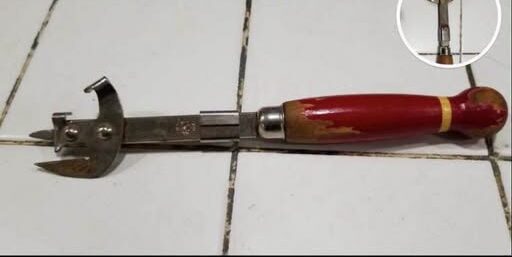
They Found a Strange Metal Tool in Grandma’s Kitchen. Older Cooks Knew Exactly What It Was
A Reddit Mystery Brought Back Memories of an Old-Fashioned Can Opener and the Jagged Lids It Left Behind
While clearing out their grandmother’s house, a Reddit user found a sharp-edged metal tool whose purpose was difficult to guess. Its shape looked imposing enough to inspire jokes about medieval weapons. Some people thought it might be a specialized nineteenth-century instrument, while others guessed it was a camping tool built to do several jobs.
Then people who had handled one before recognized it. The object was an old-fashioned can opener, the kind that cut through a lid a little at a time. For some commenters, the sight of it brought back memories of opening canned food as children. One even had a scar to show for it.
The People Who Recognized It Remembered the Work It Took
The fierce-looking edge made more sense once commenters explained what the tool had to do. It pierced the lid and gave the person holding it enough leverage to advance the blade in short steps. Each movement cut another small section of metal until there was enough of an opening to lift the lid.
“You had to punch it into the can and lever it forward step by step to cut the top off. It worked, but it wasn’t for the faint of heart.”
The description explained why the tool looked so different from the geared openers now familiar in many kitchens. Turning a handle moves a cutting wheel around the rim in a continuous motion. With the older tool, each advance depended on how the person holding it positioned the blade and steadied the can.
That effort was part of what people remembered. The tool could slip, and the finished lid might have an uneven, sharp edge. Some commenters also recalled small metal fragments coming off during the job. One person’s memory went back to childhood: “This thing was a hazard,” the commenter said. “I’ve still got a scar from when it slipped while I was opening a can as a kid.”
Those recollections gave the discussion something the early guesses had lacked. People who had used the tool could explain the shape of the blade, the reason for the lever, and the way the metal felt as it gave way. A device that looked mysterious on its own became recognizable once someone described the motion their hands still remembered.
Canned Food Came Before a Dedicated Tool for Opening It
The tool belongs to a long history of figuring out how to get food back out of a container built to keep it sealed. Tin cans appeared commercially in the early nineteenth century, decades before a dedicated can opener was patented. Early cans had thick metal lids, and directions sometimes advised customers to use a hammer and chisel.
That meant the work of opening dinner could begin with finding tools built for an entirely different purpose. The hammer supplied the force and the chisel concentrated it on a small area of metal. The method could get through a lid, but it was a cumbersome way to handle a task that would become a regular feature of home cooking.
In 1858, Ezra Warner patented a dedicated opener with a sharp, curved blade and a lever-like design. It gave users a tool shaped specifically for working through a can lid. The operator still had to provide the force and guide the blade around the opening.
Warner’s opener saw use with the U.S. military during the Civil War. Its history helps explain why an early can opener could look more at home among heavy-duty tools than among spoons and forks. The design had to manage the resistance of the metal first. Ease of use would become a greater part of the story as other inventors revisited the problem.
A Cutting Wheel Changed the Motion
In 1870, William Lyman introduced a design that used a rotating cutting wheel. The innovation changed the way the blade traveled. Earlier lever openers progressed through a series of individual cuts. The wheel could roll around the lid, making the cutting action more continuous.
The rotating wheel became an important step toward the familiar kitchen opener. Later devices offered a way to guide the cutter around the rim with a turning handle, replacing much of the repeated levering that people remembered from the older tool.
Electric openers appeared in the 1930s, and handheld designs continued to develop. By the 1950s, more comfortable manual models were available. Those changes made a difference to the person at the counter, who could open a can with less effort and without having to reposition a pointed blade for each section of the lid.
Seen in that sequence, the tool from the grandmother’s cabinet makes sense. A heavy blade and a lever were practical responses to the problem early openers had to solve. Once a cutting wheel could travel around the lid, an opener could be designed around a different and easier movement. The tools look different because they ask different things of the person using them.
Some People Still Keep the Old Opener in the Drawer
The conversation also brought out people who had held on to their old openers. For them, recognizing the unusual shape required little thought. They knew what it was for and could remember using it long before the photograph started making the rounds online.
“I still have one and use it occasionally,” a user shared on Facebook. “It’s a dangerous little thing, but it gets the job done.” Another person had tried to find one again. “Tried to buy one recently—you can’t find them anymore!”
Those reactions sat alongside memories from people who were happy to leave the design in the past. An old tool could bring back a grandmother’s kitchen for one person and a painful slip of the hand for another. Sometimes the same person could remember both, along with the peculiar satisfaction of finally getting the lid off.
What began as a question about a piece of metal ended up preserving a small detail of everyday work. The people guessing from its shape imagined camping equipment or something from an armory. The people who recognized it remembered standing at a kitchen counter, working their way around a can, and watching for the moment the lid would finally give.