
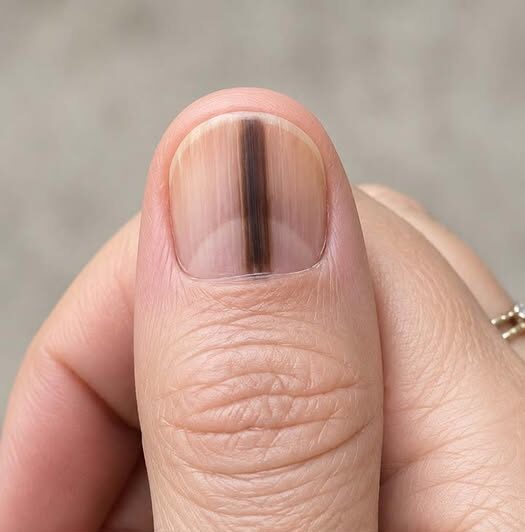
Understanding a Dark Stripe on a Thumbnail and When It May Need Attention
Why a Dark Line on the Nail Can Cause Concern
Seeing a dark stripe running down a parent’s thumbnail can be unsettling, especially when the cause is unclear and a specialist appointment is still weeks away. Even when the person affected appears calm or unconcerned, it is natural for family members to worry about what the change might mean.
In many situations, nail discoloration turns out to be harmless. Some dark streaks remain stable for years without causing health problems. At the same time, certain nail changes can point to conditions that should be evaluated by a medical professional.
Understanding the difference between common harmless changes and warning signs can help reduce anxiety while making it easier to monitor the situation carefully.
What a Dark Nail Stripe May Represent
A vertical dark line on the nail is commonly linked to increased pigment production in the nail bed. This condition is known as longitudinal melanonychia.
The stripe may appear brown, dark brown, or black. In some people, particularly those with darker skin tones, these lines are relatively common and may not signal a serious medical problem.
Some individuals notice the streak suddenly, while others realize it has likely been present for a long time. In many benign cases, the stripe remains unchanged over time and does not interfere with the nail itself.
Although many nail streaks are harmless, certain changes deserve closer attention because they can occasionally be associated with subungual melanoma, a rare form of skin cancer that develops beneath the nail.
This possibility is why monitoring the appearance and progression of the stripe is considered important while waiting for medical evaluation.
Features That Are Often Considered Less Concerning
Some nail streaks have characteristics that are generally viewed as more reassuring.
A stripe that is thin and evenly colored is often considered less alarming than one with dramatic variation in color or shape.
Clear, defined borders can also be a positive sign. When the edges of the stripe remain straight and consistent, the appearance may suggest a stable pigment pattern.
Stability over time is another important factor. A streak that looks the same month after month is usually viewed differently from one that changes rapidly.
The absence of pain, nail distortion, or surrounding skin changes can also make the situation appear less urgent.
Many people live with benign nail streaks for years without complications, particularly when the line remains narrow and unchanged.
Warning Signs That Should Be Taken More Seriously
While many cases are harmless, there are several changes that may require faster medical attention.
A stripe wider than approximately 3 millimeters may be considered more concerning, particularly if the width increases over time.
Irregular or blurry edges can also raise concern. Instead of appearing as a clean vertical band, the stripe may look uneven or spread unpredictably.
Color variation is another detail to watch carefully. A line containing multiple shades, including black, brown, or gray tones mixed together, may deserve closer examination.
Rapid change is especially important. If the stripe darkens, widens, or alters noticeably over weeks or months, it should not be ignored.
Changes to the nail itself can also matter. Cracking, splitting, lifting, or distortion of the nail may indicate a more significant issue developing beneath the surface.
One of the more serious warning signs is when the pigment extends beyond the nail and onto the surrounding skin.
Pain, swelling, or bleeding around the nail are additional symptoms that should prompt quicker medical evaluation if possible.
Monitoring the Nail While Waiting for an Appointment
When specialist care is delayed, careful observation can help track whether the condition appears stable or is changing over time.
Taking weekly photographs of the nail in the same lighting can create a reliable visual record. Consistency matters because lighting differences can sometimes make the stripe appear darker or lighter than it really is.
Measuring the width of the stripe occasionally may also be useful. Even small changes can become easier to identify when there is a written record.
Watching for new colors, spreading pigment, or changes in the surrounding skin can help identify whether the appearance remains stable.
Protecting the nail from injury is another sensible step. Trauma to the nail can complicate the appearance and make monitoring more difficult.
Keeping a simple timeline of observations may later help the specialist understand how long the streak has been present and whether any progression has occurred.
Managing Anxiety During the Waiting Period
Waiting for medical appointments can be emotionally difficult, especially when internet searches and uncertainty increase fear.
It is important to remember that many nail streaks do not turn out to be dangerous. Stable lines without rapid change are often benign.
At the same time, paying attention to warning signs is a practical and responsible approach. Monitoring the condition does not mean assuming the worst.
Balancing caution with calm observation can help reduce unnecessary stress while still ensuring that important changes are not overlooked.
Focusing on measurable details, such as size, color, and progression, may also help replace panic with more structured observation.
How to Talk About the Situation Calmly
Discussing possible health concerns with a parent can sometimes be challenging, particularly if they are not worried about the symptom.
Approaching the conversation gently and without alarm may help avoid unnecessary fear or resistance.
Instead of focusing on worst-case scenarios, it may be more helpful to emphasize that many nail streaks are harmless but that some deserve routine evaluation.
The phrase “Most nail streaks are harmless, but some should be checked just to be safe” can communicate concern without creating panic.
A calm and supportive tone may encourage cooperation while helping everyone feel less overwhelmed by uncertainty.
Why Observation Matters
Subtle changes can sometimes provide valuable clues about whether a nail streak is stable or evolving.
A stripe that remains the same width, color, and shape over time may be less concerning than one that changes quickly.
Careful monitoring also helps avoid relying on memory alone. Small changes are often difficult to recall accurately without photographs or written notes.
By documenting the appearance regularly, it becomes easier to provide clear information during a future medical appointment.
This process can also help reduce confusion about whether the stripe is truly changing or simply appearing different under varying lighting conditions.
The Importance of Professional Evaluation
Even though many dark nail streaks are benign, new or changing lines should still be evaluated by a healthcare professional whenever possible.
A specialist can examine the nail more closely and determine whether further testing or monitoring is necessary.
Because certain serious conditions can resemble harmless pigment changes in their early stages, professional assessment remains the safest course when there is uncertainty.
Prompt evaluation becomes more important if warning signs such as rapid growth, irregular coloration, pain, or spreading pigment appear.
Until then, careful observation and calm awareness are reasonable steps while waiting for the appointment.
The Bottom Line
A dark stripe on the thumbnail can be frightening to notice, especially when answers are not immediately available.
Many cases are harmless and remain stable for years without causing problems. Thin, evenly colored lines with clear borders and no changes over time are often less concerning.
However, rapid growth, irregular edges, multiple colors, nail damage, or pigment spreading onto nearby skin are warning signs that deserve quicker medical attention.
Taking weekly photos, monitoring changes carefully, and protecting the nail from injury can help during the waiting period before seeing a specialist.
Staying calm while remaining attentive is often the best approach when dealing with uncertainty surrounding nail changes.
We do not give medical advice, diagnosis, or treatment.