
Hammerhead Worms Explained: What They Are, Why They Appear, and How to Handle Them Safely
An Unusual Sight in Everyday Spaces
It can be surprising to notice a long, flat worm moving slowly across a patio, garden, or walkway.
Its shape and movement often seem unfamiliar, leading many people to wonder what exactly they are seeing.
These creatures have become more noticeable in recent years, appearing in a variety of outdoor spaces.
Their presence often raises questions about safety, origin, and environmental impact.
Understanding what they are can help remove uncertainty and guide the right response.
What a Hammerhead Worm Is
The organism commonly referred to as a hammerhead worm is a type of land flatworm.
It is known for its distinctive head shape, which resembles a hammer or shovel.
This feature makes it easy to distinguish from more familiar earthworms.
These worms belong to the Bipalium genus and are recognized for their unique appearance.
Their structure and movement set them apart from other soil-dwelling creatures.
Key Physical Characteristics
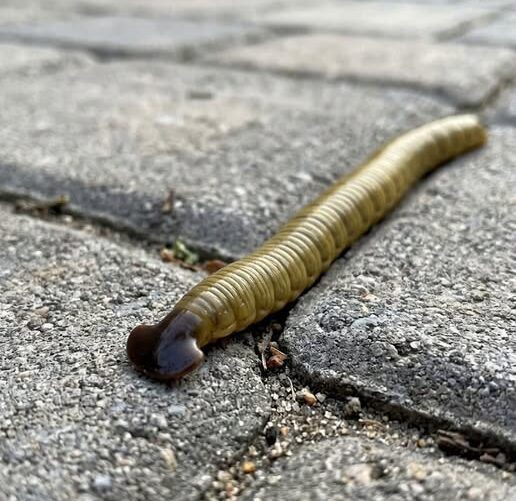
Hammerhead worms have a wide, flattened head that gives them their name.
Their bodies are long, smooth, and often coated with a slimy layer.
Coloring can vary, but many display dark stripes or shades of brown and gray.
Unlike earthworms, they do not have segmented bodies.
Their appearance is often described as unusual due to their flat shape and glossy surface.
Why They Appear So Different
One of the reasons these worms attract attention is their movement.
Instead of wriggling, they glide smoothly across surfaces.
This motion is made possible by tiny hair-like structures called cilia.
Their flat bodies and fluid movement contribute to an appearance that many find unfamiliar.
These characteristics make them stand out in natural environments.
Where They Come From
Hammerhead worms are not native to many of the places where they are now found.
They originally come from Southeast Asia.
Over time, they have spread to other regions through the transport of plants and soil.
This movement has allowed them to establish themselves in new environments.
As a result, they are now encountered in areas far from their place of origin.
Typical Environments They Prefer
These worms are most often found in damp and shaded areas.
Gardens, patios, and spaces under rocks provide suitable conditions.
They are especially active after rainfall, when moisture levels are higher.
These conditions support their movement and survival.
As a result, sightings often increase during wet weather.
Understanding Their Behavior
Hammerhead worms are predators that feed on other small organisms.
Their diet primarily consists of earthworms and similar creatures found in soil.
They use their body structure to capture and consume their prey.
This behavior plays a role in their impact on the environment.
It also explains why their presence can be concerning in certain areas.
Are They Dangerous to Humans
Many people wonder whether these worms pose a direct threat.
They are not dangerous in the sense that they do not attack or bite humans.
However, they do produce a toxic substance in their mucus.
This toxin can cause skin irritation if touched.
For this reason, direct contact should be avoided.
Why Caution Is Recommended
Although the risk to humans is limited, handling these worms without protection is not advised.
Their mucus contains tetrodotoxin, which can irritate the skin.
Using gloves or tools when dealing with them is a safer approach.
This helps prevent unnecessary exposure.
Simple precautions can reduce any potential discomfort.
The Environmental Concern
The greater concern with hammerhead worms lies in their effect on the environment.
They prey on earthworms, which play a crucial role in maintaining soil health.
Earthworms contribute to nutrient cycling and support plant growth.
When their populations decline, soil quality can be affected.
This can have broader consequences for gardens and ecosystems.
Impact on Soil and Plant Life
Healthy soil depends on the presence of organisms that support its structure and fertility.
Earthworms are a key part of this system.
When hammerhead worms reduce their numbers, the balance can shift.
This may affect plant growth and overall soil condition.
Understanding this impact highlights why these worms are taken seriously.
How They Reproduce
One of the most notable features of hammerhead worms is their method of reproduction.
They can multiply through a process known as fragmentation.
This means that when the body is divided, each part can develop into a new worm.
This ability allows their population to grow quickly.
It also makes improper handling a potential issue.
Why Improper Handling Can Worsen the Problem
Cutting a hammerhead worm into pieces does not eliminate it.
Instead, it can lead to the creation of multiple worms.
This makes certain methods of removal ineffective.
Understanding this behavior is important for preventing further spread.
Proper handling techniques are essential in managing their presence.
What Should Be Avoided
There are several actions that should not be taken when encountering these worms.
They should not be touched with bare hands.
They should not be cut into pieces.
Ignoring their presence is also not recommended.
Avoiding these actions helps prevent unintended consequences.
Safe Ways to Handle Them
If removal is necessary, certain steps can be followed.
Using gloves or tools allows for safe handling.
Applying substances such as salt or vinegar can prevent regeneration.
Once treated, the worm can be placed in a sealed container.
Proper disposal helps ensure it does not return.
Reducing the Chances of Reappearance
Preventative measures can help limit future encounters.
Checking new plants and soil before introducing them to a garden is one approach.
Keeping outdoor areas clean and organized can also reduce suitable habitats.
Managing moisture levels helps create less favorable conditions.
Regular monitoring allows for early detection.
The Importance of Awareness
At first glance, a hammerhead worm may appear to be just an unusual sight.
However, its presence reflects broader environmental considerations.
Invasive species can disrupt established ecosystems.
Understanding their role helps in managing their impact.
Awareness is a key part of responsible environmental care.
A Wider Perspective
The spread of non-native species is a reminder of how interconnected environments can be.
Changes in one area can affect others in unexpected ways.
Recognizing these connections helps guide informed decisions.
It also emphasizes the importance of careful management.
Small actions can contribute to maintaining balance.
Conclusion
Hammerhead worms may look unusual, but understanding them provides clarity.
They are not a direct threat to humans, but they can affect local ecosystems.
Knowing how to identify and handle them safely is important.
With the right approach, their impact can be managed effectively.
Awareness and proper action help protect both gardens and the environment.