
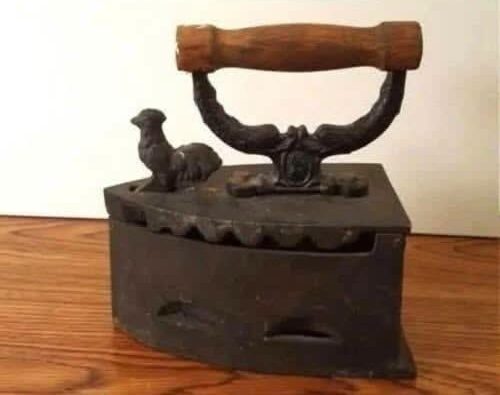
The Charcoal Box Iron: When Pressing Clothes Meant Holding a Furnace in Your Hand
Before Electricity, Ironing Required Fire
Long before electric irons became ordinary household tools, smoothing clothing was a hot, exhausting, and sometimes dangerous task.
Women working in crowded kitchens and humid washhouses often relied on heavy cast-iron devices filled with burning charcoal.
These tools were known as charcoal box irons.
They were not simply warmed pieces of metal. Each iron contained a small fire inside its hollow body.
Glowing coals provided the heat needed to flatten damp linen, sharpen collars, and remove stubborn wrinkles from clothing.
To modern eyes, the design can appear alarming.
A person was expected to hold a metal container filled with hot embers and move it repeatedly across fabric, often for hours at a time.
Yet for many households and professional laundresses, the charcoal box iron represented an important improvement over earlier methods.
A Small Furnace Built for Domestic Work
The body of the charcoal iron was usually made from thick cast iron.
Unlike a solid iron that had to be placed directly on a stove, this version was hollow.
The chamber inside held burning charcoal, allowing the heat source to travel with the tool.
Once the coals were glowing, heat passed through the metal and warmed the flat soleplate beneath them.
The user could then move the iron across cloth without returning constantly to the stove for reheating.
In effect, the device functioned like a miniature portable furnace.
Its design brought the fire closer to the work, making the ironing process more continuous.
That convenience, however, came with smoke, sparks, heavy weight, and the constant possibility of burns.
The Wooden Handle Offered Essential Protection
One of the most important parts of the charcoal box iron was its handle.
The iron body became extremely hot, so the user needed a way to grip it without touching the metal directly.
Many models featured a carved wooden handle positioned above the heated chamber.
Wood transferred heat far more slowly than iron, allowing the handle to remain cool enough to hold during use.
This simple feature made the tool practical.
Without it, the intense heat inside the box would have made prolonged ironing nearly impossible.
The handle also gave the user enough leverage to guide the heavy iron across thick fabric.
Even with this protection, the work remained physically demanding.
A charcoal iron could become heavy after being filled with fuel, and controlling it required strength and steady movement.
The Hinged Lid Allowed Workers to Feed the Fire
The upper section of the iron usually included a hinged lid.
Users opened it to place charcoal inside, remove ash, or adjust the burning coals.
The lid had to close securely so that embers would remain inside while the iron moved back and forth.
Some charcoal irons featured decorative latches shaped like roosters.
These details gave a practical household tool a distinctive appearance while also helping secure the lid.
The rooster-shaped latch became one of the most recognizable features associated with certain traditional charcoal irons.
During use, the operator had to monitor the fuel carefully.
If the charcoal burned too slowly, the soleplate would cool and fail to press the fabric properly.
If the fire became too intense, the iron could scorch linen or damage delicate material.
Keeping the Heat Steady Required Skill
Using a charcoal box iron involved more than filling it with coals and pressing clothes.
The worker had to maintain a steady temperature throughout the task.
Too little heat meant wrinkles remained in the fabric.
Too much heat could leave dark marks or burn holes into clothing.
Experienced users learned to judge the iron’s temperature through practice.
They watched how quickly it moved across damp cloth, noticed the sound of the soleplate, and observed how the fabric responded.
The charcoal also needed enough airflow to remain hot.
Openings in the iron allowed air to reach the coals and helped smoke escape.
This ventilation kept the fire alive, but it also released fumes into the room.
Smoke and Steam Filled the Workspace
Ironing with charcoal often took place in poorly ventilated kitchens, laundry rooms, or washhouses.
Wet clothing and linen produced clouds of steam when touched by the hot soleplate.
At the same time, burning charcoal released smoke and fumes through the openings in the iron.
The combination created a difficult working environment.
Rooms became hot, damp, and uncomfortable, especially when several irons or other fires were being used at once.
Professional laundresses could spend much of the day surrounded by heat and steam.
The work was repetitive, physically tiring, and required constant concentration.
Despite those conditions, clean and sharply pressed clothing remained important to households and communities.
Smooth Linen Reflected Pride and Respectability
Ironing was not performed only for comfort.
Wrinkle-free clothing and household linen were often associated with cleanliness, order, and social respectability.
Crisp collars, smooth shirts, carefully pressed dresses, and neatly finished sheets reflected the effort invested in maintaining a household.
For families with limited resources, well-kept clothing could help create an appearance of dignity and discipline.
For wealthier homes, expertly pressed garments formed part of the expected standard of presentation.
This placed considerable pressure on the people responsible for laundry work.
A poorly heated iron could leave clothing unfinished, while an overheated one could destroy valuable fabric.
Every successful result depended on judgment, patience, and physical labor.
One Stray Ember Could Ruin the Day
The charcoal box iron carried several obvious dangers.
A loose ember could escape through an opening or fall out when the lid was raised.
If it landed on fabric, it could create a burn mark or start a fire.
If it touched skin, it could cause a serious injury.
The heated metal body also posed a constant risk.
A hand placed too close to the iron chamber could be burned instantly.
Children and other people working nearby also had to avoid the tool while it was hot.
Even after the ironing was complete, the iron could remain dangerous until the charcoal cooled and the metal lost its heat.
Safe handling required attention from the moment the fire was lit until the final ember had gone dark.
The Older Sad Iron Required Constant Reheating
Before charcoal box irons became widely used, many households relied on solid metal irons commonly called sad irons.
The word referred to the heavy, solid construction of the tool.
A sad iron had no internal fuel chamber.
It had to be heated directly on a stove or near a fire before being carried to the ironing surface.
As the iron cooled, the user had to return it to the heat source.
This interrupted the work repeatedly.
Some laundresses kept several irons heating at once so that one could be used while another warmed on the stove.
The process demanded careful timing and frequent movement between the ironing table and the fire.
The Charcoal Iron Reduced Trips to the Stove
The charcoal box iron changed this routine by carrying its own heat source.
Because the burning fuel remained inside the tool, it could stay hot for a longer period.
This reduced the need for constant reheating.
A laundress could continue pressing a pile of clothing while adjusting or replacing the coals only when necessary.
Compared with the solid sad iron, this felt like a major improvement.
It saved steps, reduced interruptions, and allowed work to progress more steadily.
The user still had to manage the fire, but the fire moved with the iron instead of remaining at the stove.
For the period, that portability made the device seem remarkably advanced.
Convenience Came With New Problems
The charcoal box iron solved one major problem while creating others.
Its internal fire provided longer-lasting heat, but it also brought smoke and hot fuel directly onto the ironing surface.
A poorly sealed lid could allow ash or sparks to escape.
Uneven charcoal could create hot spots across the soleplate.
Fumes could collect in rooms without adequate airflow.
The worker also had to carry the combined weight of the iron and the fuel inside it.
For hours of repeated movement, that weight placed stress on the hands, wrists, arms, and shoulders.
The charcoal iron was more efficient than some earlier tools, but it was far from effortless.
Preparing the Iron Was a Process of Its Own
Before ironing could begin, the charcoal had to be prepared.
The fuel needed to be hot enough to provide steady heat without producing uncontrolled flames.
Once the coals were glowing, they were transferred into the iron’s chamber.
The lid was then secured, and the user waited for the soleplate to reach an effective temperature.
Starting too soon could mean working with an iron that was not yet hot enough.
Waiting too long could allow the metal to overheat.
The soleplate also had to remain clean.
A dirty or damaged surface could leave marks on freshly washed linen.
The preparation required almost as much care as the pressing itself.
Damp Fabric Helped Produce a Crisp Finish
Linen was often pressed while still slightly damp.
Moisture helped relax the fibers, allowing the heavy, heated soleplate to smooth them more effectively.
When the charcoal iron passed over damp fabric, steam rose into the air.
This contributed to the hot and humid conditions inside the workroom.
The fabric had to contain enough moisture to respond to the heat, but not so much that the process became inefficient.
Workers learned how to prepare the linen and organize it before ironing.
Sheets, shirts, collars, and other items required different levels of attention.
Detailed areas often demanded slower movement and precise control.
Ironing Was Skilled and Physically Demanding Labor
The charcoal iron may appear simple, but using it effectively required experience.
The operator had to control pressure, temperature, speed, and direction.
Heavy cloth could tolerate stronger pressure and greater heat.
More delicate material required caution.
The iron needed to move smoothly to prevent the soleplate from resting too long in one place.
At the same time, rushed movements could leave wrinkles behind.
Professional laundresses developed a rhythm that balanced efficiency with care.
Their work was often taken for granted, even though it depended on knowledge gained through years of repetition.
Domestic Technology Often Developed Through Small Improvements
The charcoal box iron represents an important stage in the development of household technology.
It did not eliminate manual labor or remove the need for fire.
Instead, it reorganized the existing process.
The heat source was placed inside the tool, allowing the user to work with fewer interruptions.
This type of improvement was common before electricity transformed domestic life.
Inventors and craftspeople adapted familiar materials such as cast iron, wood, hinges, and charcoal to create tools that were more practical than their predecessors.
Each improvement moved household work slightly closer to the convenience later generations would expect.
A Tool Positioned Between the Hearth and the Appliance
The charcoal box iron existed at a crossroads between two technological eras.
It still belonged to the world of open flames, glowing embers, and manual fuel management.
At the same time, its self-contained design resembled the later idea of a household appliance.
The user held a single device that generated and applied its own heat.
That concept would eventually become far safer and more convenient through electricity.
The charcoal iron therefore stood halfway between the traditional hearth and the modern electric socket.
It carried ancient fire inside a tool shaped for increasingly organized domestic work.
The Arrival of Electricity Changed Everything
Electric irons eventually removed the need to place burning fuel inside the device.
Heat could be produced through an internal electrical element rather than charcoal or a stove.
This reduced smoke, ash, sparks, and repeated handling of hot coals.
It also allowed temperatures to become more consistent.
Later electric models introduced greater control and improved safety, transforming ironing into a cleaner and more predictable task.
The physical labor did not disappear, but the most dangerous element was removed.
The tiny furnace inside the iron was replaced by heat available through the flick of a switch.
The Charcoal Iron Was Both Innovative and Primitive
From a modern perspective, the charcoal box iron can seem crude and unsafe.
Yet within its historical setting, it represented practical innovation.
It extended heating time, reduced trips to the stove, and made large piles of laundry easier to manage.
Its wooden handle, hinged lid, ventilation openings, and hollow chamber all served specific purposes.
The device was not designed carelessly.
It reflected the best solutions available before reliable household electricity.
Its dangers were real, but so were the difficulties it helped overcome.
Decorative Details Gave Each Iron Character
Although charcoal irons were working tools, many included decorative features.
Handles were shaped carefully, metal bodies carried molded patterns, and latches sometimes took the form of animals.
The rooster-shaped latch became especially memorable.
These details added beauty to an object associated with difficult labor.
They also demonstrated the pride craftspeople took in creating durable household equipment.
An iron could remain in use for years and pass between generations.
Its appearance therefore mattered alongside its function.
Cast Iron Made the Tool Durable but Heavy
Cast iron was well suited to holding and distributing heat.
Its thickness allowed the soleplate to remain warm while the charcoal burned inside.
The material was also durable enough to withstand repeated heating and cooling.
However, that durability came at the cost of weight.
Even an empty iron could be difficult to handle for long periods.
Once filled with charcoal, it became heavier.
The user had to lift, guide, and reposition it continuously.
What appears today as a routine household chore once demanded substantial physical endurance.
Laundresses Worked Under Constant Pressure
Professional laundresses often handled large quantities of clothing and linen.
Their income and reputation depended on returning items clean, undamaged, and properly pressed.
A mistake could ruin expensive fabric and create conflict with a customer.
Working quickly was necessary, but speed could increase the chance of burns or scorching.
The laundress therefore had to maintain concentration despite the heat, smoke, and exhaustion.
Her skill remained visible in the finished garment, even though the difficult process behind it was rarely seen.
Household Respectability Was Built Through Invisible Labor
Neatly pressed clothing helped families present themselves as orderly and respectable.
Behind that appearance were hours of demanding labor.
Someone had to wash the fabric, dry it to the correct level, prepare the iron, maintain the fire, and press every section carefully.
The finished result concealed the effort required to produce it.
A crisp shirt or smooth tablecloth appeared effortless only because the worker had mastered an unforgiving tool.
The charcoal iron therefore tells a larger story about domestic labor.
It reveals how social expectations often depended on work performed in hot rooms and dangerous conditions.
The Risk Did Not End When the Clothing Was Finished
After the final garment was pressed, the charcoal iron could not simply be stored away.
The remaining coals had to be removed or allowed to cool safely.
A hot iron placed near fabric, wood, or other flammable material could cause a fire.
Ash needed to be handled carefully, and the metal body could remain hot long after the work ended.
The entire process demanded caution from beginning to end.
Domestic fire safety depended heavily on the experience and judgment of the person using the tool.
Why Charcoal Irons Remain Fascinating Today
Surviving charcoal box irons are now often displayed as historical objects.
Their unusual shapes, wooden handles, decorated lids, and heavy construction attract collectors and museum visitors.
They offer a direct connection to a period when everyday household tasks required much greater physical effort.
Holding one reveals immediately how heavy the work must have been.
Looking inside the chamber makes the danger equally clear.
These irons remind modern viewers that convenience is often built through generations of gradual improvement.
An Object of Fire, Labor, and Ingenuity
The charcoal box iron was more than a household curiosity.
It was a practical response to the limitations of earlier ironing methods.
Its design turned loose fire into a portable source of steady heat.
The hollow cast-iron body held the embers, the wooden handle protected the user, and the hinged lid allowed the fuel to be managed.
Every feature reflected the needs of people who had to complete demanding work without electricity.
The result was both ingenious and hazardous.
A Quiet Step Toward the Modern Home
The charcoal iron did not look like a modern appliance, yet it helped establish the basic idea of one.
It combined the source of power and the working surface inside a single portable object.
Later technologies kept that principle while replacing dangerous fuel with electricity.
The transition did not happen all at once.
It moved through tools like the charcoal box iron, which improved one part of the process while still carrying the risks of an older world.
Remembering the Hands That Used It
Historical tools are often admired for their engineering, but the people who used them should not be forgotten.
Behind every preserved charcoal iron were hands that lifted it repeatedly.
Those hands managed burning fuel, avoided escaping sparks, tested the heat, and pressed endless stretches of cloth.
The work demanded strength, patience, and precision.
For many women, it formed an unavoidable part of daily household responsibility or paid labor.
Their skill transformed damp, wrinkled linen into the crisp clothing and orderly homes society expected.
From Burning Coals to the Flick of a Switch
Today, an iron can be plugged into an outlet and heated within minutes.
Temperature settings make it possible to adjust the heat for different fabrics.
There is no need to handle charcoal, empty ash, or work inside a smoke-filled room.
That convenience can make it difficult to imagine the reality of ironing before electricity.
The charcoal box iron restores that perspective.
It shows how close domestic work once remained to open fire.
It also demonstrates how determined people were to create order and beauty despite difficult conditions.
A Box of Fire That Helped Shape the Future
The charcoal box iron was a heavy cast-iron chamber filled with glowing fuel, carried across fabric by a person protected only by a wooden handle and careful technique.
One careless movement could release a spark, scorch valuable linen, or burn the user.
Yet the tool also reduced endless trips to the stove and provided a more continuous source of heat than the older sad iron.
It was dangerous, demanding, and surprisingly innovative.
Standing between the open hearth and the electric appliance, it marked an important stage in the history of domestic technology.
The device quietly prepared households for a future in which heat would no longer come from embers placed by hand.
What once required smoke, fire, and physical endurance would eventually require only the flick of a switch.