
The Curious Detail Hidden in the 7-Eleven Logo That Many People Never Notice
A Familiar Sign With an Unusual Detail
For millions of people, the glowing sign of a neighborhood convenience store is a common sight. The bright colors and bold lettering of the well-known 7-Eleven logo have become instantly recognizable across cities, highways, and residential areas around the world.
Most people walk past the sign without thinking about it. It feels familiar and ordinary, something that blends naturally into everyday surroundings.
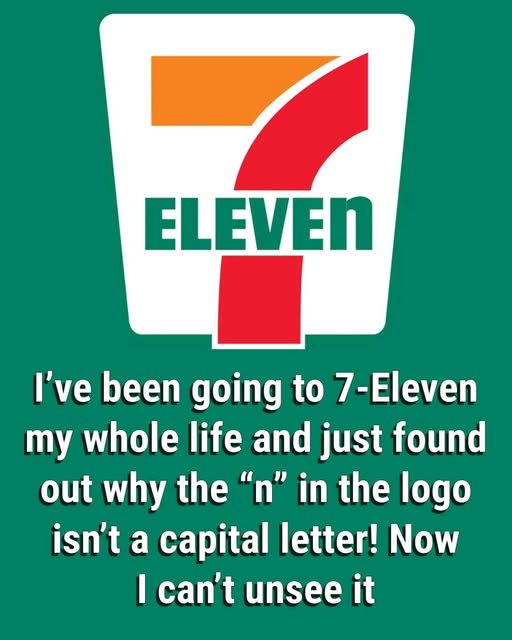
Yet for those who take a closer look, one small detail begins to stand out. The word “Eleven” in the logo contains a subtle difference that many people overlook for years.
While the first letters appear in uppercase, the final letter “n” is written in lowercase.
Once someone notices this unusual choice, it can be difficult to ignore. The lowercase letter suddenly feels out of place in a logo that otherwise appears bold and structured.
The Moment People Notice the Difference
Many individuals describe the same experience when they finally spot the lowercase letter. They have seen the sign countless times, yet only after a moment of close observation does the detail become clear.
At first, the small difference can appear accidental. Some people assume it must be a printing mistake that was never corrected.
Others wonder whether it might be part of a hidden message or a design code that carries a deeper meaning.
The truth, however, is far simpler. The lowercase “n” was intentionally chosen and has remained part of the brand’s identity for decades.
Rather than being an error, the detail reflects a thoughtful design decision made during the early development of the company’s logo.
The Early Days of the Brand
Long before the recognizable logo appeared on storefronts, the company operated under a different name. The stores were originally known as Tote’m Stores.
These early locations offered customers a convenient place to purchase everyday items. Over time, the business grew and evolved, eventually adopting a new identity that better reflected its hours of operation.
The name 7-Eleven was introduced to highlight the store’s extended schedule. At the time, being open from early morning until late evening represented a significant convenience for customers.
As the brand expanded, a distinctive logo was developed to help the stores stand out. The design featured bold numbers and bright colors that would become closely associated with the company.
The Creation of the Iconic Logo
The logo that emerged combined several visual elements. The large number “7” appeared prominently at the top, while the word “Eleven” was placed beneath it.
The colors chosen for the design included red, orange, and green. These bright tones helped attract attention and made the sign visible from a distance.
When the logo was first created, the entire word “ELEVEN” was written in uppercase letters. This style gave the sign a strong and confident appearance.
However, the design also created an unintended effect. The combination of bold colors, large numbers, and fully capitalized lettering made the logo feel somewhat intense.
While it clearly captured attention, the visual tone felt slightly rigid.
A Small Suggestion That Changed the Design
According to the company’s long-shared story about the logo’s creation, the solution came from an unexpected place.
The president’s wife offered a simple suggestion while looking at the design. She believed the word “ELEVEN” looked too severe when every letter was capitalized.
Her idea was straightforward. By changing the final “N” to lowercase, the word would appear softer and more approachable.
The adjustment was small, but it subtly transformed the overall feel of the logo.
Instead of appearing rigid and forceful, the design suddenly looked friendlier and more inviting.
The Impact of One Lowercase Letter
At first glance, the change might seem insignificant. It involved modifying only a single character in a word.
Yet small details can have a powerful influence on visual perception. The lowercase letter introduced a gentle curve that balanced the strong lines of the rest of the design.
This subtle shift helped create a more welcoming impression for customers.
The design maintained its bold presence while gaining a touch of personality that made it easier for people to connect with.
Once the change was made, the company kept the lowercase “n” as a permanent part of the logo.
Why the Design Still Feels Memorable
Over the years, the logo has remained remarkably consistent. While minor adjustments have occurred in various branding updates, the distinctive lowercase letter has stayed exactly where it is.
This consistency has helped the brand maintain a recognizable identity across generations of customers.
The unusual detail also contributes to the logo’s memorability. Even if most people do not consciously notice the lowercase “n,” it creates a subtle visual signature.
When someone finally spots the difference, it often becomes a small moment of surprise.
That moment reinforces the uniqueness of the design.
The Psychology Behind the Change
Designers often use small visual adjustments to influence how people perceive a brand. Elements such as color, typography, and spacing can affect whether something appears friendly, formal, energetic, or calm.
In this case, the lowercase letter helped soften the overall appearance of the logo.
Uppercase text can sometimes feel loud or forceful because every letter stands tall and uniform. Introducing a lowercase character breaks that pattern and creates a more relaxed visual rhythm.
This tiny modification helped transform a bold logo into one that felt both strong and approachable.
Such subtle design choices often go unnoticed, yet they play a major role in shaping how brands are perceived.
A Detail That Stands the Test of Time
Decades have passed since the logo first appeared on store signs. During that time, the brand has expanded into countless locations across many regions.
Despite changes in technology, marketing trends, and store design, the core visual identity has remained remarkably stable.
The bright color scheme, the prominent number seven, and the distinctive lowercase letter all continue to define the brand’s look.
This consistency has helped ensure that the sign remains instantly recognizable.
Customers who see it from a distance can identify the store immediately.
The Power of Small Design Decisions
The story behind the lowercase “n” demonstrates how a small suggestion can shape an entire brand identity.
What began as a simple observation about typography turned into a defining feature that has lasted for generations.
Design history often includes similar moments where minor adjustments make a lasting impact.
A slight change in lettering, spacing, or color can alter how a logo feels and how people respond to it.
In this case, one lowercase letter helped turn a convenience store sign into a memorable symbol recognized around the world.
A Detail Hidden in Plain Sight
Most people will continue walking past the familiar sign without noticing the unusual lettering. For them, the logo simply represents a convenient place to stop for everyday items.
But for those who eventually spot the lowercase “n,” the discovery adds a new layer of curiosity to something they have seen countless times before.
The detail reminds us that even the most familiar designs often contain thoughtful choices hidden within them.
Sometimes, the smallest element in a design is the one that quietly shapes how the entire image feels.
In the case of the 7-Eleven logo, one tiny letter has played that role for decades.