
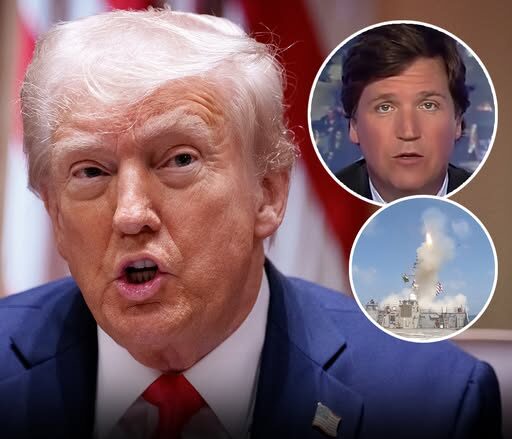
Military Strikes on Iran Spark Global Tensions and Deep Divisions Within Trump’s Political Base
Coordinated U.S.–Israeli Operations Mark Major Escalation
Military operations carried out by Israel and the United States against Iranian targets have set off significant international consequences while also exposing sharp political divisions within President Donald Trump’s support base.
According to U.S. officials, coordinated American and Israeli strikes targeted positions in Tehran on February 28. The operation represents one of the most direct confrontations between Washington and Tehran in decades.
Reports indicate that Iran’s Supreme Leader, Ayatollah Ali Khamenei, was killed during the strikes. Numerous senior Iranian officials were also reportedly eliminated as part of the operation.
In a televised interview with Fox News, President Trump characterized the campaign as a major success and suggested that momentum remained firmly on the side of U.S. forces.
“It’s moving along. It’s moving along rapidly. This has been this way for 47 years,” he said.
He added: “Nobody can believe the success we’re having, 48 leaders are gone in one shot.”
The remarks underscored the administration’s framing of the operation as a decisive blow against long-standing Iranian leadership structures.
American Casualties and Iranian Retaliation
The U.S. Central Command (CENTCOM) confirmed that three American service members were killed during the ongoing military action. Five additional service members were reported to have suffered serious injuries.
In response to the coordinated strikes, Iran launched retaliatory missile and drone attacks aimed at U.S. military installations throughout the Gulf region.
Targets reportedly included American bases located near Bahrain, Qatar, and Dubai. The retaliatory strikes signaled a rapid and direct response from Tehran.
President Trump later stated that U.S. combat operations would persist until objectives were fulfilled.
He warned Iranian security forces to “lay down your arms and receive full immunity or face certain death.”
The administration defended the continued military campaign by arguing that Iran’s development of long-range missile systems and potential nuclear capabilities posed a severe national security threat to the United States.
Strategic Justifications and Security Concerns
Officials aligned with the administration have emphasized that the operation is designed to neutralize what they describe as persistent threats from Tehran.
The broader strategy reportedly includes targeting key nuclear facilities. Earlier actions were said to have focused on sites in Fordow, Natanz, and Isfahan following Israeli strikes on military infrastructure.
Supporters of the campaign argue that failing to act would allow Iran to further expand its military reach and capabilities.
The administration’s position maintains that decisive action now could prevent larger-scale conflict in the future.
Growing Conservative Backlash Emerges
Despite the administration’s framing of the operation as necessary for national defense, several prominent conservative voices have publicly criticized the move.
Independent journalist Tucker Carlson, who had previously defended Trump during his tenure at Fox News, condemned the decision during an interview with Jon Karl.
Carlson described the military action as “absolutely disgusting and evil.”
He further stated that he had personally advised Trump against authorizing strikes during a recent meeting.
The unusually strong language marked a notable shift from his earlier support and highlighted emerging fractures within segments of the conservative movement.
Criticism From Republican Figures
Former congresswoman Marjorie Taylor Greene also expressed opposition, criticizing what she characterized as continued American involvement in foreign wars.
“Thousands and thousands of Americans from my generation have been killed and injured in never ending pointless foreign wars and we said no more. But we are freeing the Iranian people. Please.”
She questioned the framing of the operation as a liberation effort and suggested that Iran’s internal political trajectory should not be directed by the United States.
Senator Rand Paul raised constitutional concerns, pointing to Congress’s authority over declarations of war.
“The Constitution conferred the power to declare or initiate war to Congress for a reason, to make war less likely… As with all war, my first and purest instinct is wish American soldiers safety and success in their mission. But my oath of office is to the Constitution, so with studied care, I must oppose another Presidential war.”
His remarks emphasized the constitutional balance of powers and echoed longstanding debates over executive authority in military decisions.
Conservative commentator Matt Walsh also questioned the broader rationale for intervention.
“As Americans, the freedom of Iranians is not our responsibility. If a single American life is lost in the service of that goal, it will be a travesty.”
Walsh argued that U.S. foreign policy decisions should be evaluated strictly through the lens of national interest rather than humanitarian aspirations.
Deepening Ideological Divisions
The unfolding situation appears to be intensifying ideological divisions within the conservative coalition.
One faction prioritizes aggressive national security measures and views the strike as a necessary demonstration of strength.
Another faction advocates for restraint, constitutional limits on executive war powers, and a reduced role in overseas conflicts.
The debate reflects a broader philosophical split over the future direction of American foreign policy.
For some, confronting Iran directly represents a proactive defense strategy. For others, it signals the risk of prolonged engagement in another costly regional conflict.
International and Domestic Implications
Internationally, the escalation raises concerns about regional stability and the potential for broader confrontation.
The deaths of high-ranking Iranian officials, including the reported killing of the country’s Supreme Leader, represent a dramatic development with unpredictable geopolitical consequences.
Iran’s retaliatory strikes on U.S. installations illustrate how quickly such confrontations can expand.
Domestically, the political fallout may prove equally significant. Public opinion within the United States remains divided on foreign military interventions.
The clash between executive authority and congressional oversight could become a focal point of debate in the weeks ahead.
Additionally, the internal disagreements among prominent conservative figures suggest that the issue may reshape alliances and narratives within the movement.
Uncertain Path Forward
As military operations continue, the long-term strategic outcome remains unclear.
The administration maintains that its objectives are defined and focused on neutralizing long-standing threats.
Critics caution that the risk of extended engagement and unintended consequences remains substantial.
Both the international ramifications and the domestic political consequences are still unfolding.
With casualties already confirmed and retaliatory strikes underway, the situation stands as one of the most consequential moments in U.S.–Iran relations in recent history.
Whether the operation ultimately strengthens U.S. security or deepens geopolitical instability will depend on developments in the days and weeks ahead.
At home, the debate over the balance between national defense, constitutional authority, and the limits of American intervention abroad is likely to intensify as events continue to evolve.