
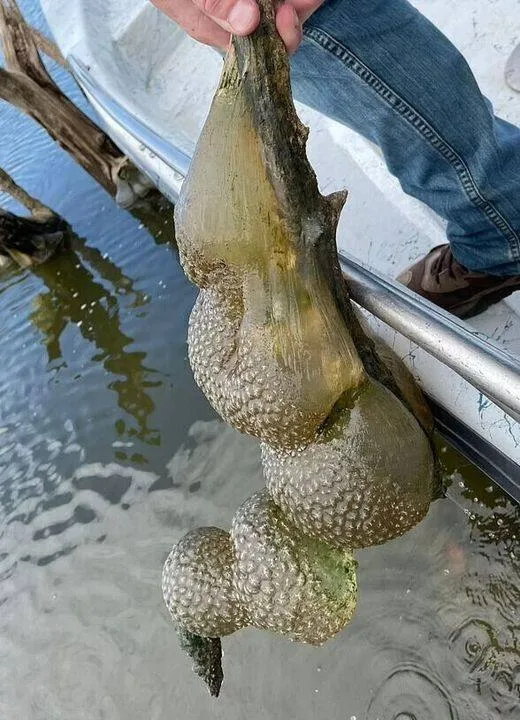
Alien Egg Pods in Oklahoma Lakes Turn Out to Be an Ancient Freshwater Species
A Strange Discovery Draws Public Attention
Residents in Oklahoma have been reacting with a mix of surprise and unease after unusual jelly-like masses began appearing in lakes across the region. Their odd shape, soft appearance, and clustered interior have led many people to compare them to something from a science-fiction story.
Photos shared online quickly fueled the mystery. Some viewers described the formations as “alien egg pods,” while others joked that they looked like something waiting to hatch beneath the water’s surface.
The growing attention around these objects has brought curiosity as well as concern. For many people seeing them for the first time, the formations seemed too bizarre to be a familiar part of a natural freshwater environment.
Wildlife Officials Say There Is No Reason for Alarm
Despite their unsettling look, the strange masses are not dangerous. Wildlife officials in Oklahoma have made it clear that these formations are harmless and do not pose a threat to people, fish, or other creatures living in the water.
They have identified the objects as bryozoans, a group of ancient aquatic microorganisms that have existed for hundreds of millions of years. What may look unusual to lake visitors is actually part of a long-established and natural freshwater system.
Officials have even issued a simple message to calm public reaction: “Don’t be alarmed if you see these strange jelly-like balls hanging from submerged tree limbs.” That warning is less about danger and more about reassuring anyone startled by the unexpected sight.
The appearance of bryozoans in Oklahoma lakes is not a sign of contamination, invasion, or a hidden hazard. In fact, their presence is often linked to healthy water conditions.
What Bryozoans Actually Are
Bryozoans are colonial organisms, which means they live together in connected groups rather than as large single animals. Each tiny member of the colony is known as a zooid, and each zooid measures only about 4 millimeters.
On their own, these tiny organisms would be easy to overlook. When they reproduce and gather in large colonies, however, they create the soft, gelatinous masses that have caught so much attention in Oklahoma lakes.
These colonies can resemble sacks filled with tiny rounded structures, which is one reason so many observers have mistaken them for eggs. Their unusual texture and appearance can seem unnatural at first glance, especially when seen attached to branches or other underwater surfaces.
In reality, bryozoans are not new, and they are certainly not alien. They have existed for an immense span of time, even longer than the age of the dinosaurs.
An Ancient Life Form Still Thriving Today
One of the most remarkable facts about bryozoans is their age. These organisms have been part of Earth’s waters for hundreds of millions of years, making them one of the oldest life forms still living in freshwater environments today.
Their long survival reflects how well adapted they are to their surroundings. While their appearance may seem fragile or odd, they have endured major environmental changes over vast stretches of natural history.
This ancient lineage adds to the fascination surrounding their discovery. What first looked to some people like a strange new phenomenon is actually a glimpse at a form of life that has been present on the planet for an extraordinarily long time.
That history makes the public reaction understandable. Seeing something so unfamiliar can be unsettling, especially when it turns out to be a species older than many better-known animals.
How the Colonies Grow and Form
Bryozoans reproduce in a way that allows their colonies to expand steadily over time. The organisms possess both male and female reproductive organs, and they also grow by cloning themselves.
As more zooids are added, the colony becomes larger and more noticeable. This process creates the gooey, ball-like formations that can cling to submerged surfaces in lakes and other freshwater settings.
Their colonies are commonly attached to rocks, branches, docks, and other structures that remain underwater. Submerged tree limbs are especially common places to find them, which is why lake visitors sometimes spot them hanging just below the surface.
Because the colony functions as a group rather than as a single individual, it can reach a size that makes it much easier for people to notice. That is often when surprise turns into curiosity.
The Jelly-Like Texture Has a Natural Explanation
The soft and slippery feel of bryozoan colonies comes from a material called chitin, which forms their outer shell. This gives them their unusual gelatinous look in the water.
Although the colonies appear delicate, the chitin can become harder once it dries out. That ability helps preserve the bryozoans until they are exposed to moisture again.
This shifting texture adds to the mystery for anyone seeing them up close. In water, they look almost like living jelly. Out of water, they can change in consistency, making them seem even more unusual.
Even so, the structure is entirely natural. What feels strange to the touch is simply part of how these organisms survive in changing freshwater conditions.
A Role Similar to Coral, but More Fragile
Bryozoans are sometimes compared to coral because both are colonial organisms that build shared structures. The comparison helps explain how many small living units can come together to form something much larger.
There is, however, an important difference between the two. Coral reefs create sturdy calcium carbonate structures that can remain in place for very long periods, even after the organisms themselves are gone.
Bryozoans also create calcium carbonate structures, but their colonies are far more fragile and much less permanent. They do not form the massive, enduring reef systems associated with coral.
This temporary quality is part of what makes them distinctive. Their colonies are delicate, seasonal, and closely tied to the specific conditions of freshwater habitats.
Why They Matter to Lake Ecosystems
While their appearance may attract attention, their environmental role is even more significant. Bryozoans contribute to water quality by acting as filter feeders.
As they feed, they consume tiny particles from the water, including plankton. This process helps keep the aquatic environment balanced and supports cleaner conditions within the lake.
Their presence can therefore be seen as a positive sign. Rather than indicating a problem, bryozoan colonies often suggest that the water is in relatively good condition.
These organisms also help sustain other forms of life. Mussels, snails, and small fish benefit from bryozoans as a food source, making them part of the wider food web within freshwater ecosystems.
A Seasonal Life Cycle Beneath the Surface
Bryozoan colonies do especially well during warmer months, when environmental conditions support their growth. During this period, they can become large enough to be seen by swimmers, boaters, and people spending time near the water.
As temperatures drop, the colonies begin to die off. Their visible presence in lakes becomes less common as cooler weather changes the conditions they depend on.
Before the colonies disappear, they leave behind tiny egg sacs known as statoblasts. These structures play an important role in continuing the life cycle.
When conditions improve again, usually in the spring, the statoblasts help generate new bryozoan colonies. This cycle allows the organisms to return year after year even when the original colonies do not survive the colder season.
Public Reaction Ranges From Fear to Humor
Not everyone seeing bryozoans for the first time responds with scientific curiosity. Many people have reacted emotionally, especially after spotting the colonies in places where they swim or boat.
One Facebook user summed up that discomfort by saying, “All I can imagine is if I touched it or it touched me while I was swimming. I would freak out!” The comment reflects the instinctive reaction many people have when they encounter an unfamiliar creature in the water.
Another person wrote, “Great, another creepy thing to make me jumpy while in the water.” That response captures how easily unusual wildlife can make ordinary outdoor experiences feel unsettling.
Others have taken a lighter approach. A third commenter joked, “That’s what the government wants you to think—aliens are real!”
The range of reactions shows how powerful appearance can be. Even harmless organisms can spark major attention when they look strange enough to challenge expectations.
Found Across Much of the World
Bryozoans are not limited to Oklahoma. They are native to many parts of the world, including North America, and can be found on every continent except Antarctica.
The reason they do not survive there is simple: the waters are too cold. Outside of that extreme environment, they are able to live in many freshwater systems where conditions support their growth and reproduction.
Their spread through waterways can happen naturally. Lakes and rivers connected to one another allow these organisms to move through broader freshwater networks over time.
They can also be transported unintentionally by birds and fish. As those animals move between water bodies, they may carry bryozoans through their intestinal tracts, helping the species appear in new areas.
A Reminder of Hidden Freshwater Diversity
The attention surrounding these so-called alien pods highlights a larger truth about lakes and rivers: many important organisms live below the surface without drawing notice. Bryozoans are one example of how much unseen life helps support freshwater ecosystems.
Because they are microscopic at the individual level, most people never think about them until the colony becomes large enough to be visible. Once seen, their strange appearance can overshadow the useful role they play.
Yet these colonies are part of the ongoing work of keeping aquatic environments functioning properly. They filter water, support other species, and participate in seasonal cycles that have continued for ages.
What first appears frightening or unnatural can, with a closer look, reveal itself as a normal and even beneficial part of the environment.
No Threat, Just an Unusual Sight
For anyone who comes across one of these gelatinous masses while swimming, boating, or exploring a lake shoreline, the message is simple. There is no reason to panic.
Bryozoans are harmless, ancient, and deeply connected to the health of freshwater habitats. Their odd shape may continue to spark comments and jokes online, but their presence is far from a warning sign.
Instead, these colonies can be viewed as evidence that nature still holds surprises in places many people think they already understand. Beneath the surface of ordinary lakes, unusual life forms continue to thrive quietly.
The next time one of these jelly-like colonies appears in view, it may still look strange. But rather than an alien mystery, it is simply another example of the complexity and wonder of the natural world at work.
Yeah