
Part 2 of 2
Once you understand what controls yolk color, the mystery becomes much simpler.
Dark orange does not automatically mean healthier.
Pale yellow does not automatically mean lower quality.
In most cases, the difference reflects feed.
Carotenoids are the natural pigments that give many plants their yellow, orange and red tones.
When hens eat more carotenoid-rich ingredients, those pigments can accumulate in the yolk.
That is why feed containing corn, alfalfa, grass or marigold can produce deeper yellow or orange yolks.
But producers can also deliberately adjust feed to create a preferred yolk shade.
That means color can be influenced intentionally.
A rich orange yolk may look more appealing, but appearance alone does not prove better welfare or dramatically better nutrition.
Likewise, a pale yolk may simply come from a different feed formula.
The hen can still be healthy.
The egg can still be perfectly normal.
So what should consumers pay more attention to?
Freshness matters.
Storage conditions matter.
Clean handling matters.
Farm hygiene matters.
And the overall quality of the hen’s diet matters far more than the final shade of the yolk.
Housing and animal-care standards are also important when judging how hens were raised.
None of those things can be reliably determined simply by cracking an egg and looking at its color.
Nutritionally, eggs remain a concentrated source of important nutrients across a wide range of yolk shades.
They provide high-quality protein.
They also contain nutrients such as vitamin B12, selenium and choline.
Eggs can also contribute vitamin D, although the exact amount can vary depending on factors such as the hen’s diet.
That last point is important.
Not every egg is nutritionally identical.
Feed can influence certain nutrients.
But yolk color itself is not a reliable shortcut for measuring those differences.
A darker color may sometimes accompany a different nutritional profile because of what the hen ate.
But the color is not proof by itself.
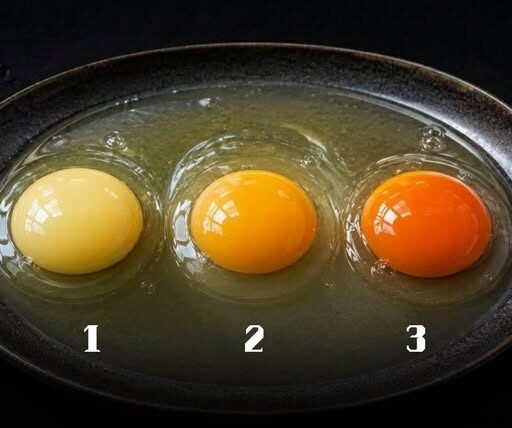
This is why dramatic side-by-side photos on social media can be misleading.
A pale yolk beside a dark orange yolk certainly looks different.
But that photograph cannot tell you whether one hen was healthier.
It cannot tell you whether one bird had more space.
It cannot reveal whether one farm maintained better hygiene.
And it cannot tell you exactly how nutritious each egg is without more information.
Color is simply one visible characteristic.
It is not a complete report card on the chicken.
If you want to make a more informed choice, look beyond the yolk.
Check how the eggs were produced.
Consider freshness and proper storage.
Look at credible information about farming and feeding practices when it is available.
And do not assume that the darkest yolk automatically represents the best egg.
In the end, pale yellow, golden and deep orange yolks can all come from healthy hens.
The most important lesson is simple.
Yolk color tells you much more about what the chicken ate than it does about how healthy the chicken was.