
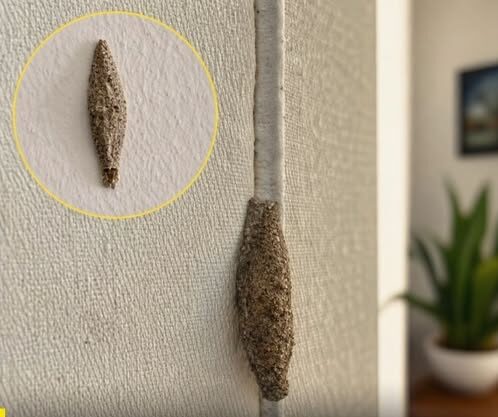
Those Tiny “Dirt Flakes” on Your Walls May Actually Be Bagworms
The Small Specks That Are Easy to Ignore
At first, they can look completely harmless.
You may notice what appears to be a tiny piece of dirt stuck to the ceiling, a small crumb attached to the wall, or an unusual bit of fuzz near a corner of the bedroom.
Because the object is so small and motionless, it is easy to assume that it is simply dust or debris that has somehow become stuck to the surface.
Then another one appears.
A few days later, you may notice several more near the ceiling, along baseboards, behind furniture, inside closets, or around the bed.
At that point, the strange pieces of “dirt” may deserve a closer look.
In some cases, what appears to be ordinary household debris may actually be a bagworm larva carrying a protective case made from material collected inside the home.
Why Bagworms Can Look Like Dust or Lint
Bagworms are especially easy to overlook because their protective coverings blend into their surroundings.
The larvae create small portable cases using whatever material is available nearby.
That can include dust, lint, loose hair, spider webs, fabric fibers, and other tiny household particles.
Instead of looking like an obvious insect, the result can resemble a dry piece of debris attached to a wall.
The case acts as both shelter and camouflage.
Because the materials come directly from the surrounding environment, the covering can closely match the colors and textures of the room where the larva is living.
A bagworm on a dusty wall may therefore look like another speck of dust. One hiding near clothing or bedding may resemble a loose fiber.
This ability to disguise itself helps explain why homeowners sometimes overlook them until several become visible.
A Portable Shelter Built From Household Debris
The larva does not simply hide beneath lint or dust that happens to be nearby.
It gathers small pieces of material and combines them into a protective structure that it carries with it.
Hair, lint, fragments of fabric, dust, and pieces of old spider webs can all become part of the case.
The appearance can vary depending on what materials are available in the room.
In one part of the home, a case may look gray and dusty. In another, it may contain more visible fibers or hair.
The small structure can then be attached to walls, ceilings, furniture, baseboards, or other protected surfaces.
When the larva remains still, the entire object may look lifeless.
That is why people often dismiss the first few as harmless dirt.
Where They Are Most Likely to Hide
Bagworms tend to benefit from areas of the home that remain quiet and undisturbed.
Bedrooms can provide several suitable hiding places, especially around headboards, under beds, behind dressers, and near ceiling edges.
Closets may also provide a comfortable environment because they often contain fabric, lint, hair, and areas that are not cleaned as frequently as open living spaces.
Baseboards and room corners are another common place to notice small cases.
These locations can accumulate dust and cobwebs, giving the larvae both building material and food sources.
Furniture that remains in the same position for months can create especially protected areas.
The narrow gap behind a wardrobe, bedside table, cabinet, or headboard may receive very little attention during ordinary cleaning.
As dust and webbing accumulate, the space becomes increasingly suitable for organisms that depend on this type of material.
Why Bedrooms Can Become a Comfortable Environment
A bedroom may appear clean while still containing undisturbed areas where dust and fibers collect.
The visible center of the room may be vacuumed regularly, but the spaces under the bed, behind furniture, and along ceiling edges are easier to forget.
Hair and fabric fibers are also common in bedrooms because of clothing, blankets, sheets, carpets, and upholstered furniture.
When these materials collect together with cobwebs and dust, they can provide bagworms with what they need to construct their protective cases.
The area near a headboard can be particularly easy to overlook.
If the bed remains against the same wall for a long period, dust may accumulate between the furniture and the wall without being noticed.
That can create a quiet hiding place only a short distance from where people sleep.
The discovery can be unsettling, but the presence of a few bagworms does not automatically mean that a home is experiencing a serious infestation.
A Few Bagworms Do Not Necessarily Mean Disaster
Seeing several small cases on the wall may immediately create concern that hundreds of insects are hidden throughout the house.
That conclusion is not always justified.
A small number of bagworms can simply indicate that certain parts of the home have remained undisturbed long enough for them to find shelter and suitable material.
In that sense, they can act as a visible sign that some overlooked areas need more thorough cleaning.
The appearance of a few cases should therefore be treated as a reason to inspect and clean the surrounding area rather than as proof of a major household emergency.
The most useful response is usually to remove the visible cases and reduce the conditions that allowed them to remain there.
Start With the Corners and Ceiling Edges
Regular vacuuming is one of the simplest ways to make the environment less suitable for bagworms.
Instead of focusing only on the floor, cleaning should include corners where walls meet ceilings.
These edges can collect cobwebs and dust that remain untouched during routine cleaning.
A vacuum attachment can be used to reach the upper corners of rooms and remove both visible cases and the debris surrounding them.
Ceiling edges should also be checked carefully, especially in bedrooms, bathrooms, closets, and laundry areas.
If an object that looks like a small piece of lint appears firmly attached to the wall, it can be removed during cleaning rather than left in place.
Reducing accumulated dust means reducing the amount of material available for new protective cases.
Baseboards Are Another Important Area
Baseboards often collect dust, hair, lint, and other small particles.
Because they run along the perimeter of a room, they also contain many quiet sections hidden behind furniture.
Vacuuming or wiping baseboards regularly removes the debris that can support bagworms.
Extra attention should be given to the sections behind beds, cabinets, couches, and other heavy furniture.
Cleaning only the exposed portions may leave large undisturbed areas untouched.
Pulling furniture away from the wall occasionally can reveal buildup that is invisible during everyday cleaning.
These hidden spaces may contain old cobwebs, dust clusters, hair, and lint.
Removing those materials makes the area less attractive as a shelter.
Do Not Forget Cobwebs
Old spider webs can become part of the material bagworms use in their cases.
That makes cobweb removal an important part of reducing their hiding opportunities.
Webs can accumulate in ceiling corners, behind doors, beneath shelves, near windows, and behind large pieces of furniture.
Even an empty web that no longer contains a spider can remain in place for months if the area is rarely disturbed.
Removing these webs also removes one of the materials that can help the larvae blend into the surrounding room.
Regular cleaning prevents the buildup from becoming established again.
Closets Need More Than Surface Cleaning
Closets can provide especially favorable conditions because they contain clothing, fabric fibers, lint, and areas with limited movement.
Items stored for long periods may remain untouched while dust gradually settles around them.
Periodically rearranging and cleaning the closet can disrupt these quiet spaces.
Clothing and other fabrics can be shaken out, while floors, corners, shelves, and baseboards can be vacuumed or wiped.
The goal is not simply to make the closet look organized.
It is to remove the loose materials and sheltered areas that allow small pests to remain unnoticed.
Even a closet that appears tidy from the doorway may have heavy dust accumulation behind boxes or beneath hanging garments.
Laundry Rooms and Bathrooms Can Collect Lint Too
Laundry rooms are another place where fibers and lint naturally accumulate.
Loose material can settle behind appliances, around baseboards, and in corners that are difficult to reach.
Bathrooms may also contain hair, dust, and webbing around ceiling edges and behind fixtures.
Cleaning these areas regularly limits the amount of material available for the protective cases.
It also makes it easier to notice unusual objects before several accumulate.
A small case standing out against a recently cleaned wall is much easier to identify than one surrounded by months of dust and lint.
Move Furniture Occasionally
One of the most effective changes is also one of the most commonly overlooked: moving furniture during deeper cleaning.
A bed, dresser, couch, or wardrobe may remain in exactly the same position for years.
During that time, dust and fibers continue collecting in the narrow space behind it.
Because those areas receive little light or disturbance, they can become ideal hiding places.
Pulling furniture forward allows the wall, floor, and baseboard behind it to be cleaned completely.
The same approach can be used beneath beds and larger cabinets.
This does not need to happen every day.
Occasional thorough cleaning can prevent long-term buildup and make the area much less hospitable.
Why Regular Cleaning Works
Bagworms depend heavily on the environment around them.
When dust, lint, old webbing, loose hair, and fabric fibers remain available, they have plenty of material for building their cases and finding protected places to stay.
When those materials are repeatedly removed, the environment becomes far less convenient.
Vacuuming also physically removes many visible cases before they remain attached for longer periods.
Wiping walls and baseboards removes debris that a vacuum may miss.
Clearing cobwebs eliminates another source of shelter and camouflage.
Together, these simple habits repeatedly disturb the locations where the larvae prefer to hide.
Pay Attention When the “Dust” Seems to Move
The first clue is often not the appearance of the case itself but a subtle change in position.
A speck that appeared near one corner may later seem slightly lower on the wall.
Another may appear where no debris had been visible before.
Because the larvae carry their cases, what appears to be an inanimate piece of lint may eventually move.
That small movement can be enough to reveal that the object is not ordinary household dirt.
Rather than panicking, remove the case and inspect the surrounding area for additional buildup.
A quick response can prevent neglected corners from remaining comfortable hiding places.
A Simple Warning From an Overlooked Corner
Discovering strange, dust-covered cases around a bedroom or closet can feel disturbing, especially when they have been hiding only a short distance from where people sleep.
However, the presence of a few does not automatically indicate a severe problem.
More often, they are a reminder that hidden areas of the home can accumulate far more debris than the spaces we see every day.
The solution begins with consistent housekeeping.
Vacuum ceiling edges and corners. Remove old cobwebs. Clean baseboards thoroughly. Move furniture from time to time. Shake out stored fabrics and keep closets, laundry rooms, and bathrooms free of unnecessary lint and dust.
These habits remove both the shelter and the materials that make bagworms difficult to notice.
Once those neglected areas are regularly disturbed and cleaned, the mysterious “dirt flakes” clinging to the walls become much less likely to return.