
Which Glass Holds the Most Water? The Simple Puzzle That Tests How Closely You Observe
Four Glasses and One Deceptively Simple Question
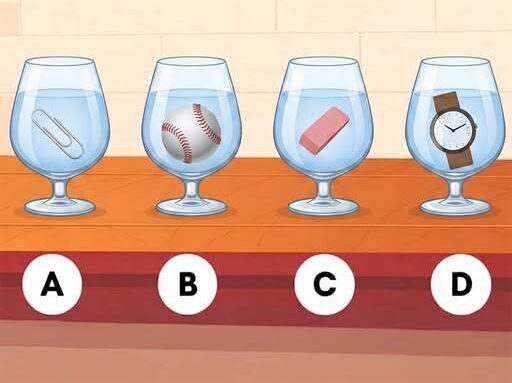
At first glance, the puzzle appears almost too easy. Four identical glasses are arranged side by side and labeled A, B, C, and D.
Each glass seems to be filled to approximately the same level. However, every glass contains a different object beneath the water.
Glass A contains a paperclip. Glass B holds a baseball. Glass C contains an eraser, while Glass D holds a wristwatch.
The question asks which glass contains the greatest amount of water. Many people answer quickly by concentrating only on the visible waterline.
Because the levels appear similar, it can seem as though every glass contains an equal amount. The objects inside the glasses, however, completely change the answer.
The Important Detail Many People Miss
The puzzle depends on the amount of space each object occupies inside its glass. An object placed in water takes up room that would otherwise be available for water.
A larger object occupies more space inside the glass. As a result, the glass containing that object must hold less actual water when the visible water levels are similar.
A smaller object occupies less space. That leaves more room for water inside the glass.
The correct answer is therefore not determined by the height of the water alone. It depends on comparing the sizes of the objects beneath the surface.
This is what makes the puzzle effective. The most noticeable information is not necessarily the information that leads to the solution.
Why Glass A Contains the Most Water
Glass A contains the paperclip, which is the smallest of the four objects. Because it takes up the least amount of room, it displaces the smallest quantity of water.
This means more of the glass remains available to hold water. Among the four choices, Glass A therefore contains the greatest amount of actual water.
The baseball in Glass B is clearly the largest object. It occupies a significant portion of the available space and leaves less room for water.
The eraser in Glass C is larger than the paperclip but smaller than the baseball. Its displacement falls somewhere between those two objects.
The wristwatch in Glass D also occupies more space than the paperclip. Depending on its shape and size, it takes up a medium-to-large amount of room within the glass.
Since the paperclip is the smallest object, Glass A is the logical answer.
The Basic Logic Behind Water Displacement
When an object is placed into a container of water, it pushes aside an amount of water related to the space the object occupies beneath the surface.
This process is known as displacement. The water must move around the object because the object and the water cannot occupy the same space at the same time.
Imagine filling an empty glass halfway and then placing a large ball inside it. The waterline rises because the ball takes up part of the glass’s interior.
If a tiny paperclip were placed into an identical glass containing the same starting amount of water, the change would be much smaller. The paperclip simply does not occupy as much space.
In the puzzle, the waterlines appear similar after the objects have already been added. Therefore, the glass containing the smallest object must contain more water than the glasses containing larger objects.
Why the Baseball Can Be Misleading
Some people choose Glass B because the baseball is the most visually dominant object. Its large size immediately attracts attention and can make that glass appear fuller than the others.
However, the baseball’s size is precisely why Glass B cannot contain the most water. Much of the apparent fullness comes from the object itself rather than the amount of water surrounding it.
This demonstrates how easily visual prominence can influence a quick decision. People often focus first on the largest, brightest, or most obvious part of an image.
The puzzle rewards anyone who pauses and considers what is taking up space beneath the visible surface.
What appears to be the fullest glass may actually contain less water because a large object is responsible for much of the occupied volume.
What Choosing Glass A May Suggest
Someone who chooses Glass A likely notices small but important details. Rather than focusing only on the waterline, that person considers how the object inside each glass affects the answer.
This choice may reflect an analytical approach to problems. A person who selects A may prefer to examine the complete situation before reaching a conclusion.
In everyday relationships, this same habit can appear as thoughtful generosity. Such people may pay attention to quiet needs that others overlook.
They may understand that meaningful support does not always need to be dramatic. A small action offered at the right moment can sometimes matter more than a large public gesture.
The paperclip choice can therefore be associated with intentional giving. The person may think carefully about what others need instead of responding impulsively.
This does not prove anything definite about someone’s personality. It simply offers a playful way to consider how attention to detail can influence both problem-solving and relationships.
What Choosing Glass B May Suggest
People who select Glass B may be responding to the most noticeable object in the picture. The baseball dominates the glass visually, making it difficult to ignore.
This choice may suggest a tendency to focus on what stands out first. Large gestures, obvious problems, and highly visible details may receive immediate attention.
In relationships, that approach can sometimes resemble a taker mindset, although it does not automatically indicate selfishness. It may simply mean that visible information has a stronger influence than hidden details.
A person who chooses B might respond quickly to dramatic situations but overlook quieter signals. Slowing down and examining what lies beneath the surface could lead to a different conclusion.
The lesson connected with this choice is not that the person is uncaring. Instead, it highlights how first impressions can guide judgment before all the information has been considered.
Looking beyond the largest object may reveal details that are more important than what initially attracts attention.
What Choosing Glass C May Suggest
Glass C contains the eraser, an object that falls between the smallest and largest choices. Someone selecting this glass may naturally prefer moderate or balanced answers.
This person may be uncomfortable with extremes and more likely to search for a middle position. They may consider several possibilities before settling on a response.
In relationships, this approach may appear through reciprocity. The person may give generously in some situations while expecting equal effort in others.
They may adjust their behavior depending on the circumstances and the people involved. Fairness can be especially important to someone who identifies with the middle choice.
This flexibility can be useful because it allows the person to respond differently when situations change. However, choosing the middle answer does not always guarantee that it is correct.
The puzzle shows that balance and accuracy are not necessarily the same thing. Sometimes the answer truly lies at one end rather than in the center.
What Choosing Glass D May Suggest
The wristwatch in Glass D can attract people who search for symbolism or hidden meaning. A watch is associated with time, timing, memory, and the importance of particular moments.
Someone choosing D may think deeply about context rather than relying only on the obvious physical details. This person might wonder whether the watch has a special purpose within the puzzle.
Such an approach may reflect thoughtfulness, but it can also make simple decisions feel more complicated. The person may continue searching for additional meaning even when the practical answer is already visible.
In relationships, this tendency can lead to giving too much at certain times and holding back at others. Emotions and timing may strongly influence how the person responds.
The person may care deeply but struggle to decide exactly when or how to show that care. Their choices can be shaped by memories, expectations, and the meaning they attach to a situation.
Glass D therefore represents a style of thinking that values context but may occasionally overlook a straightforward explanation.
Givers and Takers Cannot Be Defined by One Puzzle
The personality descriptions connected to the glasses are intended as reflection rather than diagnosis. One answer cannot determine whether someone is permanently a giver or a taker.
Most people move between both roles. A person may be generous with time but protective of money, or emotionally supportive while needing practical help from others.
Behavior can also change depending on the relationship. Someone may give freely to close family members while acting more cautiously around people who have previously taken advantage of them.
The more useful question is not whether a person belongs to one fixed category. It is whether they understand the patterns that influence their decisions.
Do they notice quiet details, or do they respond mainly to what is most visible? Do they seek fairness, or do they attach deeper meaning to every choice?
The puzzle offers a simple opportunity to pause and observe those instincts.
Why Instinctive Answers Are So Interesting
Many visual puzzles ask people to respond quickly. The first answer often comes before the person has fully examined the scene.
That instinctive response can reveal which details attract attention first. Some people notice size, others notice position, and others search for patterns or symbolism.
In this puzzle, the visible waterline may encourage the assumption that each glass contains the same amount. The objects then create a second layer that requires more careful thought.
People who recognize displacement immediately are likely applying practical reasoning. Others may rely on visual appearance before reconsidering the problem.
Neither reaction defines a person completely. However, comparing the first impression with the correct explanation can show how easily perception influences judgment.
The exercise becomes more meaningful when people ask why a particular answer felt correct before they knew the solution.
Small Details Can Change the Entire Answer
The paperclip is the least dramatic object in the image. It is small, ordinary, and easy to overlook beside a baseball or wristwatch.
Yet that tiny object determines the correct answer. Because it occupies the least space, it leaves the greatest amount of room for water.
This creates a broader lesson about observation. Important information does not always appear in the largest or most impressive form.
A quiet detail can completely change how a problem should be understood. Missing that detail can lead to a confident but incorrect conclusion.
The same principle can apply to conversations and relationships. A small change in someone’s behavior may reveal more than a dramatic statement.
Careful observers often notice what is absent, understated, or hidden beneath the surface.
The Value of Pausing Before Deciding
Quick decisions are useful in many situations, but they can also be shaped by incomplete information. The four-glass puzzle encourages a brief pause before answering.
Instead of asking only which glass looks fullest, the viewer must ask what else is occupying the glass. That second question leads directly to the solution.
This habit can improve more than puzzle-solving. Pausing allows people to separate appearance from reality and consider factors that may not be immediately obvious.
In relationships, it can prevent misunderstandings. A person’s visible reaction may be influenced by experiences or concerns that are not openly expressed.
Looking closer does not require overcomplicating every situation. It simply means allowing enough time to notice the details that could change the conclusion.
The Correct Answer and the Larger Lesson
Glass A contains the most water because the paperclip is the smallest object. It displaces less water than the baseball, eraser, or wristwatch.
The physics behind the answer is simple, but the puzzle remains engaging because it challenges people to look beyond the waterline.
The optional personality meanings add another layer of reflection. Choosing A may suggest careful analysis, B may reflect attention to visible details, C may represent balance, and D may point toward symbolic or emotional thinking.
These interpretations should not be treated as fixed labels. They are simply prompts for considering how different people observe, decide, give, and respond.
The strongest message comes from the smallest object. The paperclip does not dominate the image, yet it holds the key to understanding the entire puzzle.
Sometimes the detail that appears least important carries the biggest truth.