
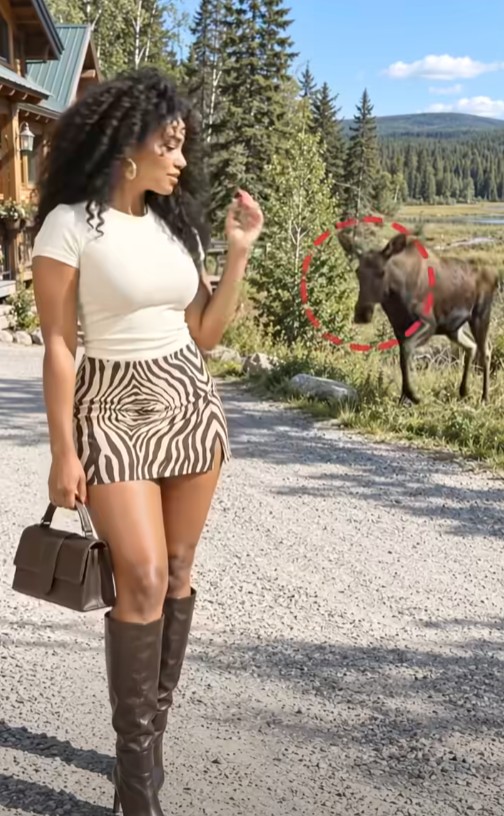
Woman Heard a Baby Moose Crying Beneath a Fallen Tree — Then She Noticed Its Mother Watching From the Forest
Sarah Mitchell Wanted to Save the Trapped Calf, but a Protective Mother Moose Stood Nearby. What Happened When Wildlife Rescuers Arrived Became an Unforgettable Encounter.
The first cry was so faint that Sarah Mitchell almost mistook it for the sound of wind passing through the trees.
She had been walking along a quiet forest trail, photographing autumn wildlife, when she heard it again. This time, the sound was unmistakable. Somewhere beyond the path, an animal was in distress.
Sarah stopped beside a fallen pine and looked through the tangled branches scattered across the forest floor.
Then she saw movement.
A young moose lay trapped beneath a pile of storm-damaged timber. Its long legs were tangled among the branches, and a heavy limb rested dangerously close to its hindquarters.
The calf struggled to lift its head and let out another frightened cry.
Sarah instinctively reached for her phone, preparing to call for help.
But before she could dial, something moved between the trees.
Less than forty yards away stood a full-grown female moose.
The animal was watching her.
And Sarah immediately understood that trying to rescue the calf herself could put both of them in serious danger.
The Mother Moose Refused to Leave Her Trapped Calf
The forest had been unusually quiet that morning. A storm several days earlier had brought strong winds, leaving broken branches and fallen trees across parts of the trail.
Sarah had planned to spend a few hours photographing the changing autumn landscape. She carried a camera, a small backpack, and enough water for the walk.
She had not expected to encounter an injured animal, much less one as large as a moose calf.
From a distance, she could see that the youngster was conscious. Its chest rose and fell rapidly, and it occasionally tried to pull its legs free.
Each movement caused the surrounding branches to shift.
The mother approached the fallen pine, lowered her head toward the calf, and sniffed the timber. After a moment, she stepped backward.
She circled the obstruction, searching for a way to reach her youngster.
But the largest limb was too heavy to move, and the smaller branches formed a tangled barrier around the calf.
Sarah watched helplessly.
She wanted to move the branches, but she knew that female moose can become extremely defensive when protecting their young.
Even a well-intentioned person approaching a calf may be perceived as a threat.
Sarah slowly backed away and took shelter behind a large tree, leaving plenty of distance between herself and the animals.
Then she called the regional wildlife emergency service.
A Wildlife Rescuer Warned Her Not to Approach
The dispatcher listened carefully as Sarah described the situation.
She explained that a calf was trapped beneath storm debris, that it appeared unable to stand, and that an adult female moose remained nearby.
The dispatcher immediately advised her to keep her distance.
A wildlife rescue worker named Daniel Foster was assigned to assess the situation.
Daniel had experience working around large wild animals and understood the dangers associated with approaching a protective mother.
He contacted Sarah while traveling toward the forest access road.
“Please don’t go near the calf,” he told her. “The mother may charge if she believes you’re threatening it.”
Sarah assured him that she was staying behind a tree near a marked trail.
Daniel asked several questions about the fallen timber, the calf’s movements, and the mother’s behavior.
He wanted to understand whether the calf was pinned beneath a heavy branch or simply tangled in smaller debris.
Sarah explained that one large limb appeared to be pressing against the branches surrounding the calf’s legs.
Daniel told her that the safest rescue might require additional personnel and a carefully controlled approach.
For the next several minutes, Sarah remained where she was, listening to the calf’s occasional cries.
The mother continued moving around the fallen tree, never wandering far from her youngster.
The Rescue Team Discovered a Dangerous Obstacle
When Daniel arrived, he carried basic rescue equipment, a first-aid kit, and a compact lifting tool.
He met Sarah along the trail and studied the scene through binoculars before moving any closer.
The calf remained trapped, but its head was raised. That was encouraging, although Daniel knew the animal could still be injured or exhausted.
The biggest concern was the arrangement of the fallen timber.
A large pine limb rested across several smaller branches, creating an unstable pile. Removing the wrong piece could cause the entire structure to shift.
Daniel also noticed a branch wedged near the calf’s front leg.
Attempting to pull the youngster free without first relieving the pressure could cause additional injury.
He contacted a wildlife supervisor and explained the hazards.
After discussing the situation, the team decided that a second ranger was needed to monitor the adult moose while Daniel assessed the obstruction.
Sarah was instructed to remain well away from the rescue area.
She understood why.
The mother moose was still standing nearby, occasionally turning her head toward the humans.
At one point, she moved closer to the fallen tree and lowered her head toward the calf.
The youngster responded with another cry.
Sarah could only imagine how frightening the situation was for both animals.
The Mother Finally Moved Toward a Clearing
As the team waited for additional help, the mother began moving toward a small clearing beyond the fallen pine.
She stopped several times and looked back at her calf.
Daniel watched her movements carefully.
He knew that distance alone did not guarantee safety. A moose could cover the ground between the clearing and the fallen tree in seconds.
When the second ranger arrived, the two rescuers reviewed their positions and established a plan for withdrawing if the mother approached.
The ranger would monitor the adult animal while Daniel worked near the debris, but only if conditions remained safe enough to proceed.
Sarah stayed at the observation point and kept her phone available.
The mother eventually moved farther into the clearing, partly hidden by the trees.
After another careful assessment, Daniel began approaching the fallen pine.
He moved slowly, watching both the calf and the unstable branches.
The youngster lifted its head when he came into view.
Daniel stopped briefly, allowing the animal to settle before continuing.
The First Attempt to Lift the Branch Barely Worked
Daniel began by removing loose branches from the outer edge of the pile.
He avoided pulling on anything that appeared to support the heavy pine limb.
Each movement was deliberate.
The calf shifted slightly, and Daniel paused whenever it began struggling.
He then positioned the lifting tool against a stable section of the timber.
His first attempt barely moved the obstruction.
The limb was heavier than he had expected.
He adjusted the tool and tried again, gradually raising the branch enough to reduce pressure on the smaller pieces beneath it.
Once the timber was supported, Daniel carefully removed the branch caught near the calf’s front leg.
The youngster immediately pulled its leg closer to its body.
For the first time, it had a little more room to move.
But the rescue was far from over.
Another section of the fallen pine still blocked the calf’s hindquarters.
And the mother had begun moving back toward the tree line.
A Sudden Movement Forced the Rescuers to Stop
The second ranger quietly alerted Daniel over the radio.
The mother moose had turned toward the rescue site and was approaching the edge of the clearing.
Daniel immediately stopped working.
He stepped away from the calf and withdrew toward a protected position, leaving the supported timber undisturbed.
The mother emerged between two trees.
For several tense moments, she stood watching the fallen pine.
Then she approached the calf and lowered her head.
The youngster made a soft sound and attempted to move its newly freed front leg.
Sarah watched from a distance, hoping the mother would not disturb the unstable branches.
Instead, the adult moose stood beside the obstruction for a short time before returning toward the clearing.
Daniel waited until she had moved away and the second ranger confirmed that the approach was safe enough to resume.
Only then did he return to the calf.
One Final Branch Was Keeping the Baby Moose Trapped
Daniel repositioned the lifting equipment and examined the remaining obstruction.
The calf’s front legs were now free, but its hindquarters were still caught beneath a heavy section of timber.
Moving the branch too quickly could cause it to roll toward the animal.
Daniel worked gradually, lifting the limb a little at a time while keeping himself clear of the unstable wood.
After several adjustments, the pressure on the calf’s hindquarters finally eased.
He removed the last loose branch and stepped backward.
For a moment, the youngster remained on the ground.
Then it stretched one front leg forward.
It shifted its weight, pushed against the forest floor, and attempted to rise.
Its first effort failed.
The calf sank back onto its chest, breathing heavily.
Daniel resisted the urge to move closer.
He wanted to give the youngster space to recover and assess whether it could stand without assistance.
After a short rest, the calf tried again.
This time, its front legs straightened.
Its hind legs trembled as it struggled to lift its body.
Then, slowly, the young moose stood.
The Calf Took Its First Unsteady Steps Toward the Trees
Sarah pressed a hand over her mouth as she watched the calf standing beside the fallen pine.
Its legs were shaky, and it seemed uncertain about moving.
Daniel and the second ranger remained at a distance, observing whether the animal could bear weight on all four legs.
The calf took one cautious step.
Then another.
It paused, turned its head, and looked toward the clearing where its mother had disappeared.
A moment later, the adult moose emerged from the trees.
Daniel immediately increased his distance from the calf, allowing the mother an unobstructed path.
The mother approached slowly.
She stopped near her youngster and lowered her head, sniffing around its face and shoulders.
The calf moved closer to her.
For several moments, the two animals stood together beside the fallen tree.
Then the mother turned toward the forest.
The calf followed.
Its steps were still awkward, but it continued moving behind her.
Sarah watched until the pair disappeared among the pines.
The Rescue Wasn’t Finished Until the Animals Were Safely Away
Although the calf had managed to stand and walk, Daniel knew that the team could not determine the full extent of any injuries from a distance.
He documented the rescue and reported the calf’s movements to the wildlife supervisor.
The team agreed to monitor the area from a distance if conditions allowed, without disturbing the mother and calf.
Daniel explained to Sarah that wild animals often need space after a stressful encounter.
Even when an animal appears capable of walking, unnecessary human contact can increase stress and create additional risks.
For that reason, the rescuers did not attempt to touch the calf again or follow the pair into the forest.
Instead, they collected their equipment and carefully cleared the immediate work area.
Sarah looked at the pile of branches that had trapped the youngster.
Only an hour earlier, the calf had been lying helplessly beneath the timber.
Now it had walked away beside its mother.
She felt an enormous sense of relief.
Sarah Realized That Helping Wildlife Sometimes Means Staying Back
As they walked toward the trail, Sarah thanked Daniel and the second ranger for responding.
Daniel reminded her that calling trained wildlife professionals had been the right decision.
Approaching the calf alone could have resulted in serious injury, especially with a protective mother nearby.
Moose are powerful wild animals, and females with calves can respond aggressively when they perceive a threat.
Even experienced responders must carefully assess the circumstances before attempting a rescue.
Sarah had helped by recognizing the emergency, recording the location, and giving the rescue team accurate information.
Most importantly, she had resisted the impulse to rush toward the frightened calf.
Her patience allowed trained personnel to evaluate the situation and develop a safer plan.
As she returned to the forest access road, Sarah thought about how differently the day might have ended if she had tried to move the heavy branches herself.
A Quiet Moment in the Forest Became an Unforgettable Memory
That evening, Sarah reviewed the photographs she had taken during her walk.
Most showed the peaceful autumn scenery she had originally come to capture: golden leaves, tall pines, and sunlight filtering through the trees.
But a few photographs recorded something entirely unexpected.
One showed the fallen pine where she had first heard the calf crying.
Another captured the mother moose standing watch near the clearing.
And the final photograph showed two moose moving together toward the trees.
Sarah studied that last image for a long time.
She knew the calf’s recovery could not be guaranteed from a single observation. But she had seen it stand, walk, and reunite with its mother.
For everyone involved in the rescue, that was a hopeful outcome.
What had begun as a quiet morning walk had become an encounter she would never forget.
The Lesson Behind the Baby Moose Rescue
Wildlife emergencies can create a powerful urge to intervene immediately, especially when a young animal appears frightened or helpless.
But situations involving large wild animals require caution.
A mother moose may perceive a person approaching her calf as a threat, even when that person is trying to help.
Fallen timber, unstable ground, and injured animals can also create hazards that are difficult to recognize without proper training.
When someone discovers an apparently injured or trapped wild animal, the safest first step is generally to maintain a safe distance and contact the appropriate wildlife authority.
Providing an accurate location and describing the situation can help responders determine whether intervention is necessary and how to approach it safely.
In Sarah’s story, that decision made all the difference.
She did not try to become the hero by rushing toward the calf. Instead, she made the call that brought experienced rescuers to the scene.
Daniel and his colleague worked carefully around the fallen timber while respecting the danger posed by the protective mother.
And after a tense rescue, the young moose was finally able to stand and follow its mother back into the forest.
Sometimes the most meaningful way to help a wild animal is not to touch it, but to give the right people the chance to bring it safely back where it belongs.