
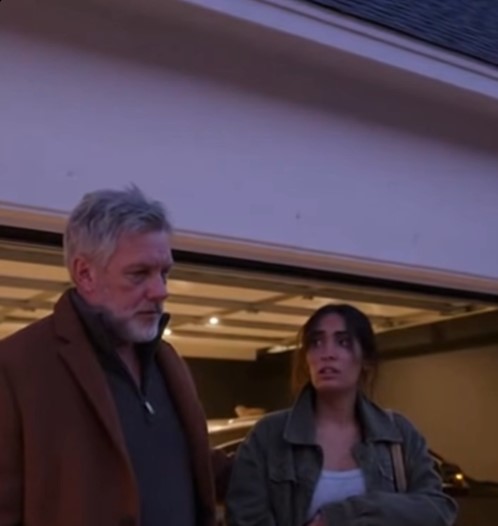
A Wealthy Man Gave a Homeless Artist a Place to Stay—Then He Found the Paintings She Had Hidden
Arthur believed he was rescuing Lexi from the streets, but the disturbing portraits inside his guest apartment forced both of them to confront painful truths
Arthur had spent most of his life surrounded by things other people dreamed of owning. His estate was so large that three gardeners were needed to maintain the grounds, and several luxury cars remained parked in his garage for weeks at a time.
At sixty-one, however, he had begun to understand that wealth could fill rooms without making a home feel alive. The polished floors, expensive artwork, and echoing hallways only made the silence more noticeable.
Arthur had never married or raised children. Most of his relationships had felt like negotiations in which affection was measured against the size of his bank account.
He had inherited a fortune from his parents, along with their emotional distance. As the years passed, he became increasingly aware that he had also inherited their loneliness.
A Chance Encounter Behind a Strip Mall
To escape the emptiness of the estate, Arthur often drove without choosing a destination. He would climb into his Bentley, place his hands on the steering wheel, and follow whatever road appeared ahead.
During one of those drives, he noticed a woman searching through a trash container behind a strip mall. She wore an oversized coat that looked decades old, and her thin arms moved through the discarded bags with determined urgency.
Arthur initially continued past her. Then something about the woman’s posture made him slow down.
She did not appear defeated. Even in obvious hardship, she carried herself like someone still fighting to survive.
Arthur pulled over and lowered his window.
“Do you need some help?” he asked.
The woman turned sharply. Her eyes widened as though she expected danger rather than kindness.
She straightened, wiped her dirty hands against her faded jeans, and stared directly at him.
“You offering?” she replied.
Arthur stepped out of the vehicle. His tailored suit and polished shoes looked almost absurd beside her worn clothing.
“I don’t know,” he admitted. “I just saw you there and… well, it didn’t seem right. A woman shouldn’t be digging through the trash at this hour.”
The woman studied his watch, the car, and the expensive fabric of his jacket.
“What’s not right is life, mister. And cheating, no-good husbands in particular. But you don’t strike me as someone who knows much about the gutter.”
An Offer Neither of Them Expected
Her bluntness surprised Arthur, but he did not leave. Instead, he asked whether she had somewhere safe to spend the night.
He mentioned shelters and family, but the woman answered every possibility with the same response.
“No. No to all of the above.”
Arthur had a furnished apartment above the garage complex on his property. It had remained unused for years, collecting dust while he lived alone in the main house.
Before he could reconsider, he offered it to her.
He assured her there would be no hidden conditions. She could stay until she was able to rebuild her life.
The woman’s guarded expression weakened, although suspicion remained visible in her eyes.
“I don’t take charity,” she whispered.
Arthur quickly reframed the offer as a practical arrangement. She could keep the apartment clean and occupied, while he gained reassurance that someone was watching the space.
After several moments, she agreed to stay for one night.
“Okay,” she said. “Just for a night. I’m Lexi, by the way.”
A Guest Slowly Became a Companion
Lexi remained silent during the drive to Arthur’s estate. She watched the gated neighborhoods and carefully landscaped properties through the passenger window as though they belonged to another world.
Arthur showed her the garage apartment and explained that the refrigerator was stocked. The space was modest compared with the main residence, but it was clean, warm, and fully furnished.
One night became several days. Several days became two weeks.
Lexi gradually began joining Arthur for meals in the main house. She remained cautious and sometimes abrasive, yet her sharp humor disrupted the lifeless routine that had defined his days.
For the first time in years, Arthur looked forward to hearing another person’s footsteps in the hallway. Even their arguments made the estate feel less empty.
Lexi eventually revealed that she had once been an artist. She had owned brushes, canvases, and access to a gallery before her marriage collapsed.
Her husband had left her for a much younger woman. During the separation, she lost her home, savings, belongings, and confidence.
“He left me for a girl half my age,” she said during dinner. “He took the house, the savings, even my brushes. He told me I was nothing without his support. I guess I started believing him.”
Arthur listened without interrupting. He understood little about homelessness, but he recognized what it meant to feel reduced to something others had decided you were.
“You’re not nothing, Lexi,” he told her.
The words felt unusually honest. Arthur was no longer speaking to someone he viewed as a temporary responsibility. Lexi had become important to him.
The Hidden Room Filled With Disturbing Portraits
The fragile trust between them changed on a Tuesday afternoon. Arthur entered the garage apartment while searching for a tire pump and forgot to knock.
The smell of linseed oil and turpentine reached him first.
Then he saw the walls.
Canvases covered nearly every available surface. Lexi had returned to painting, but her subjects were neither landscapes nor ordinary portraits.
Every canvas depicted Arthur.
In one painting, chains were wrapped tightly around his throat while his face twisted in agony. In another, dark streams resembling blood poured from his eyes.
The most disturbing portrait stood in the center of the room. It showed Arthur lying inside a velvet-lined casket, his hands folded over a pile of gold coins.
His painted face looked cold, lifeless, and completely alone.
Arthur felt sick. He backed away from the room as the meaning of the images formed in his mind.
He believed Lexi saw him as a prisoner of wealth, a monster hidden behind generosity, or a dead man who had mistaken possessions for a meaningful life.
For the first time since bringing her home, Arthur wondered whether he knew Lexi at all.
The Confrontation at Dinner
That evening, the silence between them felt different. Arthur could not look across the table without remembering the casket and the coins.
Lexi noticed that he had barely touched his food.
“Arthur?” she asked. “You haven’t touched your steak. Is something wrong?”
He placed his fork on the table and told her he had entered the apartment while searching for the air pump.
Lexi immediately turned pale. She did not pretend to be confused or deny what he had seen.
Arthur demanded an explanation.
“What the hell were those paintings?” he asked. “The chains? The blood? The coffin? I brought you into my home. I gave you a life again. And you spend your time turning me into a grotesque horror?”
Lexi’s hands began to shake.
“Arthur, please,” she said. “I didn’t mean for you to see those. Those weren’t… they aren’t what you think.”
Arthur’s anger continued building. He accused her of using him as a symbol for everything she despised.
He believed the portraits revealed her true opinion of him and that their growing friendship had been an illusion.
Lexi finally began to cry.
“No!” she said. “I was just angry! Not at you—at everything! At the world, at my ex, at the fact that I was dying in the dirt while people like you have so much they don’t even know what to do with it. I had to get the poison out of me. I used your face because you were the only person I saw every day. It wasn’t about you, it was about the pain!”
Arthur Ordered Her to Leave
Arthur heard her explanation, but humiliation and fear prevented him from accepting it. The paintings had exposed the insecurities he had spent years hiding behind money and status.
He told Lexi that the arrangement was over.
“I can’t do this,” he said. “I thought we had a connection. But you’re just using me as a canvas for your hate. I think it’s time for you to go.”
Lexi pleaded with him to reconsider. She had only recently begun feeling human again, and she still had nowhere dependable to live.
Arthur remained cold.
“You should have thought of that before you painted me dead,” he replied.
The next morning, he drove her to a local shelter. Neither of them spoke during the thirty-minute journey.
Before Lexi left the car, Arthur handed her three hundred dollars. She accepted it with trembling hands while staring at the pavement.
There was no goodbye. Lexi closed the door and walked away.
The Estate Became Empty Again
In the weeks that followed, Arthur’s home returned to its former silence. Yet the loneliness felt worse because he now knew what the rooms sounded like when another person was present.
He missed Lexi’s blunt observations and unpredictable humor. He missed having someone across from him at dinner.
As his anger faded, Arthur began reconsidering the confrontation. He realized that he had interpreted the paintings entirely through his own fear.
The chained figure, the bleeding eyes, and the casket had frightened him because they resembled truths he already suspected about himself. He had spent decades trapped by wealth, distrusting affection, and living as though emotional isolation were safer than vulnerability.
Lexi’s paintings may have been expressions of her pain, but Arthur had recognized himself inside them.
Instead of asking what she was trying to process, he had punished her for showing him an image he could not bear to face.
A Package Arrived One Month Later
Approximately a month after Lexi left, a courier delivered a large, flat package to the estate.
Arthur opened it carefully and discovered a single canvas.
This portrait was unlike the others.
It showed Arthur seated beside the library window while soft light touched one side of his face. He did not appear trapped, cruel, or lifeless.
He looked peaceful and thoughtful. More importantly, he looked kind.
The portrait presented him as someone worthy of trust rather than a wealthy stranger sealed inside an empty mansion.
A small note had been tucked into the frame.
It read: I finally finished the poison. This is what was underneath. Thank you for saving me, even if I didn’t know how to show it then. Lexi.
Arthur remained in front of the painting for a long time. It was the first possession in his enormous home that felt truly valuable to him.
The Phone Call That Reopened the Door
Arthur found Lexi’s telephone number and held his finger above the call button. Despite years of commanding employees and negotiating major financial decisions, he felt terrified that she would reject him.
Eventually, he called.
“Hello?” Lexi answered hesitantly.
“Lexi,” Arthur said. “I got the painting. It’s… it’s the most beautiful thing I’ve ever owned.”
She admitted that she had not expected him to contact her.
Arthur apologized. He told her that he had allowed his fears to distort the meaning of her art.
“I was a fool, Lexi. I saw my own fears in your art instead of seeing your survival. I’d like to apologize. Properly. Over dinner?”
Lexi accepted the invitation, but she also had news of her own.
“I’d like that,” she said. “I have a job now, Arthur. And an apartment. I can pay for my own meal this time.”
Arthur laughed.
“We’ll see about that.”
Two People Who No Longer Needed Saving
After ending the call, Arthur returned his attention to the portrait. He understood that he had made a mistake by viewing Lexi as someone he could rescue.
She had never been a project. She was an artist trying to reclaim her identity after betrayal and homelessness had nearly destroyed it.
Arthur was not a flawless benefactor either. His generosity had been real, but it was also connected to his desperate need for companionship.
They were two wounded people who had briefly found comfort in each other and then allowed fear to break the connection.
Lexi’s darker portraits had given shape to pain she could not yet explain. The final portrait showed what remained after that anger had passed.
It also offered Arthur a new way to see himself. He did not have to remain the isolated man surrounded by possessions, nor did he have to become the lifeless figure resting on gold inside a casket.
He could choose connection, admit when he was wrong, and allow another person to know him beyond his fortune.
The Empty Space No Longer Felt Like a Grave
Arthur’s loneliness did not disappear immediately. One conversation could not repair decades of emotional distance or undo the pain that both he and Lexi carried.
Something important had changed, however. The emptiness inside him no longer felt permanent.
For years, Arthur had believed vulnerability would expose him to people who wanted his money. His experience with Lexi taught him that refusing vulnerability had already cost him something more valuable.
Opening his home had allowed her to begin rebuilding her life. Seeing her art had forced him to examine the life he had built for himself.
The portraits that initially seemed cruel eventually became part of a difficult exchange neither of them had known how to express in words.
Lexi found employment and secured an apartment without remaining dependent on Arthur. Arthur found the courage to apologize without trying to purchase forgiveness.
They did not save one another in the way Arthur had first imagined. Instead, they reminded each other that broken people can still create something meaningful when they are willing to look beneath fear, anger, and appearances.
As Arthur studied the gentle portrait beside the library window, the estate remained physically unchanged. The same marble floors, expensive furniture, and quiet hallways surrounded him.
Yet the silence no longer seemed final. For the first time, it felt like space waiting to be filled.