
The Lost Photograph of Princess Diana and David Bowie That Became a Royal Mystery
A Brief Encounter at Wembley Became the Center of a Decades-Long Story
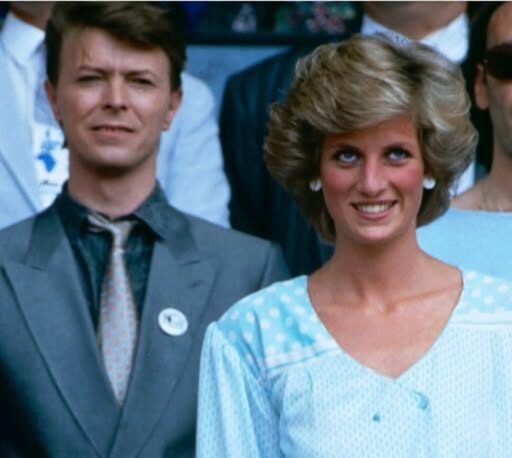
A camera flashed inside Wembley Stadium in 1987, capturing two of Britain’s most recognizable figures in a single frame. Princess Diana stood smiling beside David Bowie during an evening that would later attract far more attention than anyone present could have expected.
There was nothing openly scandalous in the photograph. Diana and Bowie were not behaving improperly, and the image did not show a dramatic confrontation, an intimate embrace, or any other obvious reason for concern.
Yet the photograph reportedly disappeared from public view soon after it was taken. Its absence transformed an ordinary celebrity encounter into a lasting royal mystery.
The significance of the picture was not found in the way Diana posed beside the famous musician. Instead, the concern centered on the wider circumstances surrounding her presence at Wembley that night.
Diana had attended the concert with Major James Hewitt, the man who would later be publicly linked to her through revelations about their private relationship. At the time, however, that connection remained hidden from the public.
A photograph showing the princess relaxed and smiling at a major concert could have encouraged questions about who had accompanied her, why she was there, and what was happening beyond the carefully managed boundaries of royal life.
A Photograph That Appeared Completely Innocent
On its surface, the picture showed a simple meeting between a princess and a rock star. Bowie appeared relaxed, while Diana looked comfortable and cheerful beside him.
Such encounters were not unusual at large charitable or cultural events. Celebrities, performers, political figures, and members of the royal family frequently crossed paths in settings where photographers were present.
What made this particular frame sensitive was not anything visible between Diana and Bowie. The musician was not the source of the deeper concern.
The image became important because it documented a night when Diana was reportedly accompanied by Hewitt. Any renewed public interest in the event could have led observers to examine details that the palace preferred to keep away from public discussion.
A single photograph can preserve far more than the two people standing at its center. It can reveal clothing, mood, surroundings, timing, and the identities of individuals who may have been nearby.
For an institution accustomed to controlling royal appearances, those details could carry enormous consequences. Even an innocent picture might create questions that official statements could not easily contain.
Diana’s Appearance Sent Its Own Message
Diana’s clothing also made the photograph memorable. Rather than appearing in the formal dresses and carefully selected outfits commonly associated with royal engagements, she reportedly wore leather pants.
The choice reflected the environment around her. She was attending a concert and wanted to look more like the people she had come to support than a distant royal figure arriving for a ceremonial appearance.
Her clothes did not represent wild or inappropriate behavior. They showed a young woman adjusting her style to a setting outside the traditional palace world.
That seemingly minor decision captured an important part of Diana’s public appeal. She could appear dignified at formal occasions while also seeming natural and approachable in less traditional surroundings.
Her ability to connect with ordinary people often strengthened her popularity. At the same time, it complicated the efforts of those who wanted every royal appearance to follow an established script.
In the Wembley photograph, Diana did not appear like a carefully arranged symbol. She appeared spontaneous, relaxed, and fully present in the moment.
That quality may have made the image more powerful than a conventional palace portrait. It offered a glimpse of the woman behind the title rather than the controlled royal figure presented at official events.
The Hidden Importance of Major James Hewitt
The story surrounding the image cannot be separated from Hewitt’s presence that evening. Although he was not the central figure in the photograph with Bowie, his connection to Diana gave the event a more sensitive meaning.
Hewitt would later be identified as Diana’s lover, turning earlier moments involving the pair into subjects of intense public interest. Events that had once appeared ordinary could then be reconsidered through the knowledge that emerged afterward.
In 1987, the palace had strong reasons to avoid speculation about Diana’s private relationships. Her marriage and royal responsibilities were already matters of enormous public attention.
A photograph associated with an outing involving Hewitt might have encouraged rumors long before the full story became widely known. Even without proof of improper behavior, questions alone could have created difficulties.
The public did not need to see an intimate gesture for speculation to begin. The knowledge that Diana was spending private time with another man could have been enough to create a damaging narrative.
For palace officials, preventing those questions may have seemed easier than answering them. Keeping the photograph away from widespread circulation would have reduced the possibility that the evening might receive closer examination.
Why One Image Could Frighten the Palace
The royal family has long depended on carefully managed public appearances. Clothing, schedules, seating arrangements, public statements, and photographs can all contribute to the image presented to the world.
Diana’s growing independence made that process increasingly difficult. Her popularity gave her a public identity that could not always be shaped by traditional expectations.
She attracted attention wherever she went, and photographers understood the value of capturing her during unguarded moments. A smile, a glance, or an unexpected companion could quickly become the center of a national conversation.
The Wembley image reportedly worried royal officials because it could not be separated from the possibility of further investigation. Once published, journalists and members of the public might have asked who organized the evening and who remained beside Diana before and after the photograph was taken.
The frame itself may have been harmless, but its surrounding story was potentially explosive. That distinction explains why an innocent photograph could still be viewed as dangerous.
The concern was not that Diana stood beside Bowie. The concern was that the photograph might open a door into a part of her life the palace was determined to keep closed.
David Bowie’s Role in the Unexpected Royal Moment
Bowie’s presence gave the image additional cultural importance. He was already one of the world’s most influential and recognizable performers, known for constantly reshaping his music and public identity.
Standing beside Diana brought together two figures who represented very different sides of British life. She belonged to the monarchy, while he represented artistic freedom and cultural change.
Despite those differences, the photograph reportedly showed no tension. Bowie appeared amused and at ease, while Diana seemed equally relaxed.
Their meeting created the kind of image that would ordinarily have been celebrated. It combined royal glamour with the energy of popular music at one of the country’s most famous venues.
Under different circumstances, the photograph might have been widely published as a charming record of two British icons sharing a brief moment.
Instead, the context surrounding Diana’s private life changed the meaning attached to it. Bowie became part of a story that was never truly about him.
His presence made the photograph unforgettable, but Hewitt’s presence in Diana’s life made it sensitive.
A Woman Who Could Not Be Completely Choreographed
The mystery of the photograph also reflects the larger struggle over Diana’s identity. The palace could control official schedules and formal announcements, but it could not fully control how she behaved, dressed, or connected with people.
Diana often appeared most compelling when she moved beyond rigid royal expectations. Her warmth and emotional openness distinguished her from the distant image traditionally associated with monarchy.
That independence made her loved by millions, but it also created tension. Every unscripted moment carried the possibility of revealing feelings or relationships that did not fit the official presentation.
At Wembley, Diana reportedly chose leather pants because she wanted to feel connected to the atmosphere around her. The decision was small, but it represented a broader refusal to remain confined to one carefully approved image.
She could be a princess and still enjoy a concert. She could meet a rock star without turning the encounter into a formal ceremony.
She could also maintain parts of her personal life beyond the palace’s immediate control. That reality was far more threatening than anything visible in the photograph itself.
How the Missing Image Gained Greater Power
When a photograph disappears, curiosity often grows stronger. An image that might otherwise have been briefly admired can become a symbol of secrecy when people believe it was intentionally withheld.
The absence of the Wembley picture allowed the story surrounding it to expand. Questions about why it vanished became nearly as important as the photograph’s actual content.
Was the concern Diana’s clothing? Was it the informal nature of the meeting with Bowie? Or was the real issue Hewitt and the possibility that his presence might attract attention?
The account surrounding the image points to the third explanation. The photograph was reportedly considered dangerous because it connected Diana to an evening that palace officials did not want examined too closely.
By removing the image from circulation, they may have prevented immediate questions. However, the disappearance also gave the photograph a reputation that an ordinary publication might never have produced.
Over time, it became more than a concert photograph. It became evidence of the pressure surrounding Diana and the efforts to control how the public understood her life.
The Photograph Eventually Lost Its Ability to Harm
Decades later, the image reportedly resurfaced in a very different world. The revelations that once threatened to create scandal were no longer secret, and the central figures had already become part of modern history.
Hewitt’s relationship with Diana had long since entered public knowledge. The photograph could no longer expose the private connection that palace officials may once have feared.
Its power had changed. Rather than threatening the monarchy with a new revelation, it offered a glimpse into an already familiar story.
Viewers could now focus on the details that made the image human: Diana’s smile, Bowie’s relaxed expression, her concert clothing, and the atmosphere of an evening away from traditional royal formality.
The photograph no longer carried the same potential to damage reputations. Instead, it became meaningful because of everything later generations understood about Diana’s life.
It showed a woman trying to experience a normal evening while living under extraordinary scrutiny. Even a simple meeting with a musician could become entangled in concerns about marriage, loyalty, image, and royal authority.
A Quiet Frame With a Larger Meaning
The lost photograph of Princess Diana and David Bowie was never important because it showed scandalous behavior. There was no outrageous pose and no visible act that demanded suppression.
Its importance came from what surrounded the frame. Diana was at Wembley with a man whose relationship with her would later become public, and the palace understood how quickly one image could lead to broader questions.
The photograph captured two cultural icons, but it also represented a conflict between personal freedom and institutional control.
Diana appeared determined to experience the concert on her own terms. Her leather pants, easy smile, and relaxed presence suggested someone temporarily stepping beyond the restrictions of royal presentation.
Bowie stood beside her as a symbol of a world built on reinvention and creative independence. Their brief meeting unintentionally produced an image that reflected far more than celebrity recognition.
Behind the smiles was a royal system attempting to manage a woman whose personality could not be fully contained. Every effort to choreograph her life was challenged by the fact that Diana remained spontaneous, emotionally expressive, and deeply individual.
The palace may have succeeded in keeping the photograph out of public view for years. It could not prevent the truth surrounding Diana’s life from eventually becoming known.
When the image finally emerged, it no longer functioned as a dangerous secret. It stood instead as a reminder of how much fear could be attached to one harmless moment.
A single flash had preserved Diana beside one of Britain’s greatest music stars. The photograph’s disappearance revealed something even more significant: the extraordinary lengths to which powerful institutions could go to control the story of a woman who repeatedly refused to remain on script.