
Charges Dropped Against Olympic Canoeist Arrested at Lincoln Memorial Reflecting Pool
Federal Prosecutors End the Felony Case Against David Hearn
The Department of Justice has moved to dismiss all charges against David Hearn, a 67-year-old three-time Olympic canoeist who was arrested after touching a section of peeling sealant at the Lincoln Memorial Reflecting Pool.
Hearn had been accused of damaging federal property during a bicycle ride in June. The case exposed him to a possible sentence of up to ten years in prison on a single felony count of property destruction.
From the beginning, Hearn maintained that he had not vandalized the pool. He said he reached into the water only to examine a piece of lining that was already separating from the bottom.
He also said he released the material immediately after National Park Service staff instructed him to stop touching it.
Federal prosecutors have now acknowledged that newly reviewed evidence does not support the claim that Hearn caused the damage.
In a 20-page motion filed Friday, the government asked the court to dismiss the criminal charge and admitted that the widespread deterioration of the pool lining could not reasonably be attributed to vandalism.
New Evidence Changed the Government’s Position
The dismissal followed a closer examination of the renovation work completed at the Reflecting Pool before the planned America 250 celebrations.
The new information indicated that the material was failing because of problems with the installation rather than deliberate destruction by visitors.
U.S. Attorney Jeanine Pirro wrote that the extensive peeling resulted from a “flawed installation by the contractor” and a “rush to complete the project prior to events associated with the America 250 celebration.”
Those findings directly weakened the original theory behind Hearn’s arrest. The government had initially treated the damage as an intentional act committed against federal property.
However, the filing recognized that the condition of the pool could be explained by failures in the renovation process.
“Given all of this newly discovered information, it is difficult to attribute the widespread damage to the Reflecting Pool to vandalism, let alone to establish that fact beyond a reasonable doubt,” Pirro wrote.
The statement marked a major reversal in a case that had carried extremely serious consequences for Hearn.
A man who had faced the possibility of a decade in federal prison was no longer being accused of causing any damage at all.
Hearn Said the Liner Was Already Peeling
Hearn consistently described the incident as a brief and harmless interaction with material that had already come loose.
While cycling near the Reflecting Pool, he noticed a section of the lining peeling away from the floor beneath the water.
He reached down to inspect it, but he did not tear it from the surface or attempt to remove it from the pool.
When park personnel told him to release the material, he complied immediately.
Despite that explanation, Hearn was arrested and charged with felony property destruction.
The severity of the charge drew attention because there was no allegation that he arrived with tools, entered a restricted construction area, or carried out a planned act of vandalism.
The accusation centered on the brief moment when he touched the deteriorating liner.
His defense team argued that the material had already failed before Hearn came into contact with it and that the government had no evidence showing he caused the damage.
The Pool Was Already Losing Millions of Gallons
Questions about the condition of the Reflecting Pool grew as additional evidence became available.
A National Park Service witness admitted under oath that the pool had been leaking millions of gallons of water each week before Hearn touched the lining.
That testimony indicated that major structural or installation-related problems were already present.
The leaking was not the result of one visitor briefly handling a loose section of material. It was part of a much larger failure affecting the renovated pool.
The government’s latest filing accepted that the widespread damage could not be connected to Hearn’s actions beyond a reasonable doubt.
The acknowledgment also raised questions about why he was arrested and charged before the cause of the deterioration had been fully investigated.
Had the condition of the pool and the renovation work been examined earlier, the felony case might never have been filed.
A Fifteen-Million-Dollar Renovation
The Reflecting Pool had undergone work as part of a $15 million renovation project connected to preparations for the United States’ 250th birthday celebrations.
The project was intended to improve the landmark before the major national events associated with America 250.
However, problems reportedly appeared soon after the pool was filled.
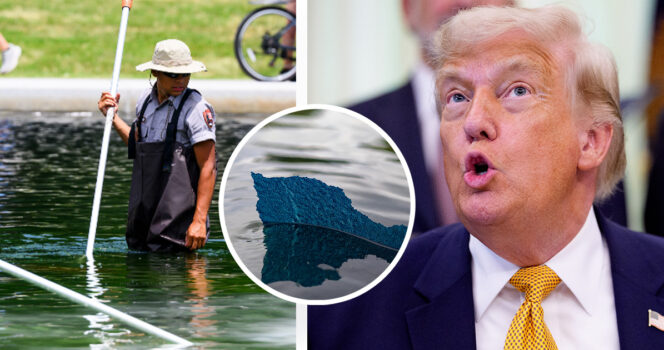
Large areas of the newly installed blue lining began to bubble, split, and separate from the surface below.
The rapid deterioration suggested that the material had not bonded properly or had been installed under conditions that prevented it from performing as intended.
The government now says the work was affected by a flawed installation and pressure to finish the project before the upcoming celebrations.
That explanation places responsibility for the damage on the renovation process rather than on individual visitors who encountered the loose material afterward.
Public Accusations Followed the Damage
As images and accounts of the damaged lining circulated, the condition of the Reflecting Pool became part of a broader public controversy.
Donald Trump accused “Radical Left Lunatics” of deliberately damaging the pool and said law enforcement authorities were investigating the matter.
The statement presented the deterioration as intentional political vandalism rather than a construction or installation failure.
Hearn’s arrest appeared to support that narrative at the time, even though he denied causing any damage.
The new court filing now offers a sharply different explanation.
Federal prosecutors have acknowledged that the peeling was connected to defects in the work itself and that the evidence does not establish vandalism.
The reversal demonstrates how early public assumptions can become disconnected from the facts revealed during a later investigation.
Defense Lawyers Welcome Dismissal but Demand Accountability
Hearn’s attorneys welcomed the government’s decision to drop the case, but they made clear that dismissal alone did not resolve their concerns.
They argued that Hearn should never have been arrested or exposed to a possible ten-year prison sentence.
“Its dismissal today does not erase the abuse of government power in arresting and charging a patriotic American who did nothing wrong,” his lawyers said in a joint statement.
The defense team criticized the investigation as rushed and unsupported by a complete understanding of the pool’s condition.
“The government’s approach was ready, fire, aim. The administration owes Mr Hearn an apology.”
The statement reflected the legal team’s position that the case caused harm even though it did not result in a conviction.
An arrest, public accusation, and felony prosecution can affect a person’s reputation and well-being regardless of whether the charge is later dismissed.
Hearn’s lawyers believe the government should formally acknowledge the consequences of pursuing the case without sufficient evidence.
An Olympic Career Overshadowed by a Felony Charge
Before the Reflecting Pool incident, Hearn was widely known for his accomplishments as a competitive canoeist.
He represented his country at three Olympic Games and remained connected to outdoor recreation later in life.
The June encounter occurred while he was on a bicycle ride, not during a protest or organized demonstration.
His defense emphasized that he was an ordinary visitor who became curious about material visibly separating from the pool floor.
The felony accusation suddenly placed his athletic career and public reputation behind a far more damaging headline.
Instead of being identified primarily as a three-time Olympian, he became associated with an allegation that he intentionally damaged one of the nation’s best-known landmarks.
The dismissal restores the legal position Hearn maintained from the beginning: that he committed no act of vandalism.
The Case Raised Questions About Investigative Judgment
The collapse of the prosecution has drawn attention to how the original charging decision was made.
Property destruction on federal land can carry severe penalties, particularly when prosecutors assign a high value to the alleged damage.
Before bringing such a charge, investigators are expected to determine whether the accused person actually caused the damage and whether the conduct was intentional.
In Hearn’s case, evidence later showed that the pool had serious problems before he arrived.
The lining was already peeling, the structure was losing millions of gallons of water, and sections of the newly installed material were failing across a wide area.
Those conditions made it difficult to claim that one brief touch caused the deterioration.
The government’s own motion now acknowledges that the evidence is insufficient even to establish vandalism, much less prove Hearn was responsible for it.
His lawyers argue that authorities acted first and investigated the underlying cause afterward.
Other Visitors Also Faced Charges
Hearn was not the only person accused after touching sections of the failing pool liner.
Other visitors reportedly faced misdemeanor cases connected to similar contact with the peeling material.
Those prosecutions were based on the same general assumption that visitors had intentionally damaged the Reflecting Pool.
With the felony case against Hearn now formally collapsing, legal analysts expect the remaining misdemeanor charges to be dismissed as well.
The government’s admission that the damage resulted from installation failures makes it harder to continue prosecuting others for encountering the same defective material.
If the liner was already bubbling and separating across the pool, touching a loose section would not necessarily establish that a visitor caused the underlying damage.
The dismissal of the remaining cases would bring the legal response more closely in line with the new evidence about the renovation.
The Difference Between Contact and Vandalism
The case also highlights the distinction between touching damaged property and intentionally damaging it.
Vandalism normally requires evidence that a person deliberately defaced, destroyed, or impaired property.
Hearn’s explanation was that he briefly examined material that was already detached and released it when instructed.
Prosecutors have now accepted that the widespread peeling cannot be attributed to him.
The revised understanding of the incident removes the central element required to support the felony charge.
Without proof that Hearn caused the damage, the government could not reasonably proceed toward trial.
The dismissal therefore reflects more than prosecutorial discretion. It represents an admission that the factual foundation of the case did not hold up under review.
A Serious Charge Ends Without a Trial
Hearn will no longer face trial on the property destruction charge.
The decision removes the threat of a lengthy prison sentence and ends the immediate legal uncertainty that followed his arrest.
However, his defense team continues to seek recognition of what it views as an unjustified use of federal power.
The lawyers argue that the government should apologize for arresting a man who did not damage the pool and for portraying an innocent action as a serious crime.
The controversy is now likely to shift from Hearn’s behavior to the decisions made by the contractor, project supervisors, investigators, and prosecutors.
Questions remain about how a $15 million renovation began failing so soon after completion and why visitors were blamed before the installation problems were fully understood.
A Case That Ended Where It Began
From the beginning, Hearn said the liner was already coming away from the floor of the Reflecting Pool.
He insisted that he touched it briefly out of curiosity and stopped when park staff spoke to him.
Months later, the government’s own evidence has supported the central part of his explanation.
The pool’s condition was not the result of one man reaching into the water. It was part of an extensive failure linked to the installation and the effort to complete the renovation before the America 250 events.
The felony charge that once threatened to send a three-time Olympian to prison for up to ten years has now been abandoned.
For Hearn, the dismissal brings relief but not complete closure. His attorneys maintain that the arrest should never have happened and that the government must answer for the way the case was handled.
For the public, the reversal serves as a reminder that an arrest does not prove guilt and that early explanations can change dramatically when all of the evidence is examined.
What was initially described as deliberate destruction of a national landmark is now officially understood as a failed installation that was already deteriorating before David Hearn ever reached into the water.