
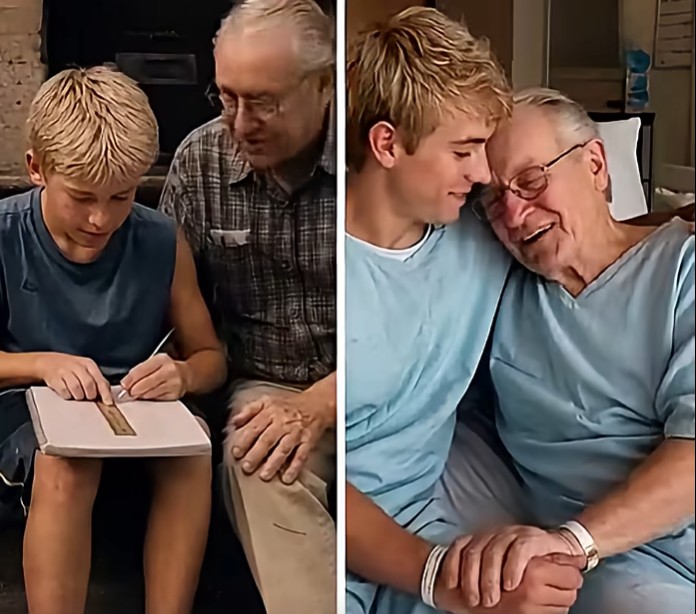
An Old Man Taught a Struggling Boy Math—Eleven Years Later, His Former Student Helped Save His Life
Fiction: A Lesson Beside a Bus Stop Became a Lifelong Connection
Every afternoon, Mason settled onto a cracked wooden bench beside a broken bus stop and opened his battered blue notebook. He filled its pages with equations, fractions, and geometry problems, sometimes using a stick to work through numbers in the dirt.
Most people passed without stopping. They saw an elderly man sitting alone, with little reason to wonder about the calculations occupying his attention.
One summer afternoon, a ten-year-old boy paused nearby. His shoes had worn thin, and strips of black tape held his backpack together.
His name was Lucas. He watched the notebook with interest, although interest was not the same as confidence.
Mason looked up.
“You like math?” he asked.
“I’m… trying.”
Lucas studied the equations before admitting the part that troubled him.
“But I don’t understand it.”
Mason invited him closer and made room on the bench. Instead of beginning with a complicated formula, he drew a circle in the dirt.
“Imagine that’s a pie.”
“What kind?”
“Chocolate.”
Lucas laughed.
“Then I’m listening.”
A Classroom Without Walls
Lucas began returning almost every evening. The bench became a place where he could ask questions without feeling embarrassed by what he did not yet understand.
Mason used whatever was available. Imaginary pieces of pie helped explain fractions, coins made multiplication easier to follow, and bottle caps became tools for recognizing patterns.
The materials were simple, but Mason’s patience made the lessons different. A wrong answer did not bring an irritated sigh or a reminder that the problem had already been explained.
Instead, he cleared the work and changed his approach.
“Let’s try it another way.”
Lucas still became frustrated. Sometimes he dropped his pencil and insisted that he was stupid, as though struggling with a worksheet proved something permanent about him.
Mason refused to accept that conclusion.
“You’re smarter than you think.”
He repeated the reassurance until Lucas began remembering it even between lessons. The words became something to hold onto when the numbers seemed impossible.
When schoolwork came back covered in corrections, they examined each mistake together. Mason wanted Lucas to understand that an error was information he could use.
“That’s what mistakes are for,” he said.
“Otherwise, they’re just decorations.”
Gradually, Lucas stopped hiding his homework. His first response to a difficult problem became an attempt rather than an apology.
The Boy Disappeared Without a Goodbye
For months, their meetings continued. Then Lucas stopped coming.
Mason waited through one evening, then another. As the days passed, he kept looking toward the street for the familiar backpack patched with tape.
Lucas’s family had moved away. There was no final meeting and no opportunity for the boy to explain what those hours beside the bus stop had meant.
Mason continued with his life, carrying the memory of their lessons without knowing where they had led. He had seen Lucas begin to improve, but he never learned what happened afterward.
Eleven years passed. The neighborhood changed around the place where they had sat, with buildings disappearing and businesses coming and going.
The bus stop was replaced. Eventually, the old bench was gone too.
As time passed, Mason’s own life grew quieter. His health declined, and he eventually found himself in a hospital bed facing a treatment he could not afford.
He listened as the doctors explained what he needed. Then he asked the question that determined whether he could receive it.
“How much?”
The answer was beyond his means. He had no substantial savings or family member he could turn to, and his coverage would not meet the full cost.
A Familiar Question in a Hospital Room
One evening, a nurse brought another patient into Mason’s room. The younger man would remain there temporarily before being moved to a different room.
Mason was exhausted and paid little attention. For a while, neither patient spoke.
Then the younger man began studying his face. Recognition emerged slowly, followed by disbelief.
“Wait.”
Mason turned toward him.
“So… you still like math?”
The question brought back the bench, the circle in the dirt, and the child who had once hesitated to sit beside him.
“Lucas?”
“Yeah.”
The boy had grown into an engineer. He had built a career and a company, but he had never forgotten the man who first helped him believe he could learn.
They began talking, filling the years between them with explanations and memories. Lucas told Mason about the move that had ended their meetings so suddenly.
Then he reached into his bag and produced a worn blue notebook. Mason had given it to him years earlier, and Lucas had kept it.
The cover was faded and the pages fragile. Inside were problems they had worked through together, with Mason’s writing beside Lucas’s childhood answers.
The Words Lucas Had Carried With Him
Lucas opened the notebook to a page bearing the reassurance that had become part of their lessons.
“You’re smarter than you think.”
Seeing the words again left Mason unable to speak. He had offered them so naturally that he had never known how much Lucas depended on them.
“I read that whenever I was scared.”
Mason looked down at the notebook.
“You didn’t need me after that.”
“I did.”
Lucas explained that the lessons had stayed with him through difficult schoolwork, rejected opportunities, and moments when others underestimated him because of his circumstances.
Remembering Mason did not solve every problem. It helped him keep trying long enough to work through them.
As they talked, Lucas became more aware of Mason’s condition. The old man eventually admitted that he could not afford the treatment he needed.
“It’s all right.”
But Lucas understood that it was not. The man who had once helped him face an unfamiliar problem was now facing one of his own.
This time, Lucas had the means to help.
A Letter Changed Mason’s Prospects
The following morning, Lucas’s bed was empty. Mason assumed he had been transferred, as the nurse had said he would be.
Then a nurse entered carrying a small cloth bag and placed it on the table.
“This was left for you.”
Inside were the blue notebook, a bank card, and a handwritten letter. As Mason read, he discovered that Lucas had arranged to pay for his treatment.
The care he needed would be covered. Lucas had acted because he wanted Mason to have the opportunity to continue living, just as Mason had helped him imagine a future years earlier.
The letter also explained that Lucas had tried to find him. He had returned to the old neighborhood and asked about the man who used to sit beside the bus stop.
Those searches had failed. Their unexpected meeting in the hospital had finally brought them together again.
For Mason, the letter changed more than the immediate financial situation. It revealed that the lessons he thought had ended abruptly had continued to matter in a life he could no longer see.
Recovery Brought Their Friendship Back Into Daily Life
Treatment was difficult. Mason endured painful days and exhausting nights, but he no longer faced them without company.
Lucas returned every day. Sometimes he brought food or flowers; sometimes he simply stayed and talked.
One afternoon, he arrived with engineering blueprints.
“I need you to check these.”
Mason laughed at the request.
“You’re an engineer.”
“I know.”
“You don’t need me.”
“I still want you to check them.”
The papers gave them familiar ground. Once again, they sat together looking at numbers, discussing mistakes, and enjoying the work of understanding something.
Occasionally, Mason circled a detail.
“You missed this.”
“Guess I’m still learning.”
Those exchanges restored something valuable to Mason’s days. He was receiving help, but he could also contribute, question, and share the pleasure that mathematics had always given him.
Slowly, his strength began to return. One morning, with Lucas beside him, he stood without assistance.
The Teacher Recognized a Lesson of His Own
As his condition improved, Mason reflected on the years when he had not known what became of Lucas. He had assumed the value of his teaching depended on seeing its results.
Lucas’s return had changed that understanding. The encouragement had continued working long after the bench was empty.
“All those years ago, I thought I was teaching you.”
“You were.”
Mason shook his head.
“I think you were teaching me too.”
He had learned that an unfinished goodbye did not make their time together meaningless. A child could carry a lesson into places the teacher would never visit.
When Mason was finally discharged, Lucas waited outside. Later, they returned together to the neighborhood where they had first met.
The bench and broken bus stop were gone, but Mason remembered the spot. He took out the notebook and wrote on its final page before handing it to Lucas.
“A good lesson doesn’t end when the page is turned. It follows you until you need it again.”
Lucas read the words, then looked up. The friendship that had begun with a circle in the dirt had survived eleven years of separation.
Mason had once given a discouraged boy patience and confidence. Years later, Lucas returned with practical help, steady companionship, and the chance for his old teacher to recover.
Neither could have predicted that outcome beside the bus stop. At the time, there had simply been a child willing to learn and an older man willing to make room for him.