
My Father Shattered My Graduation Trophy, but the Broken Glass Finally Made Us Tell the Truth
The Sound That Changed Everything
The crack came before the crash.
One moment, my father was standing in the living room holding the graduation trophy I had brought home only hours earlier. The next, it slipped from his hands and struck the hardwood floor between us.
The glass shattered instantly.
Sharp pieces scattered beneath the coffee table, across the rug, and near the shoes I had not yet taken off. The engraved plate broke away from the base and landed face down.
For several seconds, neither of us moved.
My father stared at the broken trophy as though he had not expected it to fall. His hands remained suspended in front of him, still shaped around an object that was no longer there.
Then he looked at me.
His expression hardened.
Instead of apologizing, he said the words that turned an accident into something far more painful.
“Maybe now you’ll stop acting like this changes anything.”
A Celebration That Never Felt Like One
Graduation was supposed to be one of the happiest days of my life.
I had spent years working toward it, pushing through late nights, difficult exams, financial pressure, and the constant fear that I would disappoint everyone who believed in me.
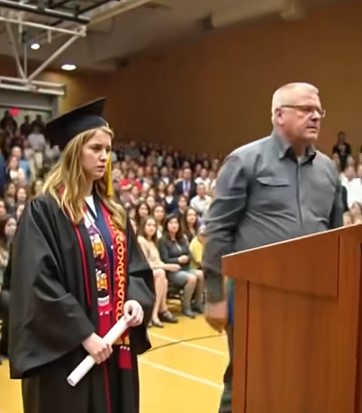
When my name was called, I walked across the stage and accepted my diploma while hundreds of people applauded.
I searched the audience for my father.
He was sitting several rows back with his arms folded. He clapped, but his face remained unreadable.
After the ceremony, families gathered outside for photographs. Parents adjusted graduation caps, hugged their children, and repeated how proud they were.
My father stood beside me for one picture.
He placed a hand lightly on my shoulder and looked toward the camera. The moment the photograph was taken, he stepped away.
“You ready to go?” he asked.
That was the closest he came to saying anything about what I had accomplished.
The Trophy Meant More Than He Understood
The trophy had been presented during a smaller academic ceremony earlier that week.
It recognized the work I had completed during my final year, but to me, it represented much more than grades or public recognition.
It represented every morning I had forced myself out of bed after sleeping only a few hours.
It represented the shifts I worked while studying, the assignments I finished while exhausted, and the doubts I kept hidden from almost everyone around me.
Most of all, it represented the hope that my father might finally look at me and see someone worth celebrating.
I had imagined bringing it home and placing it in his hands.
I imagined him reading my name on the engraved plate and smiling.
I imagined hearing the simple words I had wanted from him for years.
“I’m proud of you.”
Instead, the trophy lay broken at our feet.
Years of Silence Entered the Room
My father and I had not always been distant.
When I was younger, he taught me how to ride a bicycle, how to change a tire, and how to throw a ball without closing my eyes.
He used to make pancakes on Sunday mornings, even though he always burned the first batch.
He laughed more then.
He asked questions and waited for the answers.
But over the years, something changed.
Conversations became shorter. Meals became quieter. His concern began to sound like criticism, and my attempts to explain myself often ended with one of us leaving the room.
We lived in the same house but learned how to avoid each other.
There were long evenings when the only sounds between us were silverware touching plates or the television playing in the background.
I stopped telling him when I was struggling.
He stopped asking.
The Loss We Never Discussed
Our distance grew after my mother died.
She had been the person who translated us to each other.
When my father became too stern, she reminded me that fear often sounded like anger coming from him. When I became defensive, she helped him understand that I was not rejecting him.
After she was gone, neither of us knew how to continue the relationship without her.
My father responded to grief by becoming more controlled. He worked longer hours, repaired things that were not broken, and filled every quiet moment with a task.
I responded by needing him more than ever.
I wanted him to ask whether I was sleeping. I wanted him to notice when I stopped eating dinner. I wanted him to sit beside me and admit that he missed her too.
He did none of those things.
Instead, he told me to focus on school.
At the time, it felt cold.
Years later, I began to understand that school was the only future he believed he could still protect.
Every Choice Became an Argument
As I grew older, almost every decision created conflict between us.
He questioned the subjects I studied, the people I spent time with, and the jobs I considered after graduation.
Whenever I chose something he had not recommended, he treated it as a rejection of everything he had sacrificed.
I saw control.
He saw danger.
I believed he did not trust me.
He believed I did not understand how easily life could collapse.
Neither of us explained those feelings clearly.
We simply argued about the visible issue and ignored the fear underneath it.
By graduation day, years of resentment were already waiting beneath the surface.
The Argument Begins
After we returned home from the ceremony, I placed the trophy on the kitchen table and went upstairs to change.
When I came back down, my father was holding it.
He read the engraving silently.
For one hopeful second, I thought the moment I had imagined was finally arriving.
Then he asked what I planned to do next.
I told him I had decided to accept an entry-level position in another city.
His entire posture changed.
“You already accepted it?” he asked.
“Yes.”
“Without talking to me?”
I reminded him that I had mentioned the opportunity several times.
He said mentioning something was not the same as discussing it.
I told him I was an adult and did not need permission to begin my life.
His jaw tightened.
He looked down at the trophy and said I had become so focused on proving myself that I had forgotten the people who helped me get there.
Words Become More Painful Than Glass
I accused him of turning every achievement into another reason to criticize me.
He said I was ungrateful.
I said he was impossible to please.
He told me the real world would not applaud me for every small success.
I asked whether he understood how difficult it was to spend years hoping for approval that never came.
That was when the trophy fell.
After the glass broke, his anger did not disappear.
It became sharper.
He said the trophy did not erase the reckless choices I had made or the times I ignored his advice.
I stared at him, stunned by how quickly he had reduced one of the proudest moments of my life to another disappointment.
“You couldn’t give me one day,” I said. “You couldn’t let me have one day without making me feel like I failed you.”
The Question I Had Avoided for Years
My father opened his mouth to respond, but I did not let him.
Years of unanswered questions came out before I could stop them.
I asked why he had never told me he was proud of me.
I asked why every conversation felt like an evaluation.
I asked why he had stopped hugging me after my mother died.
My voice shook as I described the quiet dinners, the closed doors, and the nights I had cried alone because I did not know how to reach him.
“Did you ever wonder whether I was okay?” I asked.
For the first time since the argument began, he looked frightened.
Not angry.
Frightened.
His eyes dropped toward the broken glass.
“Every day,” he said.
The Truth Beneath His Anger
His answer was so quiet that I nearly missed it.
I asked why he had never said anything.
He sat down heavily on the edge of the sofa.
For several moments, he seemed unable to speak.
Then he admitted that after my mother died, he had become terrified of losing me too.
Every risk I took reminded him that he could not control the future.
Every decision he did not understand felt like another opportunity for life to take someone away from him.
He had convinced himself that keeping me focused, cautious, and close was the same as protecting me.
He did not realize how much his fear sounded like disappointment.
“I thought if I stayed hard on you, you’d be ready,” he said.
“Ready for what?”
He looked toward the family photograph on the wall.
“For how hard it gets.”
The Man He Had Lost
My father admitted that he no longer recognized himself.
Before my mother’s death, affection had come more easily. She had helped him soften his words and express what he could not say on his own.
Without her, he retreated into the version of himself that felt safest.
He became practical, strict, and emotionally distant.
He believed that showing fear would make him weak when I needed him to be strong.
Instead, his silence made me believe I had been left alone.
He told me that every time he tried to speak honestly, he felt the grief rising again.
So he discussed grades, bills, schedules, and responsibilities because those things were easier than admitting he was still broken.
“It’s hard,” he finally said.
The words were simple, but they carried years of pain.
My Hurt Had Its Own History
I understood his grief, but understanding did not erase mine.
I told him that the trophy was not the only thing he had broken.
For years, I had interpreted his silence as rejection.
Every time he changed the subject when I mentioned my mother, I believed he did not care about how much I missed her.
Every time he criticized a decision without asking why I had made it, I felt invisible.
I did not need him to solve my problems.
I needed him to ask about them.
I needed him to say he was scared instead of turning fear into anger.
I needed to know that I was more than a responsibility he was determined not to fail.
He listened without interrupting.
That alone felt unfamiliar.
We Stop Pretending
Nothing was repaired instantly.
There was no perfect apology that erased years of distance.
My father did not suddenly become comfortable discussing his emotions, and I did not stop feeling angry simply because I understood where his behavior came from.
But for the first time, we stopped pretending that everything between us was normal.
He admitted that he had failed to show love in ways I could recognize.
I admitted that I had begun making important decisions without including him because I expected criticism before the conversation even began.
We had both protected ourselves by creating more distance.
The result was a relationship in which neither of us felt understood.
That night, we began telling the truth.
The Apology I Had Waited to Hear
My father eventually stood and walked toward me.
He stopped several feet away, as though he was unsure whether he still had the right to come closer.
“I am proud of you,” he said.
I had imagined hearing those words for years.
When they finally arrived, they did not feel triumphant.
They felt painful.
Part of me was relieved. Another part mourned all the moments when I had needed to hear them and had not.
He apologized for the trophy.
Then he apologized for making me believe that his fear was a measure of my worth.
I did not tell him everything was fine.
It was not.
I told him I wanted us to try again, but I could not continue pretending his silence did not hurt.
He nodded.
“I don’t know how to do this,” he admitted.
“Neither do I,” I said. “But I don’t want to give up.”
Cleaning the Floor Together
We spent the next hour gathering the broken glass.
My father found a broom while I collected the larger pieces by hand.
Neither of us spoke much.
The silence was different now.
It was no longer being used to avoid the truth. It gave us time to absorb what had finally been said.
When we found the engraved plate, one corner was bent, but my name remained visible.
My father rubbed his thumb across the lettering.
“We can replace it,” he said.
I looked at the shattered base and the pieces spread across the floor.
“I don’t think I want to.”
He appeared confused, but he did not argue.
The Trophy Remains Broken
I carefully arranged the largest pieces on my dresser.
The fractured glass catches the morning light differently now. Some edges reflect brightly, while others remain cloudy and uneven.
The trophy no longer looks like the object I carried home after graduation.
It cannot be restored to its original shape.
That is why I kept it.
It is not a monument to failure or the worst argument my father and I ever had.
It is a reminder that the truth surfaced only after the polished surface broke.
For years, our relationship appeared intact from the outside. Beneath that appearance were grief, resentment, fear, and questions neither of us knew how to ask.
The broken trophy made those hidden fractures impossible to ignore.
Building a Different Relationship
My father and I did not become inseparable after that night.
We still misunderstand each other.
He still sometimes offers advice when I need comfort. I still become defensive when his questions sound too much like criticism.
The difference is that we now try to name what is happening.
He has learned to say when he is worried.
I have learned to tell him when his words hurt instead of disappearing into silence.
We speak about my mother more often.
Sometimes the conversations last only a few minutes before one of us needs to stop.
But we no longer act as though avoiding her name protects us from missing her.
The First Fragile Bridge
My father’s quiet admission that life had become “hard” did not sound dramatic.
Yet it became the first honest bridge between us in years.
He allowed me to see the frightened, grieving person beneath the stern parent I had come to resent.
I allowed him to see that my independence was not an attempt to abandon him.
It was an attempt to build a life while carrying the same loss in a different way.
We had both been standing on opposite sides of a canyon of silence, waiting for the other person to cross first.
Neither of us realized that the bridge would begin with one imperfect sentence.
Some Things Are Remade, Not Repaired
The trophy will never be what it was before it hit the floor.
Neither will my relationship with my father.
Too much has happened for us to return to the easy closeness of my childhood.
But returning is no longer the goal.
We are trying to create something different—something that acknowledges the damage instead of hiding it.
It is slower, less polished, and sometimes uncomfortable.
It is also more honest than the relationship we had before.
The cracks remain visible.
So do the efforts we have made to keep showing up.
What the Broken Glass Taught Us
I once believed healing meant restoring something perfectly.
I thought an apology should erase the pain and return people to the way they were before the damage occurred.
That night taught me otherwise.
Some losses cannot be reversed. Some words cannot be forgotten. Some years cannot be recovered.
Healing can still begin when people stop defending themselves long enough to admit what is true.
My father had loved me through fear, but he had not known how to make that love feel safe.
I had needed him deeply, but I had hidden that need beneath anger and independence.
The trophy shattered because his grip failed.
Our silence began to break because we finally let it.
A Scarred but Honest Beginning
When I look at the broken trophy now, I do not only remember the sound of glass striking the floor.
I remember my father sitting on the sofa, struggling to explain the grief he had carried for years.
I remember asking the questions I had been afraid to ask.
I remember hearing him say he was proud of me.
Most of all, I remember choosing not to leave when walking away would have been easier.
We did not repair everything that night.
We began something more important.
We replaced silence with truth.
The trophy remains broken on my dresser, carefully arranged rather than hidden.
It reminds me that some things cannot be remade into what they once were.
They can still become something honest, scarred, and real.