
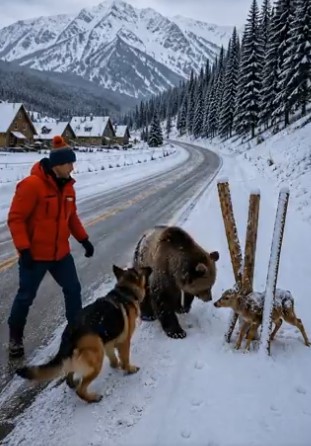
Hikers Help Young Deer Reach Safety During Snowy Forest Encounter
A quiet winter walk became an unforgettable wildlife experience
A peaceful morning in a snow-covered forest took an unexpected turn when a group of hikers discovered fresh tracks leading toward a quiet clearing.
The unusual footprints immediately caught their attention. Curious but cautious, the hikers followed the trail slowly until they noticed a young deer standing in an area of deep snow.
The animal appeared to be having difficulty moving comfortably through the heavy accumulation. Its small size and uncertain steps suggested that the winter terrain had become a serious obstacle.
The hikers also noticed a large bear exploring another part of the surrounding forest. The presence of both animals created a sensitive wildlife situation that required calm judgment rather than sudden intervention.
Instead of moving closer, the group stopped and watched from a safe distance. They understood that approaching too quickly could frighten the deer, disturb the bear, or create unnecessary danger for everyone involved.
The hikers chose patience over immediate action
The group carefully observed the clearing before deciding what to do. Their first priority was avoiding any behavior that might make the situation more stressful.
The young deer seemed uncomfortable in the deep snow, but the hikers did not know whether it was injured, exhausted, or simply struggling to find firmer ground.
They also recognized that the bear was a wild animal moving naturally through its habitat. Although its presence made the encounter appear dramatic, the hikers did not assume that it needed to be approached or chased away.
Sudden movement, loud voices, or an attempt to physically reach the deer could have caused both animals to react unpredictably. The group therefore remained quiet and allowed enough space for the wildlife to move freely.
Their response demonstrated an important principle of responsible outdoor behavior: helping an animal does not always mean touching it or immediately entering its space.
Sometimes the most useful first action is simply to stop, observe, and understand what is happening before making a decision.
Winter creates difficult conditions for young wildlife
Snow-covered forests may look peaceful, but winter can create significant challenges for the animals that live there.
Deep snow makes movement slower and more tiring. Animals must use additional energy to travel, search for food, and reach places that offer shelter.
Young animals can face even greater difficulty because they are smaller and may have less experience navigating changing terrain.
The deer in the clearing appeared to be struggling because the snow was deep enough to limit its movement. Each step required effort, and the surrounding ground did not provide an obvious path toward an easier area.
Food can also become harder to locate during winter. Plants may be buried, familiar paths may disappear, and harsh conditions can make ordinary travel more demanding.
These seasonal challenges are part of the natural world, but they can occasionally place a young animal in a situation where professional assistance may be appropriate.
The group contacted wildlife professionals
After observing the area, one member of the hiking group quietly contacted the regional wildlife service.
The others remained in place and continued watching the deer and the bear from a respectful distance.
Calling trained responders allowed the hikers to seek help without attempting an unsafe rescue themselves. Wildlife professionals have the experience needed to evaluate an animal’s condition and determine whether intervention is necessary.
The hikers’ goal was to protect the young deer while avoiding unnecessary interference with the bear or the wider forest environment.
They understood that the bear was not behaving unnaturally. It was simply moving through the area and exploring its surroundings as part of its normal activity.
Rather than treating the bear as an enemy, the group waited patiently and allowed it to continue on its way.
The bear gradually moved deeper into the forest
As time passed, the bear slowly wandered farther away from the clearing.
The hikers did not attempt to direct its movement. They remained still and gave the animal enough space to leave the area naturally.
Once the bear had moved deeper into the woods, the situation became safer for the wildlife team to approach.
The gradual departure also reduced the possibility that the deer would become more frightened by activity around the clearing.
The hikers continued to watch quietly until the trained responders arrived. Their patience helped preserve a calm environment during a moment that could easily have become chaotic.
By refusing to rush, shout, or move toward the animals, the group avoided adding further pressure to an already challenging situation.
The wildlife team approached with care
When the wildlife professionals reached the clearing, they moved slowly and spoke quietly.
Their calm approach reflected their experience with animals in stressful or unfamiliar conditions.
They did not immediately grab or restrain the young deer. Instead, they first examined the surrounding snow and considered how the terrain was affecting its ability to move.
The deer remained relatively calm as the team assessed the area. Avoiding direct handling helped reduce the possibility of panic or injury.
The responders recognized that the animal’s main difficulty appeared to be the depth of the snow rather than an immediate need to be carried away.
They therefore focused on changing the conditions around the deer rather than forcing the animal to move unnaturally.
A safer path was created through the snow
The wildlife team began creating a more manageable route through the deep snow.
By clearing and compressing sections of the path, they made it easier for the deer to step forward without sinking as deeply.
This method allowed the animal to remain in control of its own movement. It also reduced the amount of energy needed to reach firmer ground.
The responders worked carefully, avoiding loud noises and sudden gestures. Every action was designed to encourage movement without frightening the deer.
Rather than pulling or carrying it, they gave the young animal time to understand the new path and move at its own pace.
The process required patience because the deer did not immediately rush forward. It took one uncertain step at a time.
Small steps led toward safer ground
Progress was slow, but each movement brought the deer closer to an area where the snow was shallower.
The wildlife team remained nearby without crowding the animal. Their position allowed them to guide its direction while preserving enough distance for it to feel less threatened.
The hikers watched from farther away as the young deer gradually followed the newly created route.
For several minutes, the outcome remained uncertain. The animal had to regain confidence while navigating terrain that had already caused difficulty.
The responders continued using quiet movements and allowed pauses whenever the deer appeared hesitant.
This calm method prevented the situation from becoming a struggle. It also allowed the animal to use its natural instincts as it moved toward safer ground.
The deer reached an area with shallower snow
After several careful minutes, the young deer finally reached a section of the forest where the snow was noticeably less deep.
The change in terrain immediately made movement easier. Its steps became steadier, and the animal appeared more confident as it moved forward.
Everyone watching felt a sense of relief. The deer was no longer trapped in the same difficult patch of heavy snow.
The responders did not celebrate loudly or move closer after the animal reached the safer area. They continued protecting the quiet atmosphere of the forest.
Their objective was not to turn the rescue into a prolonged human interaction. It was to provide only the assistance needed for the deer to continue its natural journey.
The animal’s improved movement suggested that creating the path had been enough to help it overcome the immediate obstacle.
The team continued monitoring the area
The wildlife professionals remained nearby for a period of time after the deer reached firmer ground.
They watched to ensure that it could move comfortably and did not show signs of becoming trapped again.
This monitoring was an important part of the response. Leaving immediately could have made it difficult to know whether the animal had truly reached a manageable location.
Once the team was satisfied that the deer could continue moving, the responders began withdrawing quietly from the area.
They avoided following the animal deeper into the forest. Continued pursuit could have caused stress or interfered with its normal behavior.
The deer was allowed to choose its own direction and disappear naturally among the trees.
The hikers witnessed a lesson in responsible assistance
What began as an ordinary winter walk became a lasting experience for the group of hikers.
They had entered the forest expecting peaceful scenery and fresh air. Instead, they witnessed how thoughtful decisions can affect the outcome of a sensitive wildlife encounter.
The group realized that their most important contribution had not been a dramatic physical rescue. It had been their willingness to remain calm, maintain distance, and contact people with the proper training.
Had they rushed toward the deer, they might have frightened it into deeper snow. They could also have disturbed the bear or placed themselves in danger.
By slowing down and observing, the hikers gave the situation time to develop safely.
The experience showed them that compassion must be combined with awareness. Good intentions alone are not always enough when wild animals are involved.
Forests are shared homes for many species
Encounters between animals are a natural part of life in the forest.
People may interpret the presence of a bear near a young deer as an immediate crisis, but wildlife behavior should be observed carefully before conclusions are made.
In this case, the bear eventually moved away without direct human interference. The deer then received limited assistance from trained professionals.
The outcome respected both animals and the environment they shared.
Forests provide shelter, food, travel routes, and protected spaces for many species. Visitors enter these habitats temporarily and have a responsibility to avoid unnecessary disturbance.
Maintaining distance, controlling noise, and staying on appropriate routes can help reduce the impact of human activity on wildlife.
Healthy habitats help animals survive changing seasons
The young deer’s experience also highlighted the importance of protecting natural habitats.
Healthy forests provide animals with different types of terrain, areas of shelter, and access to seasonal food.
During winter, these resources become especially important. Animals need places where snow is shallower, trees offer protection, and movement is less demanding.
When natural habitats remain intact, wildlife has more opportunities to adapt to difficult weather conditions.
Responsible visitors support these environments by avoiding damage, removing waste, and respecting areas used by animals.
Even a quiet forest can be filled with activity that people do not immediately see. Tracks in the snow often reveal how many animals depend on the same landscape.
Kindness and experience worked together
The wildlife team’s actions demonstrated that compassion is most effective when guided by knowledge.
The responders did not handle the deer simply because they had the ability to approach it. They first examined the situation and selected the least disruptive form of assistance.
Creating a path through the snow allowed the animal to remain active and independent. It also reduced the risks associated with unnecessary restraint.
The team’s quiet voices and slow movements helped keep the deer calm throughout the process.
The hikers also contributed by listening, maintaining their distance, and allowing trained professionals to manage the situation.
Cooperation between the public and wildlife services can create better outcomes when animals appear to be in difficulty.
Young animals may need additional consideration
Wild animals adapt to winter in remarkable ways, but young animals may experience additional challenges.
They are still learning how to move through unfamiliar terrain, locate safe routes, and respond to changing conditions.
Deep snow can be especially demanding because smaller animals may sink more easily and become tired more quickly.
However, a young animal that appears alone or uncomfortable does not always require immediate human contact.
Its parent may be nearby, or the animal may be capable of solving the difficulty if given enough time and space.
Careful observation and professional guidance help determine whether intervention is appropriate.
The deer disappeared into the winter landscape
Once it reached the shallower snow, the young deer continued moving through the forest.
Its steps became more secure as it traveled away from the clearing.
Before long, the animal disappeared among the trees, leaving only fresh tracks behind in the snow.
For the hikers, those tracks became a quiet reminder of everything they had witnessed.
The encounter showed that a meaningful act of compassion does not need to be forceful or dramatic.
Patience, respect, and a willingness to seek professional help were enough to give the deer a safer opportunity to continue its journey.
What to do when a wild animal appears to be in trouble
Anyone who discovers a wild animal in a difficult situation should begin by keeping a safe distance.
Observe quietly and avoid making sudden movements that could frighten the animal or cause it to move into greater danger.
Do not assume that an animal needs to be touched, carried, fed, or removed from its surroundings.
If assistance appears necessary, contact local wildlife authorities or trained rescue professionals and describe the situation clearly.
Remain in a safe place while waiting for guidance. Do not approach large animals or enter an area where another wild animal may be present.
The safest response protects the observer as well as the wildlife.
Baby Deer Found in the Snow During an Unexpected Encounter With a Large Bear pic.twitter.com/tB88DAbh9D
— Animal Rescue Stories (@AnimalStory5) August 3, 2026
Should people attempt a wildlife rescue themselves?
Direct intervention should only be considered when it can be done safely and does not create a greater risk for the person or the animal.
In most wildlife situations, trained professionals are better prepared to respond because they understand animal behavior and have suitable equipment.
An untrained rescue attempt can cause stress, injury, or separation from the animal’s natural surroundings.
The hikers in this forest made the responsible choice by remaining calm and contacting the regional wildlife service.
The professionals then used the least invasive method available, helping the deer reach shallower snow without unnecessary handling.
The positive outcome offered a lasting lesson: responsible wildlife assistance begins with patience, awareness, and respect for nature.