

Oklahoma City Liquor Store’s “Pull Your Pants Up” Sign Sparks Debate Among Customers
Store Management Says the Rule Is About Decency, Respect and Concerns Inside the Business
A liquor store in Oklahoma City drew widespread attention after posting a blunt message telling customers to pull up their pants before entering the business.
The sign at Midwest Wine and Spirits was aimed specifically at people wearing their pants low enough for their underwear or part of their backside to remain visible.
Management made its position unmistakable.
Customers unwilling to follow the rule were told they were not welcome inside.
The policy quickly generated debate, with some people supporting the store’s right to establish standards for customers while others questioned whether such a rule could unfairly target certain people.
Despite the controversy, store representatives defended the sign and said they considered extremely low-sagging pants disrespectful to other customers.
Repeated Encounters With Sagging Pants Led to the Sign
Management explained that the message did not appear without a reason.
Employees had repeatedly encountered customers entering the liquor store with their pants hanging so low that their underwear and portions of their backside were exposed.
Eventually, the store decided a direct notice was necessary.
The message was deliberately simple and impossible to misunderstand.
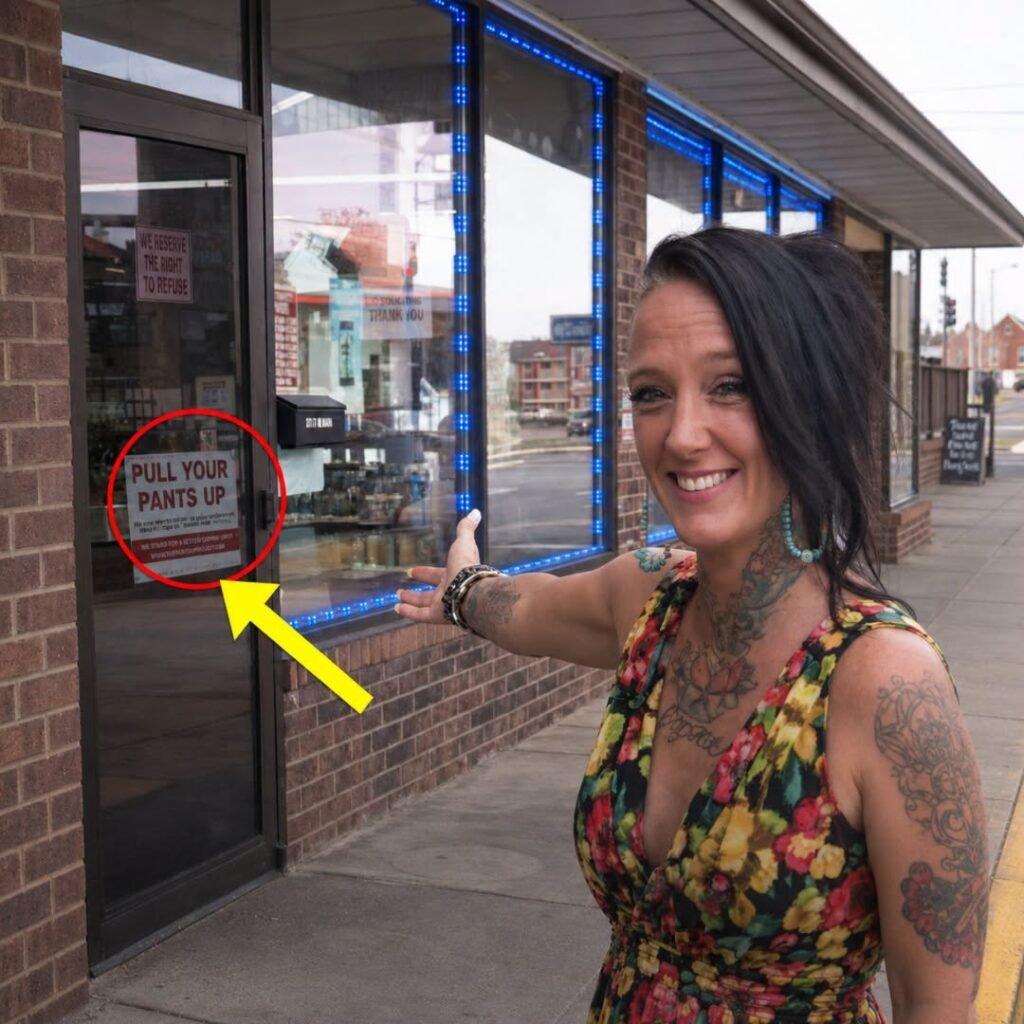
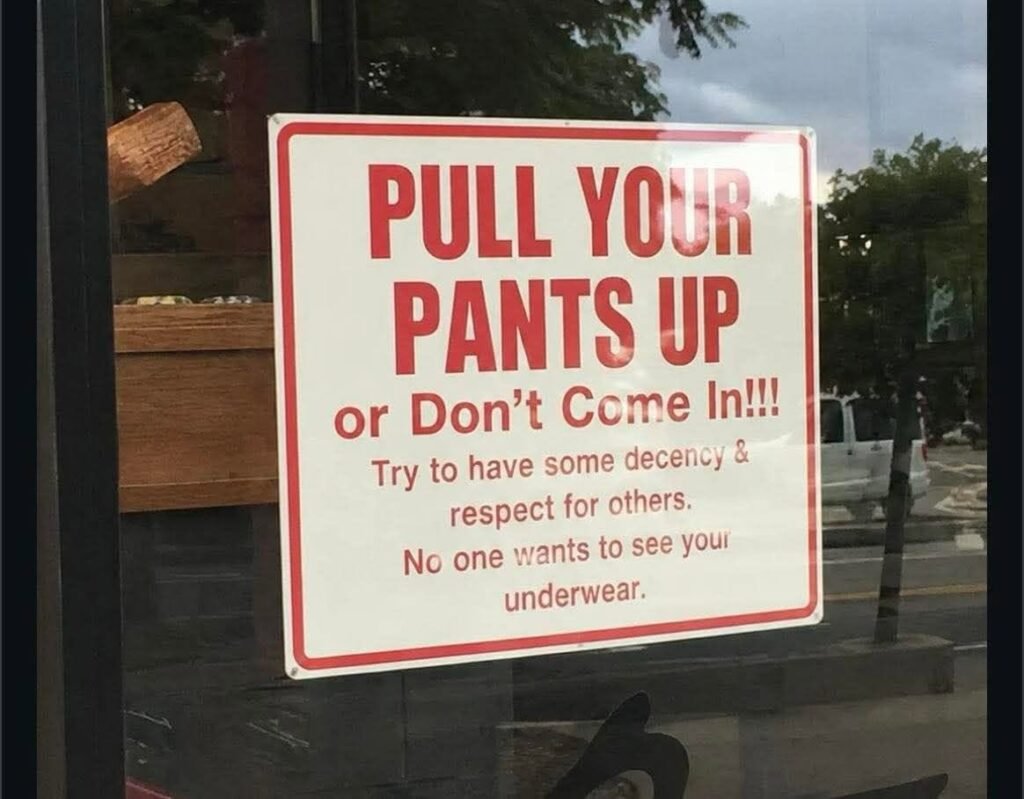
“Pull your pants up or don’t come in!!! the sign reads. “Try to have some decency & respect for others. No one wants to see your underwear.”
Rather than approaching every individual customer after entering the store, management chose to communicate the expectation before people came inside.
The sign effectively established a dress standard for anyone wishing to shop there.
Manager Says the Fashion Choice Is Offensive to Him
One of the store’s managers, Chad Gilbert, acknowledged that sagging pants are considered a fashion choice by some people.
That did not change his personal view of the style.
“I realize wearing pants low is a fashion statement for some, but it doesn’t work for me, and I find it somewhat offensive,” Chad Gilbert, one of the managers said.
For Gilbert, the issue centered on what customers should reasonably be expected to cover while inside a business shared with other members of the public.
He did not believe other shoppers should have to see someone’s underwear or exposed backside while purchasing items.
The store therefore chose to establish a boundary and communicate it publicly.
The Rule Immediately Divided Opinion
Not everyone who encountered the policy agreed with the reasoning behind it.
Some critics viewed the message as unnecessarily judgmental.
Others raised concerns about whether enforcement could become discriminatory if particular groups were treated differently.
Customer Sunshine Weatherby questioned whether a liquor store was the most appropriate business to make a moral argument about clothing.
“I can see that if it was like a church,” Sunshine Weatherby (above) said. “There are families there, you might have a problem with that, but this is a liquor store. I’ve seen worse at a liquor store.”
Her criticism focused less on whether sagging pants were attractive and more on whether the business should place itself in the position of judging customers’ appearance.
One Customer Said Consistent Enforcement Matters
Weatherby did not necessarily insist that the sign had to be removed.
She recognized that businesses generally make decisions about the conduct they allow inside their establishments.
Her larger concern involved how such a policy would be applied.
If every customer violating the same clothing standard was treated equally, she indicated she could accept the store’s decision.
If the sign instead became a means of treating customers differently because of race, she believed that would cross an important line.
That distinction became one of the central issues surrounding the debate.
A rule about visible underwear could be understood as a general dress requirement, but critics were concerned about whether enforcement would remain neutral.
Employees Also Raised a Security Argument
Store workers said the controversy was not exclusively about appearance.
They also connected loose, sagging clothing with concerns about theft.
Employee Shana Wiessner said she pays closer attention to customers who enter with their pants hanging particularly low.
“Usually, when people come in with their pants sagging, it’s easier for them to steal bottles,” Shana Wiessner said.
From the employee’s perspective, extremely loose clothing could make it easier to conceal merchandise.
That gave staff another reason to dislike the style inside a store filled with bottles and other products that could potentially be hidden beneath clothing.
Workers Say They Watch Certain Situations More Closely
Wiessner explained that she keeps a particularly close eye on people whose clothing could potentially make concealment easier.
She said increased attention sometimes resulted in people being caught attempting to hide bottles inside their clothing.
For employees, that experience helped turn the issue from a simple disagreement over fashion into a business-security concern.
A retail store has to balance customer comfort with protecting merchandise.
Management believed the dress requirement assisted with both.
The public reaction, however, showed that not everyone interpreted the sign in the same way.
The Sign Uses Deliberately Strong Language
There is little ambiguity in the wording chosen by the store.
Rather than politely suggesting that customers adjust their clothing, the sign directly tells them to pull up their pants or stay outside.
That forceful tone was part of what made the message attract so much attention.
Some people appreciated its bluntness.
They believed businesses should be able to ask customers to maintain basic standards of dress and avoid exposing underwear to other shoppers.
Others felt the wording sounded confrontational and carried unnecessary judgment about a style of clothing.
The debate quickly became about much more than one Oklahoma City liquor store.
Sagging Pants Have Long Generated Strong Reactions
Clothing styles often create disagreements between generations and communities.
Sagging pants are no exception.
For people who wear them, the style can be viewed simply as personal expression.
For people who dislike the appearance, visible underwear can be interpreted as inappropriate in shared public spaces.
The disagreement becomes more complicated when a private business establishes rules around that clothing.
Customers may view their clothing as a personal choice, while a business owner may believe that entering private commercial property means accepting certain standards.
Midwest Wine and Spirits placed itself directly in the middle of that debate with its sign.
Management Focused on What Other Customers Have to See
The store’s justification repeatedly returned to consideration for other shoppers.
Employees said they did not want customers having to look at exposed underwear or backsides while inside the business.
From that perspective, the rule was framed as one involving public decency rather than individual fashion preference.
A person could choose to wear sagging pants elsewhere, but management did not want the style displayed in that manner inside the store.
The sign therefore acted as notice that customers were expected to adjust their clothing before entering.
Critics Questioned the Store’s Moral Position
The fact that the business sells alcohol added another dimension to the discussion.
Weatherby’s comments highlighted what she considered an inconsistency.
She suggested that strict standards of modesty might make more immediate sense in a church or another family-oriented setting.
A liquor store, in her view, was already a place where customers could encounter behavior that some people might consider less traditional.
That did not mean she defended exposing oneself in public.
Her point was that context mattered when a business presented a clothing rule as a matter of decency.
Business Rights and Customer Expectations Collided
The controversy also raised a broader question about how much control private businesses should exercise over customers’ appearance.
Stores commonly establish rules related to behavior, safety and clothing.
Customers, meanwhile, may object when those standards appear overly restrictive or insulting.
Midwest Wine and Spirits made clear that it expected anyone entering the property to keep their pants high enough to cover their underwear.
Those unwilling to comply could shop elsewhere.
For supporters of the sign, that was a straightforward business decision.
For critics, the concern was whether the rule would be applied fairly and without prejudice.
The Possibility of Discriminatory Enforcement Became a Key Concern
Weatherby’s position illustrated the difference between objecting to a rule itself and objecting to how a rule might be enforced.
She did not argue that customers should automatically have the right to ignore every standard established by a business.
Her concern centered on equal treatment.
If two people entered the store with similarly sagging pants, both should face the same response.
The controversy would become much more serious if certain customers were singled out while others were allowed to ignore the same rule.
That concern explains why some people viewed the sign through a racial lens even though management described its motivation as behavior and appearance.
The Store Maintained That Its Motive Was Straightforward
Management continued defending the policy as a response to clothing they considered inappropriate.
Their position was that no customer should have to see another person’s underwear or exposed backside while shopping.
Employees also believed excessively loose clothing could create practical problems involving concealed merchandise.
Those two concerns formed the primary justification for keeping the sign in place.
The store did not attempt to hide its opinion behind vague wording.
It wanted customers to know the rule before they walked through the door.
Note: we are republishing this story, which originally made the news in September 2016.
Security Concerns Added Practical Weight to the Policy
The theft concern described by Wiessner gave the discussion a different dimension from simple aesthetics.
Retail employees routinely watch for behavior that could make shoplifting easier.
According to the store worker, sagging and loose pants had been associated with attempts to conceal bottles.
That experience influenced how she monitored shoppers entering the store.
For staff members, the issue therefore involved both customer appearance and loss prevention.
The store had merchandise to protect, and employees believed certain clothing could make theft easier.
A Simple Sign Became a Much Larger Conversation
The situation demonstrated how quickly a small notice posted at one business could become part of a broader social debate.
At its most basic level, the store was telling customers to keep their underwear covered.
But the message touched on questions involving personal expression, respect, discrimination, private property and business security.
Different people naturally focused on different parts of the controversy.
Some saw basic etiquette.
Others saw unnecessary policing of clothing.
Some focused on the store’s right to set rules.
Others worried about who might be most heavily affected by those rules.
Supporters Saw the Sign as a Reasonable Request
People sympathetic to the store’s position argued that covering underwear in a public business is not an extreme expectation.
From that viewpoint, customers remain free to choose their clothing but should make modest adjustments when entering someone else’s establishment.
They also understood why employees might be frustrated after repeatedly encountering people whose pants were hanging particularly low.
The sign offered a simple solution.
Instead of having the same conversation repeatedly, the expectation was posted where everyone could see it.
Opponents Focused on Tone and Potential Bias
People uncomfortable with the policy had different concerns.
Some objected to the confrontational language.
Others questioned whether clothing should determine who is considered respectful enough to enter a liquor store.
The most serious criticism involved the possibility that the policy could become discriminatory.
A neutral dress requirement and discriminatory treatment are not the same thing.
That is why equal enforcement became so important to people such as Weatherby.
The Store Refused to Back Away From Its Position
Despite the criticism, Midwest Wine and Spirits continued standing behind the sign.
Management believed customers should dress with enough consideration that other shoppers are not forced to see exposed underwear.
Employees also remained concerned about situations in which loose clothing might make it easier to conceal bottles.
For them, the policy addressed problems they had encountered inside the store rather than an abstract debate over fashion.

The Debate Ultimately Comes Down to Where the Line Should Be Drawn
Few people would argue that businesses should have absolutely no ability to establish behavioral standards.
At the same time, customers reasonably expect those standards to be applied consistently.
The Oklahoma City sign sits directly between those principles.
Management considers visible underwear inappropriate and has chosen to restrict it.
Some customers consider that a reasonable request.
Others believe the language and assumptions surrounding sagging pants deserve greater scrutiny.
A Decade-Old Controversy Still Raises Familiar Questions
The story originally attracted attention in September 2016, but the disagreement behind it remains easy to understand.
Clothing continues to generate arguments over personal freedom, social expectations and what businesses can reasonably demand from customers.
For Midwest Wine and Spirits, the answer was direct.
If someone wanted to enter the store, management expected that person to pull up their pants and keep their underwear covered.
The sign may have been only a few lines long, but the reaction showed how much meaning people could attach to those words.
To supporters, it represented basic respect.
To critics, it raised questions about judgment and potential discrimination.
To employees, it also represented a practical response to behavior they believed could contribute to theft.
Years later, the controversy still leaves the same central question for readers to consider: how far should a private business be allowed to go when establishing standards for the appearance and conduct of its customers?