
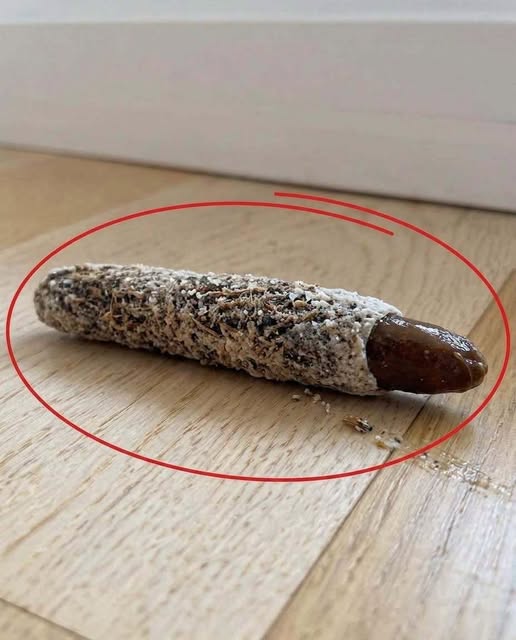
This Strange Dusty Tube on the Floor Isn’t Trash—It May Be a Tiny Creature’s Portable Home
The Odd Little Object Looked Harmless Until Someone Took a Closer Look
At first, it looked like nothing worth noticing.
Just a small, dull tube resting on the floor.
Dusty.
Grayish.
Easy to mistake for a clump of lint, a dried leaf fragment, or some debris that had fallen from furniture.
It was exactly the kind of thing most people would sweep up or vacuum without a second thought.
But the longer I looked at it, the stranger it seemed.
Something About the Shape Felt Too Deliberate
The object did not look completely random.
Its sides appeared structured.
Dust and fibers seemed pressed together in a way that suggested organization rather than accident.
It looked almost as though something had carefully assembled it.
That was when curiosity replaced the urge to throw it away.
Then Someone Asked a Question That Changed Everything
“What if it came from an animal?”
Suddenly, the strange little tube became far more interesting.
If it was not ordinary household debris, what exactly was it?
Was something still living inside?
Had it fallen from a wall or ceiling?
Was it dangerous?
Or was it simply part of a tiny natural process most people never notice?
The Answer Was Smaller Than Expected
Research eventually pointed toward a case-bearing moth larva, commonly referred to in household discussions as a plaster bagworm.
The strange tube was not simply a pile of dust.
It was a protective case.
A tiny larva builds the structure around itself and carries it as it moves.
What looked like discarded debris was actually shelter.
The Case Is Built From Materials Already Inside the Home
The most fascinating part is how ordinary the building materials can be.
Fibers.
Dust.
Hair.
Lint.
Other tiny pieces of material found in the surrounding environment.
To a person, those things are barely worth noticing.
To the larva, they can become the walls of a portable protective case.
That Explains Why the Object Blends In So Well
Because the case is made from materials collected from its surroundings, it can look remarkably similar to ordinary household dust.
Its muted color helps it disappear against walls, floors, baseboards, and other surfaces.
Unless someone happens to notice the shape or sees it moving, the case can easily be mistaken for trash.
The Larva Carries Its Shelter With It
Unlike an animal that lives permanently inside a fixed nest, the case-bearing larva moves while partially protected by its case.
The structure becomes a kind of mobile shelter.
The larva can extend part of its body when it needs to move or feed and retreat inside when disturbed.
That makes the strange dusty tube far more sophisticated than it first appears.
A Tiny Animal Has Turned Household Debris Into Architecture
That was the detail that changed the discovery from unsettling to fascinating.
The materials seemed worthless.
Yet the larva had used them deliberately.
Something most people would call dust had become protection.
The case was evidence of a tiny animal adapting to the environment people created around it.
These Cases Can Appear in Quiet Areas of a Home
People may notice them on walls, near baseboards, in corners, or on other relatively undisturbed surfaces.
They can also turn up in places where lint, hair, and fine debris accumulate.
Because the cases are small and visually blend into their surroundings, they may be present for some time before anyone notices them.
Movement Is Often the Biggest Clue
A piece of ordinary lint stays where it falls.
A larval case may slowly change position.
That movement can be subtle.
Someone may first notice that the mysterious object is no longer exactly where it was a few hours earlier.
Watching carefully may reveal the tiny animal extending from one end and slowly carrying the case along.
That Can Be Startling If You Are Not Expecting It
A dusty object moving across a wall or floor naturally attracts attention.
Without knowing what it is, people may imagine something far more alarming.
The unfamiliar often feels threatening simply because the brain has no immediate category for it.
Once the object is identified, however, much of that fear disappears.
The Name “Plaster Bagworm” Can Sound More Dramatic Than the Creature Looks
The common name can make the animal sound much larger or more dangerous than the tiny larva inside the case.
In reality, what people usually notice is the small portable shelter rather than the larva itself.
The case is the most visible part of the encounter.
The Discovery Is a Reminder That Homes Are Small Ecosystems
People tend to think of indoor spaces as completely separate from nature.
Walls, windows, floors, and furniture create the feeling of a controlled environment.
But tiny organisms still find opportunities inside.
They use the warmth.
They use the shelter.
They use the microscopic materials people leave behind.
Entire Lives Can Be Happening Beneath Our Notice
We move through rooms quickly.
We sweep.
We vacuum.
We wipe surfaces clean.
Most of the time, we never consider what might be happening on a scale small enough to disappear beneath our attention.
Then something unusual appears on the floor and forces us to look closer.
That Is What Made This Discovery So Memorable
The object itself was tiny.
The reaction to it was not.
At first, there was uncertainty.
Then suspicion.
Then curiosity.
Finally, understanding.
What looked like meaningless debris turned out to have a purpose.
Not Every Strange Household Find Is a Sign of Immediate Danger
People naturally become cautious when they discover something unfamiliar indoors.
That caution is useful.
Unknown insects, droppings, nests, stains, or damaged materials can sometimes indicate a problem that needs attention.
But unfamiliar does not automatically mean dangerous.
Identifying the object before reacting can prevent unnecessary panic.
Observation Can Tell You a Lot
Look at the shape.
Notice whether it moves.
Check whether there are several similar cases nearby.
Look at the surrounding area for lint, hair, webbing, or other material.
Small details can help separate ordinary debris from something biological.
The Structure of the Case Is Particularly Interesting
It may look roughly textured from a distance.
Up close, the materials appear incorporated into a compact enclosure.
The case protects the softer body inside while still allowing the larva to move.
It is a simple structure, but remarkably effective for something built from such insignificant materials.
The Case Also Acts as Camouflage
Because it resembles the environment, the larva is less visually obvious than it would be if moving around completely exposed.
The shelter hides its shape and helps it blend into the surroundings.
A person sees a dusty speck.
The larva gains protection.
There Is Something Remarkable About That Use of Materials
Humans tend to assign value based on usefulness to us.
Dust is unwanted.
Lint is discarded.
Loose fibers are cleaned away.
But another creature can use exactly those materials as resources.
What one species sees as waste can become another species’ shelter.
That Shift in Perspective Makes the Object Less Unpleasant
At first, the tube may inspire disgust or concern.
Once its function is understood, it becomes easier to appreciate the ingenuity involved.
The object is not simply dirt.
It is evidence of behavior.
Construction.
Adaptation.
Of Course, Most People Still Do Not Want Large Numbers of Them Indoors
Finding one strange case can be an interesting discovery.
Finding many may encourage someone to look more carefully at the environment.
Areas with accumulated lint, hair, spider webs, or other organic material may provide more resources for small household insects.
Regular cleaning can reduce some of the material available to them.
Vacuuming Quiet Corners Can Be Helpful
Baseboards, closets, corners, and areas behind furniture are easy to overlook.
These spaces can collect dust and fibers for long periods.
Routine vacuuming and removal of webbing can make the environment less attractive to creatures that rely on those materials.
Humidity Can Also Influence Indoor Insect Activity
Many small household organisms do better where moisture is available.
Bathrooms, laundry areas, storage rooms, and other humid spaces often support more insect activity than dry, well-ventilated areas.
Reducing excess moisture can therefore be useful as part of general household maintenance.
That Does Not Mean Every Tiny Case Requires a Major Response
One isolated find does not automatically mean a serious infestation exists.
The important thing is context.
Are there many cases?
Are they repeatedly appearing?
Is there visible damage to fabrics or stored materials?
Those observations are more informative than panic over a single mysterious object.
The Discovery Can Also Encourage Better Household Awareness
People often clean on autopilot.
Something looks like dust, so it disappears into the vacuum.
But occasionally slowing down reveals a surprising amount of detail.
A tiny insect case.
A shed skin.
A miniature web.
Small traces of animals sharing the space without ever being noticed.
Nature Does Not Stop at the Front Door
That is perhaps the larger lesson.
Buildings create boundaries for people.
They do not completely exclude the natural world.
Tiny animals adapt to cracks, corners, fabrics, warmth, and moisture.
Some species have become remarkably successful at living close to humans.
The Plaster Bagworm Is Easy to Overlook Precisely Because It Is So Well Adapted
Its portable case does not announce itself.
It blends in.
It uses material already present.
It occupies spaces where people rarely focus their attention.
That makes it almost invisible until someone happens to notice the unusual shape.
The Mystery Often Begins With One Simple Question
What is that?
That question can turn a routine cleaning moment into a miniature investigation.
You look closer.
You notice the fibers.
You notice the symmetry.
You realize the object may have been built rather than broken.
Suddenly, the floor looks slightly different.
The Answer Changes the Feeling Completely
Before identification, the strange tube can feel eerie.
Afterward, it becomes understandable.
A tiny larva has built a case from household material and is carrying it around as protection.
The mystery disappears.
Wonder replaces it.
That Is One of the Benefits of Learning What We Find Around Us
Knowledge does not necessarily make every insect welcome.
But it helps put things into proportion.
Instead of imagining the worst, you can understand what the animal is doing and decide calmly whether any action is needed.
Fear Often Comes From the Missing Explanation
A familiar object is rarely frightening.
An unfamiliar one can immediately trigger suspicion.
Once the strange object has a name and a purpose, it becomes easier to view it objectively.
The dusty tube is no longer an unexplained thing.
It is a shelter.
And That Shelter Is Surprisingly Ingenious
The larva does not have access to manufactured building materials.
It uses whatever the environment provides.
Fibers become walls.
Dust becomes camouflage.
Loose material becomes protection.
A creature almost too small to notice creates something complex enough to travel with it.
It Is Easy to Forget How Much Engineering Exists in Nature
Birds build nests.
Spiders build webs.
Bees create structured colonies.
And tiny larvae can construct protective cases from scraps most people would throw away.
The scale is different.
The principle is similar.
What Looked Like Trash Had Been Carefully Repurposed
That is why the discovery lingered in my mind.
It was not because the creature was dramatic.
It was because something so easily dismissed had turned out to contain a whole story.
An animal had collected material.
Built protection.
Moved through the house.
And done all of it almost completely unnoticed.
The Object Became a Reminder to Look More Closely
We assume we understand familiar spaces.
The kitchen is the kitchen.
The hallway is the hallway.
The floor is just the floor.
But closer inspection can reveal another scale of life happening alongside our own.
Even Dust Can Become Part of Something Living
That may be the most surprising part of the entire discovery.
Materials we remove without thought can become useful to a creature small enough to see the world completely differently.
A strand of hair.
A fiber from fabric.
A particle of dust.
Together, they can become a portable home.
The Strange Tube Was Not a Threatening Mystery After All
It was simply unfamiliar.
Once identified, the fear faded.
The discovery became less about something disturbing hiding inside the house and more about how resourceful tiny creatures can be.
Sometimes the Most Interesting Things Are the Ones We Almost Throw Away
Had the object been swept up immediately, nobody would have thought about it again.
Instead, curiosity turned a piece of apparent debris into a lesson about adaptation.
The longer I considered it, the less unsettling it became.
And the more impressive it seemed.
Not Every Strange Discovery Means Something Is Wrong
Sometimes an unfamiliar object is simply evidence that another form of life has found a way to exist quietly in the same environment.
It is still reasonable to keep a home clean and address repeated insect activity when necessary.
But there is also value in understanding before reacting.
The Dusty Case Told a Much Bigger Story Than Its Size Suggested
It began as something easy to mistake for trash.
Then the careful structure raised questions.
Those questions led to the case-bearing moth larva.
And suddenly, something ordinary became fascinating.
A tiny animal had gathered forgotten material from a human home and transformed it into protection.
Sometimes Dust Really Can Become a Home
The next time a strange little tube appears on a wall, floor, or quiet corner, it may be worth looking before reaching for the broom.
It could simply be lint.
Or it could be evidence of a hidden life operating on a scale most of us rarely notice.
That does not make every household insect welcome.
But it does make the world inside our homes a little more interesting.
Because sometimes the object we almost throw away is not debris at all.
It is architecture built from dust, fiber, and instinct by a creature small enough to turn the forgotten pieces of our lives into a place to live.