
A Young Man Mocked an Elderly Woman on a Bus—Then She Recognized His Father’s Face
Fiction: The Stranger Who Knew His Name
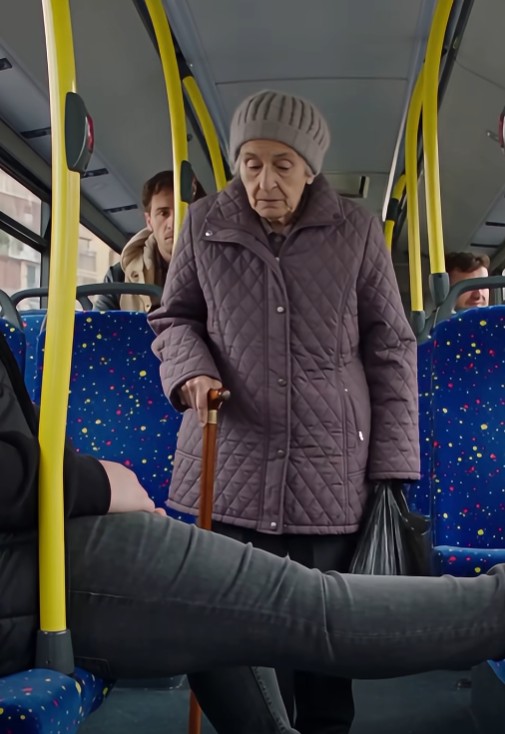
Álvaro stretched his leg across the aisle, blocking the passage beside his seat. In front of him stood an elderly woman leaning on a walking cane, a plastic bag hanging from her hand.
Several passengers watched without intervening. The woman in a beige jacket seated nearby had stopped pretending not to notice.
Doña Carmen remained where she was. She was small and slender, but the young man’s laughter did not persuade her to retreat.
She asked his name again. Álvaro dismissed the question, apparently assuming she wanted to complain about him.
Carmen studied his face instead of arguing. Her gaze moved over his nose, his jaw, and the small scar that distinguished him.
Then her expression changed. She said his surname was Medina.
The laughter stopped.
Álvaro straightened, suddenly interested in the woman he had been trying to ignore. He asked how she knew him.
Carmen explained that she did not know him personally. But she knew his father, Rafael Medina.
The bus continued along the avenue while Álvaro stared at her. Around them, the other passengers grew quieter.
Thirty years earlier, Carmen told him, Rafael had been about his age. He had also laughed too readily and behaved as though nothing could happen to him.
Álvaro asked where she had met his father.
Her answer was the hospital.
A Hospital Stay His Father Had Never Mentioned
Álvaro immediately objected. His father had never worked in a hospital, and he could not imagine what connection this woman might have had to him there.
Carmen explained that Rafael had been a patient. He had remained hospitalized for almost four months after a serious car accident.
The young man shook his head. He had never heard that story.
Carmen did not insist that he accept it simply because she said so. She told him he could ask his father when he returned home.
Rafael had been twenty, she continued. He had driven too fast and believed himself beyond danger until the car left the road.
Then Carmen mentioned the other person involved: Rafael’s closest friend, Miguel.
Álvaro recognized the name. A photograph of Miguel stood in his father’s office, although Rafael had never offered much explanation beyond describing him as an old friend.
Hearing that name from a stranger made the story harder to dismiss. Álvaro rose abruptly and demanded to know who Carmen was.
She calmly told him to sit down.
He obeyed, surprising himself as much as the passengers watching. The confidence he had displayed a few minutes earlier was beginning to give way to uncertainty.
Carmen explained that she had been a nurse. She had cared for Rafael during the weeks when his injuries left him unable to move freely and unwilling to imagine a future beyond his hospital bed.
The Grandmother Who Stayed Beside the Bed
As Carmen spoke, Álvaro began looking at her differently. Until then, he had barely considered the life she might have lived before becoming the elderly woman standing in front of him.
He asked why Rafael had never mentioned her.
Carmen suggested that someone else had occupied the most important place in that part of his father’s story: a woman named Teresa.
Álvaro went pale. Teresa was his grandmother.
Carmen remembered her sleeping in a chair beside Rafael’s bed. She ate cold sandwiches, refused to leave, and watched her son direct his anger toward the doctors, the world, and himself.
Rafael had sometimes said he did not want to continue living. Álvaro struggled to reconcile that account with the father he knew.
Carmen explained that Teresa had been devastated. When Rafael refused rehabilitation, his mother had hoped Carmen could persuade him to cooperate.
Álvaro wanted to know what she had done.
She admitted that she had made him angry. Her words had been harsh, challenging him about an opportunity he appeared ready to abandon.
The following day, he had begun rehabilitation.
Carmen presented that exchange as something that had happened between them, not as a simple answer to everything Rafael had suffered. His recovery had taken time, and Teresa had remained beside him.
Listening, Álvaro finally noticed how long Carmen had been standing with her weight supported by the cane.
An Empty Seat Becomes an Uncomfortable Lesson
Álvaro asked why Carmen had wanted his name in the first place. She explained that his face—and particularly his arrogant smile—had reminded her of Rafael.
A few nearby passengers reacted quietly. Álvaro flushed, but Carmen was not trying to entertain them.
She glanced toward his extended leg and reminded him that his father had spent months unable to walk normally. During that time, Rafael would have understood the value of being able to reach a seat.
Álvaro looked down at the obstruction he had created.
He withdrew his leg completely and stood, offering Carmen his place. She hesitated, making clear that she did not want a gesture performed only from guilt.
He could not honestly deny that guilt was part of it. But he remained standing and waited until she accepted.
Once seated, Carmen settled her bag beside her. Álvaro held the yellow pole nearby, no longer attempting to take up more space than he needed.
The conversation might have ended there. He had learned something about his father, and Carmen had finally been able to rest.
Instead, she opened the plastic bag and removed an old cardboard box tied with string.
When Álvaro asked about it, she explained that it was the reason she had intended to visit Rafael.
Inside lay a dark metal watch. Álvaro recognized it immediately as something that had belonged to his grandfather.
A Watch Teresa Had Entrusted to Carmen
Álvaro believed the watch had disappeared after Teresa’s death nine years earlier. Seeing it in Carmen’s possession raised another set of questions.
She explained that it had not vanished. Teresa had given it to her during a visit a few weeks before she died.
It was meant to reach Rafael when he was ready to hear the truth.
Carmen lifted the watch and opened it. Inside was a small photograph showing two young men together.
Álvaro recognized Rafael. Beside him was Miguel, familiar from the photograph in his father’s office.
Behind them stood a young woman with dark hair, wearing a nurse’s uniform.
He looked from the picture to Carmen. She confirmed that the woman was her, at twenty-nine.
An inscription thanked her for saving both men.
Álvaro returned to those words. Carmen’s earlier account had left him believing Miguel had died after the crash, yet the dedication referred to both men surviving through her help.
Carmen’s expression became more serious. Miguel had survived, she told him.
Álvaro insisted that his father had always said otherwise. Carmen answered that people had needed to believe Miguel was dead.
Then she explained why: the crash had not been an ordinary accident. The car’s brakes had been tampered with.
Rafael had been injured, but Carmen said the intended target was Miguel.
The photograph in the watch no longer looked like a simple keepsake. It had become part of a history Álvaro realized his family had deliberately kept from him.
Álvaro Insists on Coming Along
When the bus reached Carmen’s stop, she stood and prepared to leave. Álvaro picked up her bag before she could reach for it.
He wanted to accompany her.
Carmen initially refused, telling him to speak with Rafael. But Álvaro could not see how he would obtain an honest explanation from someone who had maintained the same story for thirty years.
As the doors began closing, he signaled for them to remain open. Carmen studied him for a moment, then reluctantly accepted his help.
She remarked on his resemblance to Rafael’s stubbornness. For the first time, the comparison did not sound entirely like a criticism.
They stepped off the bus together.
Several minutes later, they arrived at a small house on the outskirts of the city. Álvaro did not recognize it as his father’s home and asked where they were.
Carmen approached the door rather than answering immediately. She knocked, waited, and knocked again.
Eventually, footsteps sounded inside.
The man who opened the door had gray hair and a deep scar along the left side of his face. At the sight of Carmen, his expression changed.
He had not expected her to return.
Then he noticed Álvaro. Tears gathered in his eyes as he studied the young man’s face.
Álvaro saw something familiar in him too: a smile resembling Rafael’s, the same resemblance that had first caught Carmen’s attention on the bus.
When he asked the man’s name, the answer was Miguel.
The Man Who Was Supposed to Be Dead
Álvaro struggled to accept what stood directly in front of him. His father’s old friend was alive, older than in the photograph but unmistakably connected to it.
Miguel confirmed that Rafael had needed to say he was dead. Before explaining further, he looked toward the street and brought them inside.
He closed the door.
Someone was still searching for him, he said. Even after thirty years, he believed the danger had not ended.
Carmen placed the watch on the table. Miguel recognized it and asked whether Teresa had given it to her.
When she confirmed that she had, he opened it carefully. Beneath the photograph was a concealed compartment Álvaro had not noticed.
Miguel pressed along its edge. A small key fell out.
Carmen had not known it was there. Miguel said Rafael had.
The key opened a security box containing evidence, he explained. Those documents concerned money stolen over several years from a company.
Álvaro asked which company.
The answer was Medina Construcciones.
It was his family’s business—the company Rafael now directed. Until that moment, the story had seemed to concern a hidden part of his father’s youth. Now it reached into the family’s present.
Miguel explained that he had been leading the company before the crash. He also made clear that Rafael had not stolen it from him.
But Rafael knew who had.
A Telephone Call Brings the Past to the Door
A sound outside interrupted the conversation. Carmen moved to the curtain and looked discreetly toward the street.
A black vehicle had stopped outside the house. Two men got out, followed by a third.
Miguel immediately concealed the key and asked whether Carmen had been followed. She shook her head.
Then Álvaro remembered the call he had made from the bus.
He had contacted his father and mentioned speaking with a woman named Carmen. At the time, he had thought he was asking about a remarkable coincidence.
Now Miguel and Carmen looked at him in silence. The young man realized that information he considered harmless might have exposed the house.
Miguel stepped back, understanding that his survival might no longer be concealed.
Álvaro asked who the men were. Carmen told him they worked for his family.
Before he could make sense of that answer, a heavy blow struck the door. Another followed.
Miguel opened a drawer, removed an envelope, and handed it to Álvaro. He instructed him to give it to Rafael if they got out.
The envelope concerned the question Rafael needed to answer: why he had allowed everyone to believe Miguel was dead.
Álvaro looked at the handwritten dedication. It was addressed to Rafael Medina from his brother.
He stared at Miguel.
The man his father had called an old friend was his uncle.
Rafael Arrives Before the Explanation Is Finished
Before Miguel could explain, the door gave way. A gray-haired man appeared in the entrance.
Álvaro recognized him immediately.
His father stepped inside and looked first at Carmen, then Miguel, and finally his son. For a moment, nobody spoke.
Rafael noticed the watch on the table. His expression changed as though its presence had confirmed something he had spent years avoiding.
Carmen stood with her cane. Thirty years had passed, she reminded him, and the objects in front of them connected that entire span: the photograph, the watch, the hidden key, and the envelope still in Álvaro’s hand.
Álvaro asked his father why he had said Miguel was dead.
Rafael closed the door behind him.
Only a short time earlier, Álvaro had been treating Carmen as an inconvenience on a bus. Now she stood at the center of a history involving his father, his grandmother, his uncle, and the company he had always understood as his family’s own.
He also needed to know why Carmen had kept the truth concealed. Her connection to Miguel was more personal than her work as a nurse, and the reason for her silence reached into Álvaro’s own life.
Carmen answered quietly. Had the world discovered that her husband was still alive, she explained, Álvaro would never have been born.