
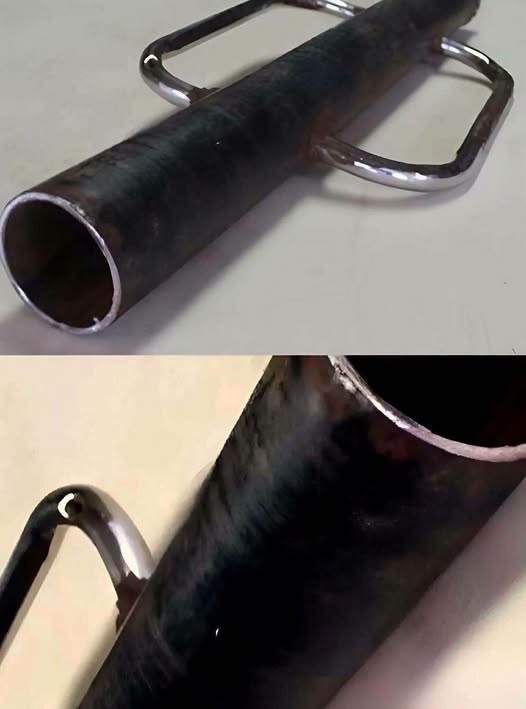
This Brutal-Looking Steel Cylinder Isn’t a Weapon—It’s a Simple Tool That Builds Fences One Strike at a Time
The Mysterious Metal Object Has Confused People Online, but Its Real Purpose Is Surprisingly Practical
At first glance, it looks like something pulled from a battlefield scrap pile.
Heavy steel.
Welded handles.
A hollow cylindrical body.
No obvious controls.
No wheels.
No engine.
No clear clue explaining what anyone is supposed to do with it.
That strange appearance is exactly why photos of the object often trigger wild guesses online.
Some People Think It Is a Weapon
Others assume it must be an old military tool.
Some guess that it belongs in a gym.
Others imagine it came from a medieval workshop or an abandoned factory.
Its blunt, industrial appearance certainly makes those guesses understandable.
But the truth is much simpler.
It Is a Manual Post Driver
The heavy steel cylinder is designed for one straightforward job.
Driving posts into the ground.
Fence posts.
Garden posts.
Sign posts.
Temporary barriers.
And other upright supports that need to be planted firmly into soil.
There is no complicated machinery involved.
The Design Is Almost Ridiculously Simple
A manual post driver is essentially a heavy hollow tube with handles attached to its sides.
The open end slides over the top of a post.
The user grips the handles.
Then the tool is lifted and driven downward.
Again.
And again.
Each impact forces the post deeper into the ground.
Gravity and Human Strength Do Most of the Work
There is no electric motor generating the force.
No battery.
No fuel tank.
The weight of the steel driver combines with the downward motion of the person using it.
When the tool crashes against the top of the post, that energy is transferred directly downward.
Repeated strikes gradually push the post farther into the soil.
It Is One of Those Tools That Makes More Sense the Moment You See It Used
Looking at a manual post driver sitting on a workshop floor can be confusing.
Watching someone use it makes the design instantly obvious.
The hollow body keeps the tool centered around the post.
The handles give the user control.
The heavy closed top delivers the impact.
Almost every part of the design exists for one reason.
Efficiency.
The Tool Can Look More Aggressive Than It Really Is
That is part of what makes it such a popular mystery object.
Its thick steel construction gives it an intimidating appearance.
The handles can resemble those found on heavy industrial or military equipment.
And because many people have never installed fence posts themselves, they may have no familiar reference for what the tool is supposed to look like.
Farmers Have Long Understood Its Value
On farms and ranches, fencing is essential.
Animals need boundaries.
Fields may need to be separated.
Gardens require protection.
Property lines need to be marked.
And all of those fences depend on posts that stay firmly planted in the ground.
A Fence Is Only as Reliable as the Posts Holding It Up
Wire, boards, or panels may be the most visible parts of a fence.
But the vertical posts take much of the structural load.
If the posts lean or loosen, the entire fence can begin to fail.
Wind places pressure against it.
Animals lean against it.
Rain softens the soil.
Seasonal temperature changes shift the ground.
That Means the Posts Need to Be Driven Deep Enough
The exact depth depends on the kind of post, the soil, and the purpose of the fence.
But the goal is always the same.
Get the post deep enough that ordinary forces cannot easily move it.
A manual post driver helps accomplish that with surprisingly little technology.
The Tool Is Especially Useful for Metal Fence Posts
Many agricultural and garden fences use narrow steel posts.
These can often be driven directly into suitable soil rather than requiring a large hole to be dug first.
The post driver fits over the top.
Repeated downward impacts push the post into position.
The process can be physically demanding, but it is direct and effective.
Wooden Posts May Require Different Preparation
Larger wooden fence posts are often installed differently depending on soil conditions and the project.
A hole may be dug or started first.
But the principle behind the manual driver remains useful for certain posts and installations.
It provides controlled impact directly from above.
That Controlled Direction Is One of the Cleverest Parts of the Design
If someone simply swung a heavy hammer at the top of a post, every strike would carry the risk of landing off-center.
The post could bend.
The user could miss.
The tool could glance sideways.
A hollow post driver surrounds the post.
That naturally helps keep the downward force aligned.
The Post Itself Acts Like a Guide
As the driver moves up and down, the post remains inside the steel tube.
This keeps the impact concentrated on the top.
The result is a design that is simple but remarkably well suited to its task.
No Electricity Means It Can Work Almost Anywhere
This is one reason manual post drivers remain useful even when powered equipment exists.
They do not need an outlet.
They do not need a charged battery.
They do not need gasoline.
If a worker can carry the tool to the location, the tool can generally be used there.
That Matters in Remote Areas
Fences are often built in places far from houses, workshops, and electrical service.
A rancher may be repairing a fence along a distant pasture.
A worker may be installing posts beside a rural road.
A gardener may be working at the far end of a property.
In those situations, simplicity becomes an advantage.
There Is Very Little to Break
A manual post driver has few components.
No motor brushes.
No electronic controls.
No complicated transmission.
No fuel system.
Its durability comes partly from the absence of complexity.
That Is Why the Basic Design Has Lasted
Many modern tools improve rapidly because better electronics, batteries, and materials become available.
A manual post driver does not require much improvement.
Its core purpose is already served by mass, shape, handles, and gravity.
There is only so much technology required to repeatedly drop a heavy steel cylinder onto a post.
In That Sense, It Belongs to a Special Class of Tools
Some designs survive because they solve a physical problem in the most direct possible way.
A hammer.
A shovel.
A pry bar.
A wheelbarrow.
A manual post driver fits naturally into that family.
Its Effectiveness Comes From Basic Physics
Lift the mass.
Store potential energy.
Drop the mass.
Transfer that energy into the post.
Repeat.
The idea is easy to understand even without technical training.
The Difficult Part Is the Work
Manual post driving can be tiring.
The tool itself is intentionally heavy.
That weight helps create impact, but someone still has to lift it repeatedly.
Installing many posts can become a serious physical task.
This is why larger projects may use powered post drivers or other machinery.
But Manual Versions Still Have Important Advantages
They are portable.
They are relatively straightforward.
They can be used for smaller jobs.
They work well in places where bringing larger machinery would be impractical.
And they can be moved from post to post without complicated setup.
You Might See One Along a Cattle Fence
Imagine a long line of wire stretching across a pasture.
Every few yards, a steel post rises from the ground.
Before the wire could be attached, someone had to install those posts.
A manual post driver may have been part of that process.
You Might Also See One in a Garden
Garden fencing often depends on simple metal posts.
They can support mesh designed to keep animals out.
They can hold temporary barriers.
They can support lightweight trellises or protective enclosures.
A post driver can make installation faster than improvising with an ordinary hammer.
Construction Crews May Use Similar Tools
Temporary fencing and barriers are common on work sites.
Posts may need to be installed quickly and removed later.
Manual driving tools can be useful for tasks that do not justify heavier machinery.
Outdoor Events Can Depend on Them Too
Festivals, fairs, temporary parking areas, and other outdoor gatherings often require barriers, markers, or temporary fencing.
Visitors generally see only the finished layout.
They rarely think about the tools used before the gates opened.
A strange steel cylinder may have quietly helped create those boundaries.
The Tool Often Works Behind the Scenes
That may explain why so many people fail to recognize it.
Most consumers never see fence construction happening.
They see the finished fence.
They see straight posts.
They see wire held under tension.
The post driver disappears once the job is done.
Social Media Turns That Lack of Familiarity Into a Guessing Game
Post a photograph of an unfamiliar tool without context and imagination takes over.
People focus on appearance.
Heavy steel suggests military equipment.
Side handles suggest exercise gear.
A hollow cylinder suggests some sort of industrial component.
The guesses can become increasingly elaborate.
The Real Answer Usually Feels Almost Too Ordinary
It is not a secret weapon.
It is not an antique torture device.
It is not a mysterious machine part.
It puts posts in the ground.
That simplicity is exactly what makes the reveal satisfying.
There Is Something Refreshing About a Tool With One Clear Purpose
Modern devices often attempt to perform several functions at once.
A phone is also a camera.
A watch can monitor health data.
Cars contain increasingly complex electronics.
The manual post driver does not pretend to be versatile in that way.
It exists to strike downward.
And It Does That Job Extremely Well
The shape helps keep the strike centered.
The weight produces force.
The handles provide control.
The hollow interior lets the driver travel along the post.
Every major feature contributes directly to the task.
This Is Functional Design in Its Purest Form
There is very little decoration.
No unnecessary styling.
No screen.
No branding is required to understand the operation.
Even a handmade version can follow essentially the same concept.
The Material Has to Withstand Repeated Impact
Steel is well suited to the job because the driver experiences force every time it hits a post.
A lighter or fragile material would not perform the same way.
The rugged appearance is therefore not accidental.
The tool looks brutal because its work is brutal.
That Does Not Mean It Should Be Used Carelessly
Like any heavy striking tool, a post driver demands attention.
Hands need to remain on the designated handles.
The user needs stable footing.
The post should be positioned properly.
Anyone nearby should remain clear of the work area.
The Weight That Makes It Effective Can Also Cause Injury
A manual driver is not something to swing casually.
Repeated lifting can strain muscles.
A slipping tool can create danger.
A poorly positioned post can shift unexpectedly.
Proper technique matters even when the tool itself appears simple.
Protective Equipment Can Also Be Sensible
Work gloves can improve grip.
Sturdy footwear can help protect the feet.
Eye protection may be useful where dirt, rust, or fragments could be thrown during installation.
Safe work practices remain important even with low-tech equipment.
Soil Conditions Can Change the Entire Job
Driving a post into soft ground is very different from trying to force one through dry, rocky soil.
Clay can resist movement.
Stone can stop a post completely.
Very loose soil may fail to hold the post securely.
The tool is effective, but it cannot eliminate the realities of the ground itself.
That Is Where Experience Becomes Valuable
Someone who has installed hundreds of fence posts learns to read the soil.
They recognize when a location needs preparation.
They know when a different type of post would work better.
They know when powered equipment is worth bringing in.
The Tool Connects Modern Work With Very Old Principles
Humans have been driving stakes and posts into the ground for thousands of years.
The materials have changed.
The shapes have changed.
The purpose has often remained remarkably similar.
Create a boundary.
Support a structure.
Mark a place.
There Is Something Almost Timeless About the Motion
Lift.
Strike.
Lift.
Strike.
The repetition turns human effort into a structure that may remain standing for years.
It is simple work, but the result can shape an entire landscape.
Look Across a Farm and You Can See the Result Everywhere
Straight fence lines divide pastures.
Posts define property edges.
Wire keeps livestock where they need to be.
Gardens remain protected.
All of that depends on small pieces of infrastructure most people rarely think about.
A Single Post Does Not Look Important
Put hundreds of them together and they begin organizing land.
They influence where animals move.
They determine where fields begin and end.
They support gates.
They create boundaries that can remain visible for generations.
The Post Driver Helps Create Those Lines
That makes the tool much more significant than its crude appearance suggests.
It may spend most of its life leaning against a shed wall or lying in the back of a work truck.
But when needed, it turns loose posts into permanent parts of the landscape.
There Is No Need for It to Look Elegant
Its beauty is in function.
The scratches show use.
The dents show impact.
Rust may show years spent outdoors.
The handles may be polished smooth where countless hands have gripped them.
Old Tools Often Carry Their History Physically
A digital device can become obsolete while still looking almost new.
A manual post driver often becomes more visibly worn as it proves its usefulness.
That wear can make an older example look even more mysterious to someone unfamiliar with the job.
But Farmers and Fence Builders Usually Recognize It Immediately
To them, there is nothing mysterious about the cylinder.
It is simply another working tool.
The surprise exists mostly for people whose lives rarely require putting posts into the ground.
That Difference in Familiarity Is What Makes Mystery Objects So Interesting
Every occupation has tools outsiders may struggle to identify.
Farmers know equipment office workers may never encounter.
Mechanics recognize parts that look meaningless to everyone else.
Carpenters use specialized tools that can resemble strange artifacts when removed from context.
A Manual Post Driver Is a Perfect Example
Outside its normal environment, it looks bizarre.
Placed over a fence post, its purpose becomes obvious.
Context transforms the object.
The Design Has Survived Because It Still Works
There are powered alternatives.
There are hydraulic systems.
There are pneumatic drivers.
There is heavy machinery capable of installing posts much faster.
Yet the manual version remains useful.
Sometimes Technology Does Not Replace Simplicity
It simply gives people another option.
For a large commercial fencing project, powered equipment may make sense.
For repairing a few posts at the edge of a pasture, carrying a simple steel driver may be easier.
Different tools solve different versions of the same problem.
The Manual Driver Has Another Advantage: Immediate Readiness
Pick it up.
Place it over the post.
Start working.
There is almost nothing to prepare.
That convenience has real value.
It Is Hard to Improve on Something That Already Matches Its Job So Well
Design trends come and go.
Materials evolve.
Manufacturers create new versions.
But the basic form remains recognizable because the physical problem has not changed.
A post still needs downward force.
That Is Why the Strange Cylinder Keeps Surviving
It does not survive because of nostalgia.
It survives because people still need fences.
They still need posts.
And there are still situations where a heavy steel tube and two handles are enough to get the job done.
The Object Is a Reminder That Useful Things Do Not Have to Be Complicated
Modern culture often treats complexity as improvement.
More features.
More automation.
More electronics.
More connectivity.
Sometimes those advances are genuinely helpful.
Sometimes simplicity remains unbeatable.
This Tool Has No Software to Update
No password.
No subscription.
No charging cable.
No operating system.
Its instructions could almost be explained in one sentence.
Put it over the post and drive downward.
Yet the Result Can Last for Decades
A properly installed fence line may remain in place through years of storms, heat, cold, and daily use.
The tool itself disappears from view once the work is finished.
The posts remain.
That May Be the Most Impressive Part
The manual post driver is not glamorous.
It does not attract attention while doing its job.
Most people will never think about it when they see a finished fence.
But it has quietly helped shape farms, gardens, construction sites, and rural landscapes for generations.
So the Next Time You See This Strange Steel Cylinder, You Will Know What It Is
It is not battlefield equipment.
It is not an oversized exercise weight.
It is not a medieval weapon.
It is a manual post driver.
A heavy steel tool built around one brilliantly simple idea.
Lift It, Drop It, and Let Physics Do the Rest
That is the entire secret.
No motor.
No wires.
No complicated technology.
Just steel, gravity, human strength, and stubborn soil.
And perhaps that is why the design remains so satisfying.
In a world constantly searching for the next upgrade, the manual post driver is proof that some tools do not need reinventing.
Sometimes the smartest design is simply the one that keeps working.