
Why Blue Stop Signs Exist and What Drivers Should Do When They See One
Why a Blue Stop Sign Immediately Feels Unusual
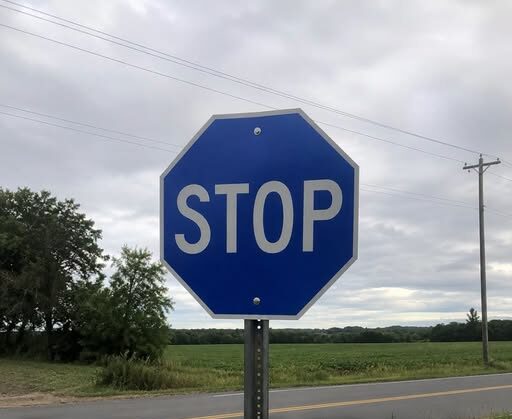
A blue stop sign can create an immediate sense that something is wrong. Drivers are accustomed to seeing the familiar red octagonal sign with white lettering, so encountering the same shape in blue can be surprisingly confusing.
The reaction is understandable because traditional stop signs are deeply connected to everyday driving habits. Most people recognize the standard sign almost automatically, often responding before they have consciously thought about its color, shape, or wording.
When that familiar design suddenly appears in an unexpected color, the brain receives conflicting signals. The shape and message suggest that the driver should stop, while the blue background makes the sign look different from the traffic control devices people normally encounter.
That unusual combination is what makes blue stop signs so memorable. They look official enough to demand attention while remaining different enough to make drivers wonder whether they are legitimate traffic signs at all.
Where Blue Stop Signs Are Usually Found
Blue stop signs are generally associated with private property rather than government-regulated public roads. They may appear in places where property owners want drivers to follow an organized traffic pattern even though the area does not use the same regulated signage found on ordinary streets.
Gated communities are one example. Roads inside these developments can include intersections, entrances, parking areas, and other locations where vehicles need to slow down or yield to one another.
Corporate campuses may also use unusual signs as part of their internal traffic systems. Large properties can contain several roads, parking areas, pedestrian zones, and intersections that require drivers to move cautiously.
Parking lots are another common environment where privately installed traffic signs may appear. Even though these areas are different from normal public streets, vehicles still cross paths and drivers still need clear instructions about who should proceed first.
In these settings, a property owner may install a stop sign to encourage orderly movement. The sign can serve a practical purpose even when its appearance does not match the standard red design drivers expect to see on regulated roads.
Why the Color Makes Such a Difference
The meaning of a stop sign is reinforced through years of repetition. Drivers repeatedly encounter red octagonal signs at intersections, and the combination becomes strongly associated with stopping.
Changing only the color can disrupt that automatic recognition. A driver may understand the word and recognize the shape while still needing an extra moment to process why the sign looks unfamiliar.
This is more than a visual curiosity. Driving often depends on quick and predictable reactions, particularly at intersections where vehicles may be approaching from several directions.
An unusual sign can therefore attract attention for two different reasons. It communicates an instruction, but it also creates uncertainty because it does not look like the traffic signs most drivers have been trained to expect.
That uncertainty explains why photographs and discussions of blue stop signs often attract interest. The signs appear familiar and incorrect at the same time, producing the impression that a normal part of the road environment has somehow been altered.
Blue Signs and Standard Traffic Control
The key distinction is that blue stop signs are almost never part of government-regulated traffic control. Standard public-road traffic signs follow established requirements, and the familiar red stop sign is the design drivers normally encounter in those regulated environments.
A blue sign installed on private property does not carry the same status as a standard stop sign placed as part of an official public traffic system. Its presence is usually connected to the rules and traffic needs of the property where it has been installed.
That does not mean the sign should simply be ignored. The location of the sign can still indicate that vehicles are approaching an area where traffic paths meet and where extra caution is necessary.
The practical message can therefore remain important even when the sign itself is not functioning in exactly the same way as a government-regulated stop sign.
Drivers should distinguish between the legal status of the sign and the physical conditions surrounding it. A privately installed blue sign may not have the same regulatory standing, but the intersection or crossing it identifies can still present a genuine risk.
Why Private Properties Use Stop Signs
Private developments often contain road systems that resemble small public street networks. Vehicles may enter from different directions, travel around buildings, cross parking areas, or approach entrances where visibility is limited.
Without some form of traffic organization, those spaces could become difficult to navigate. Property owners may therefore install signs intended to tell drivers when to slow down, stop, or give another vehicle the opportunity to move first.
The purpose is generally practical. A sign can help establish a predictable pattern of movement in an area where several drivers might otherwise reach the same crossing at the same time.
Some private properties may use signs that differ in appearance from the standard devices seen on public roads. A blue stop sign is one example of how an instruction can remain recognizable while using a nonstandard design.
The unusual color does not change the fact that the sign has usually been placed at a location where someone believed stopping would make traffic movement safer or more orderly.
Why Ignoring the Sign Can Still Be Risky
Drivers who realize that a blue stop sign is probably located on private property may be tempted to treat it as unimportant. That approach can create unnecessary danger.
The most important issue is not simply whether the sign carries the same legal weight as a conventional public-road stop sign. Drivers also need to consider why the sign was installed at that particular location.
A stop sign usually identifies a conflict point where traffic paths intersect. Another vehicle could be approaching from the side, leaving a parking area, entering a roadway, or moving through the same space from another direction.
Proceeding without stopping could therefore create a collision risk even if the sign itself is not part of an official government traffic system.
The unusual appearance can also affect other drivers differently. One person may stop completely while another assumes the blue sign can be ignored. When drivers respond unpredictably to the same intersection, the possibility of confusion increases.
The Safest Response for Drivers
The simplest response to a blue stop sign is also the safest one: treat the instruction seriously. Coming to a full stop allows the driver to evaluate the surrounding area before continuing.
After stopping, the driver can look carefully for approaching vehicles, pedestrians, or other movement around the intersection. Once the path is clear, the vehicle can proceed normally.
This cautious approach removes much of the uncertainty created by the sign’s unusual appearance. Instead of trying to make an immediate judgment about the sign’s legal status while the vehicle is moving, the driver can focus first on avoiding a conflict.
Stopping briefly is particularly sensible because the sign has likely been positioned there for a reason. Whether the location is inside a gated community, on a corporate campus, or within a parking area, the sign usually marks a place where traffic needs to be controlled.
Drivers do not lose anything important by choosing caution. A short stop provides time to understand the surroundings and reduces the possibility of moving unexpectedly into another vehicle’s path.
Why Familiarity Matters Behind the Wheel
Blue stop signs also demonstrate how strongly drivers depend on visual familiarity. People do not analyze every road sign from the beginning each time they drive.
Instead, repeated experience creates quick associations. Certain shapes, colors, and symbols trigger expected responses, allowing drivers to process large amounts of road information rapidly.
When one element is changed, such as turning a normally red stop sign blue, the familiar pattern becomes less automatic. The driver may need an additional moment to understand what is being shown.
That moment of hesitation is one reason standardized traffic signs are so effective. Consistency helps drivers recognize instructions quickly and respond predictably.
A nonstandard sign interrupts that consistency. Even if its intended message is obvious after a moment of thought, the initial visual surprise can still influence how a driver reacts.
Private Rules Can Still Serve an Important Purpose
The difference between official traffic regulation and private traffic management can sometimes be overlooked. A private property may not operate under exactly the same signage system as a public roadway, but it still needs drivers to move safely around the property.
Signs are one way property owners attempt to create that order. The signs can direct traffic at entrances, intersections, parking areas, and other places where several routes meet.
A blue stop sign therefore should not automatically be interpreted as a joke or meaningless decoration. Its nonstandard appearance may indicate that it belongs to a private traffic system rather than a government-regulated one.
The message itself remains straightforward. Drivers approaching the location are being asked to stop before continuing.
Following that instruction can reduce confusion between motorists and create a more predictable flow of vehicles through the area.
What Drivers Should Remember
Seeing a blue stop sign can be startling because it challenges one of the most familiar visual rules of driving. The shape and wording communicate an unmistakable instruction, while the unexpected color makes the sign appear unusual.
In most situations, these signs are found on private property such as gated communities, corporate campuses, or parking lots. They are generally not part of the same government-regulated traffic control system as standard red stop signs.
That distinction explains why the sign may look different, but it does not make caution unnecessary. The sign can still identify an intersection or crossing where vehicles may come into conflict.
The safest choice is to stop, check the surrounding traffic carefully, and continue only when it is safe to do so. This response avoids unnecessary uncertainty and recognizes the practical reason the sign was placed there.
A blue stop sign may look like an error in an otherwise familiar road environment, but its appearance usually has a simple explanation. It is most often a privately installed traffic-control device intended to bring order to a location outside the standard public-road system.
For drivers, the lesson is equally simple. When an unfamiliar sign communicates a clear request to stop at a potential traffic conflict point, choosing caution is safer than allowing the unusual color to create confusion.