
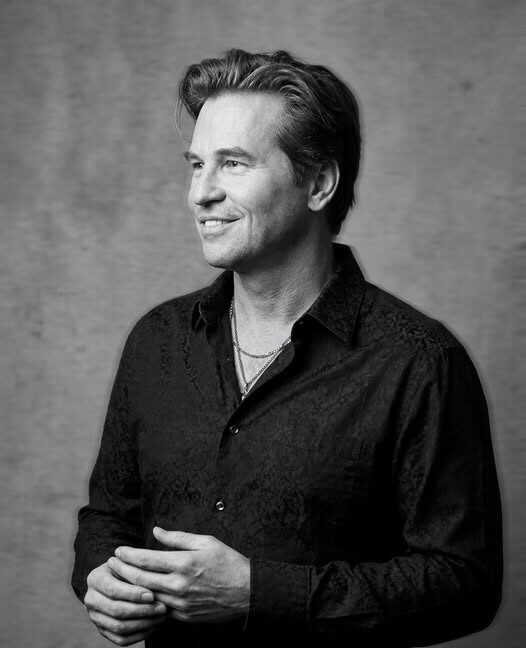
Val Kilmer’s Final Chapter Revealed the Quiet Strength Behind One of Hollywood’s Most Unforgettable Stars
A Hollywood Presence That Seemed Larger Than Life
For decades, Val Kilmer carried an unmistakable presence on screen. Whether he was playing a confident fighter pilot, a troubled rock legend, a dying gunfighter or a masked superhero, he had a way of making characters feel unpredictable, intense and impossible to ignore.
To audiences who grew up watching him, Kilmer often appeared almost untouchable. His performances projected confidence, mystery and an edge that made even familiar roles feel uniquely his own.
Then came April 1, 2025.
News of Kilmer’s death brought an immediate wave of emotion across Hollywood and among generations of fans who had followed his career through its many transformations.
The tributes naturally celebrated the famous performances. Yet the story of Val Kilmer had become about much more than the characters that made him a star.
His later years revealed another side of the actor: a man confronting serious health problems, major changes to his voice and the unavoidable passage of time while continuing to search for ways to express himself creatively.
The Role of Iceman Changed Everything
One of the performances most closely associated with Kilmer came through Iceman, the cool and intensely competitive fighter pilot who became one of the most memorable figures in his career.
The role helped establish the image that would follow Kilmer for years: controlled, confident and effortlessly commanding.
Behind that polished exterior, however, Kilmer was developing a reputation as an actor deeply committed to his work.
He approached roles with an intensity that could make his performances feel unusually personal. Rather than simply delivering lines and moving through scenes, he became known for paying close attention to the smallest details of a character.
That commitment eventually led him toward roles that demanded very different kinds of energy.
Instead of remaining trapped in the image of a conventional leading man, Kilmer repeatedly chose characters that allowed him to explore darker, stranger and more complicated personalities.
Becoming Jim Morrison
His portrayal of Jim Morrison became another defining point in his career.
Taking on the role of such a recognizable and complicated figure required Kilmer to move far beyond the effortless confidence audiences had already seen from him.
The performance strengthened his reputation as someone willing to disappear deeply into a character rather than simply rely on celebrity or appearance.
It also demonstrated the range that would define much of his career.
Kilmer could appear controlled and intimidating in one project and emotionally volatile in another. He could bring humor to a scene and then shift almost instantly toward something darker.
That unpredictability helped make his work memorable.
His performances were rarely passive. Even when playing characters who spoke softly, Kilmer often created the sense that something larger was happening beneath the surface.
Doc Holliday Became One of His Most Beloved Performances
Among all the characters Kilmer portrayed, Doc Holliday became especially important to many fans.
The role allowed him to combine vulnerability, danger, intelligence and dark humor in a single performance.
His Holliday was physically weakened but never emotionally defeated. The character could face death with a grin while still revealing the exhaustion and pain beneath the confidence.
That combination made the performance endure long after the film itself first reached audiences.
In retrospect, the character also carries an unexpected emotional resonance when viewed alongside Kilmer’s later life.
Years after playing a man who faced physical decline while refusing to surrender his personality, Kilmer would confront his own health challenges.
The circumstances were completely different, but the image of resilience became increasingly connected with how fans viewed the actor himself.
Taking On Batman
Kilmer later entered another major chapter of his career when he took on the role of Batman.
Playing such an established character placed him at the center of one of entertainment’s most recognizable franchises.
Once again, the role demonstrated how unusual Kilmer’s career had become.
Within a relatively short span of time, audiences had seen him as Iceman, Jim Morrison, Doc Holliday and Batman.
Each demanded a different kind of performance.
The variety reflected an actor who seemed unwilling to remain in one comfortable category. Kilmer could move between action, drama and larger-than-life characters while maintaining a distinctive screen presence.
Those choices also made him difficult to define.
He was a movie star, but he never seemed interested in becoming only a conventional one.
The Man Behind the Famous Characters
People who worked with Kilmer often remembered the intensity he brought to his profession.
He could concentrate obsessively on a line or a particular moment, searching for exactly the right way to deliver it.
That seriousness became part of his professional reputation.
But there was another side as well.
Colleagues also remembered moments of vulnerability and humor, including the unexpected laugh that could suddenly change the atmosphere in a room.
Those contrasting qualities reflected the complexity that appeared throughout his work.
He could seem distant and deeply engaged at the same time. He could project enormous confidence while carrying a sensitivity that became increasingly visible later in his life.
The contradiction was part of what made him compelling.
Illness Changed His Life and His Voice
As Kilmer grew older, the most difficult challenge of his life unfolded away from the kinds of fictional dangers he had faced on screen.
Serious illness affected his health and dramatically changed his voice.
For an actor whose profession depended so heavily on speech, expression and physical presence, those changes were profound.
The voice audiences had recognized for decades was no longer the same.
His appearance changed as well, making the passage of time and the consequences of illness increasingly visible.
For someone who had once seemed physically invincible on screen, the transformation was difficult to ignore.
Yet Kilmer did not simply disappear from creative life.
Finding New Ways to Continue Creating
Even as his health declined, Kilmer remained connected to the craft that had defined so much of his life.
His circumstances required adaptation.
Things that had once come naturally became more difficult, particularly communication through the voice that had been such an important part of his performances.
Instead of treating those limitations as the end of his artistic identity, he continued searching for other ways to create and communicate.
That determination became one of the most powerful elements of his later story.
For many fans, seeing Kilmer during those years changed the way they understood him.
The larger-than-life movie star was still there, but so was a man openly living with vulnerability.
The contrast made his journey increasingly personal.
His Later Years Connected With Fans in a Different Way
During the height of Kilmer’s fame, audiences primarily knew him through carefully constructed characters.
His later years offered something different.
People saw an actor facing physical limitations that could not be hidden behind costumes, lighting or performance.
They saw the effects of illness.
They saw the changes in his voice.
They saw someone confronting the reality that time changes everyone, including people who once appeared immortal on a movie screen.
For some fans, that vulnerability made Kilmer more relatable than he had ever been during the years when he was playing glamorous heroes and charismatic outsiders.
His struggle reflected experiences familiar to countless families dealing with illness, aging and dramatic changes in everyday life.
There was no need for theatrical exaggeration.
The reality itself carried enough emotional weight.
Resilience Became Part of His Legacy
By the final stage of his career, Kilmer’s legacy had expanded beyond questions of which performance was his best.
His determination to remain creatively engaged despite enormous personal challenges became part of how people remembered him.
He had built his career by portraying complicated people.
In time, audiences came to understand that Kilmer himself could not easily be reduced to the image of a Hollywood leading man.
He was ambitious, vulnerable, intense and deeply connected to his work.
He could be difficult to categorize because his career was filled with contrasts.
Those contrasts ultimately became central to his appeal.
Hollywood Reacts to the News of His Death
When news of Kilmer’s death emerged on April 1, 2025, the response reflected the enormous reach of his career.
Tributes celebrated the characters that had become permanently connected with his name.
Iceman represented one side of Kilmer: confident, competitive and almost impossibly cool.
Jim Morrison revealed another: volatile, artistic and deeply troubled.
Doc Holliday brought together humor, danger and vulnerability.
Batman placed Kilmer behind one of cinema’s most recognizable masks.
Together, those performances demonstrated why his work remained so memorable across different generations of moviegoers.
Yet many of the emotions surrounding his death also reflected admiration for the person audiences had watched during his difficult later years.
More Than a Collection of Famous Roles
A film career can easily be summarized through titles and characters, particularly when an actor becomes connected with several iconic performances.
But that kind of list captures only part of Kilmer’s story.
His career was also about constant reinvention.
He moved from youthful stardom toward increasingly complicated roles, eventually entering a period when his personal struggles became as visible as his professional achievements.
Illness changed what he could do, but it did not erase his desire to create.
The fading of his voice did not remove his artistic identity.
The physical changes brought by time did not eliminate the intensity that had always been associated with him.
Instead, his later years added another dimension to a career already filled with unusual turns.
The Image of the Untouchable Star Finally Changed
In his younger years, Kilmer often appeared almost invulnerable.
There was the confident expression behind aviator glasses, the intensity of the musician onstage, the calm humor of a gunfighter staring toward death and the imposing presence of a superhero hidden beneath a mask.
Those images became permanent pieces of popular culture.
But life eventually replaced the illusion of invincibility with something more human.
Kilmer aged.
He became seriously ill.
His voice changed.
His body changed.
And rather than completely hiding from those realities, his later public life allowed audiences to witness some of them.
That vulnerability did not weaken his legacy.
For many people, it strengthened it.
Val Kilmer’s Story Continues Through His Performances
Val Kilmer’s final film credit may mark the end of his active career, but it does not represent the end of his influence.
His performances continue to exist exactly where audiences first discovered them: in scenes that captured his unusual ability to appear fearless and fragile at the same time.
New viewers will continue encountering Iceman’s confidence, Jim Morrison’s chaos, Doc Holliday’s wounded humor and Batman’s darkness.
Longtime fans will remember where they were when those characters first became part of their lives.
But Kilmer’s later story offers an equally lasting image.
It is the image of an artist confronting limitations he never expected while continuing to search for ways to communicate.
It is a quieter kind of courage than the heroism usually portrayed on movie screens.
Perhaps that is why it feels so powerful.
Behind decades of memorable performances was a man facing the same realities that eventually confront everyone: change, vulnerability, physical decline and mortality.
His response was not to pretend those realities did not exist.
He continued creating.
He continued finding ways to be seen.
And he allowed audiences to witness a version of himself far removed from the seemingly untouchable star they had first known.
That may ultimately be one of the most enduring parts of Val Kilmer’s legacy.
He was complicated, intense, vulnerable and unforgettable on screen, but the resilience he showed when the cameras could no longer hide life’s difficulties revealed something even more lasting.
The characters remain.
So does the work.
And behind them remains the memory of an actor who spent a lifetime refusing to become simple, predictable or easily defined.