
Part 3 of 3
The woman stared at Dr. Evans.
“What do you mean?” she asked.
The doctor looked down at the papers from the red envelope, then back at her.
“These results showed that we needed to monitor you much more closely than usual,” he said. “Your pregnancy has become higher risk, and after what happened today, I don’t want to take any chances.”
Her hand immediately moved to her stomach.
“Is the baby in danger?”
Dr. Evans answered carefully.
“Right now, the baby’s heartbeat is reassuring. But we’re going to keep watching both of you.”
The woman closed her eyes.
For the first time since arriving at the hospital, some of the fear left her face.
Not all of it.
But enough for her to breathe again.
More tests followed.
Nurses checked her repeatedly while Dr. Evans reviewed the results.
The fall had frightened everyone, but the immediate monitoring showed no sign that the baby needed to be delivered that day.
Still, the doctor made one thing clear.
She would not be going home without a safety plan.
“Do you have somewhere else you can stay?” he asked quietly.
The woman looked away.
That hesitation gave him his answer.
A hospital social worker was called.
For the first time, the woman began speaking openly about what life at home had become.
The debts.
The arguments.
The fear.
The way she had learned to stay silent because silence usually ended things faster.
Every sentence seemed difficult to say.
But once she started, she didn’t stop.
Across town, meanwhile, the security footage was being reviewed again.
Chief Miller sat beside two police officers in the mall security office.
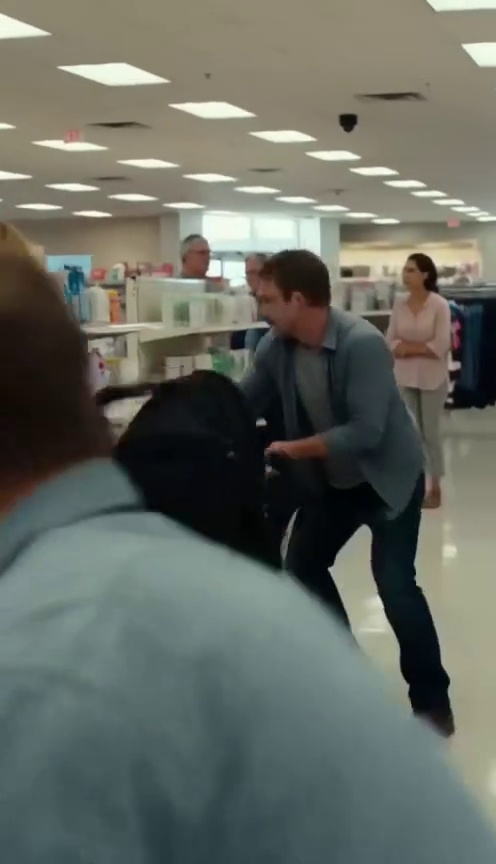
The video showed the entire confrontation clearly.
The argument.
The woman falling.
The husband taking the car-seat box.
The handbag spilling across the floor.
The officers watched the recording more than once.
When they returned to the customer service area, the husband was no longer demanding a refund.
The car seat remained behind the counter.
He sat silently.
One officer asked him to stand.
“We need you to come with us so we can continue discussing what happened.”
His confidence was gone.
He looked toward the exit, then toward Chief Miller.
“This is a misunderstanding.”
Miller said nothing.
The cameras had already told their story.
The husband was escorted away while the investigation continued.
Chief Miller then walked back toward customer service.
He looked at the unopened car-seat box still sitting on the counter.
“Put this aside,” he told the employee. “Don’t return it.”
The employee nodded.
“For her?”
“For her.”
Later that evening, the woman was still at the hospital when Chief Miller arrived carrying the box.
She looked surprised when he entered the room.
“You didn’t have to do that,” she said.
He set the car seat down near the wall.
“It belongs with you.”
Her eyes filled with tears.
“Thank you.”
Miller nodded toward the chair beside her bed.
“You did something much harder today.”
She looked confused.
“What?”
“You told the truth.”
For a few seconds, she said nothing.
Then she looked toward the window.
“I should have said something sooner.”
“What matters is that you said it now.”
The hospital helped arrange temporary accommodation and follow-up support while the investigation continued.
The woman did not return home that night.
In the days that followed, she remained under close medical supervision.
The baby continued to do well.
The legal situation involving her husband would take much longer to resolve, but one thing had changed immediately.
She was no longer dealing with everything alone.
Weeks later, she returned to the mall.
This time, she wasn’t frightened.
She carried the same car seat, now removed from its cardboard box.
Chief Miller happened to be near the entrance when he saw her.
She smiled.
“I wanted you to know we’re okay.”
He looked down at the car seat, then back at her.
“That’s all I needed to hear.”
She placed one hand over her stomach.
The road ahead was still uncertain.
There were medical appointments, legal questions and a completely different future to build.
But for the first time in a long time, the decisions were hers.
And the object that had started the argument—the simple newborn car seat her husband had wanted to return for cash—had become a reminder of something else entirely.
It represented the moment strangers stopped looking away.
And sometimes, that one moment is enough to change everything that comes next.