
Part 2 of 2
By the early 20th century, the colorful geometric designs painted on Pennsylvania barns were already a familiar part of the landscape.
What changed was the way outsiders began describing them.
Writers and travelers increasingly used the term “hex sign.”
The name sounded mysterious.
It suggested magic, protection and old-world superstition.
And people loved the story.
Over time, the explanation became more dramatic.
Visitors were told the symbols could protect barns from fire.
Some were said to guard livestock.
Others supposedly attracted luck, fertility, prosperity or happiness.
But historians have repeatedly pointed out that these meanings were not always part of the earliest tradition.
Many of them developed later.
Tourism played a major role.
As travelers became fascinated with Pennsylvania Dutch culture, artists began creating smaller decorative versions of barn designs that could be sold in shops.
These signs were easier to hang on a house than a massive painted barn pattern.
And they needed stories.
So meanings became more specific.
Two birds might symbolize friendship or happiness.
A heart might represent love.
A rosette could be connected with good fortune.
A star could be described as a symbol of protection or guidance.
Those explanations helped transform regional folk art into a recognizable commercial tradition.
Color symbolism became part of that process too.
Today, many sellers and folk artists assign meanings to particular colors.
Red is often connected with strength, passion or good luck.
Blue may represent peace or spirituality.
Green is commonly associated with growth, fertility or the land.
White may symbolize purity.
Black is sometimes linked with protection.
These interpretations are now widely repeated.
But they should not be mistaken for a single ancient code followed by every Pennsylvania German farmer.
There was no universal chart hanging in barns telling people exactly what each color had to mean.
Different artists, families and communities could use symbols differently.
Another common misunderstanding involves the Amish.
Barn stars and hex signs are often described as “Amish symbols.”
That is misleading.
The tradition is much more broadly connected to Pennsylvania German culture.
Many Amish communities historically favored simpler decoration and did not commonly cover barns with elaborate painted signs.
The colorful symbols became especially associated with other Pennsylvania German farming communities and with the tourism industry that later promoted the designs.
That did not stop the association from spreading.
Souvenir shops, postcards and roadside attractions helped turn “Pennsylvania Dutch” imagery into something visitors could immediately recognize.
The barn star became one of the strongest symbols of that identity.
Eventually, the design moved far beyond Pennsylvania.
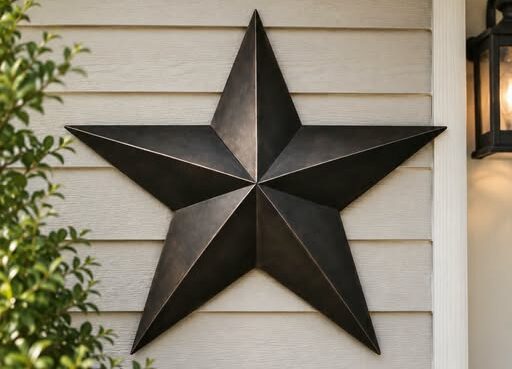
Metal stars began appearing on houses across the United States.
They were mounted above garages.
They appeared on fences.
They decorated porches and garden sheds.
Some people chose them simply because they liked the rustic appearance.
Others purchased them because they had heard the old stories about luck or protection.
And some used them because the stars reminded them of farms, family or rural life.
That is part of what makes the symbol so interesting.
Its meaning has never been completely fixed.
For one family, a barn star may simply be decoration.
For another, it may represent heritage.
For someone else, it may symbolize protection, prosperity or good fortune.
And for historians, it represents a much larger story.
It shows how traditions change when they move from one generation to another.
A painted design can begin as regional folk art.
Then outsiders give it a new name.
Tourists attach new stories to it.
Artists create new interpretations.
And eventually, something once found mainly on farm buildings becomes a symbol recognized across the country.
That does not make the newer meanings worthless.
Traditions are constantly evolving.
What matters is understanding where the stories came from.
The old stars painted across Pennsylvania barns were not necessarily secret magical codes.
They were expressions of craftsmanship, identity and belonging.
The supernatural meanings came later and became part of their own folk tradition.
Today, both histories exist side by side.
You can see an old barn star as a piece of Pennsylvania German folk art.
You can also understand why generations of people have attached personal meanings to its colors and patterns.
Either way, it is more than just a shape nailed to a wall.
It carries traces of the people who painted barns, preserved traditions and transformed simple geometric designs into enduring symbols.
So the next time you see a star hanging above a barn or porch, remember: its story is not one single legend, but generations of art, folklore and changing ideas about what that five-pointed symbol means.