
Part 1 of 2
An 83-year-old Canadian grandmother died through medical assistance in dying after her family says she had previously rejected the procedure and later became distressed when she realized it was scheduled to take place.
Now, her granddaughter is demanding answers.
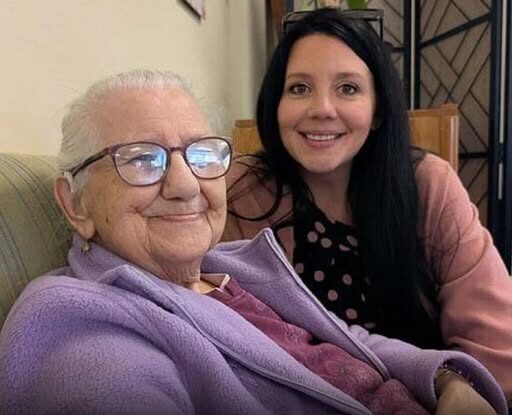
Brigitte Stegemann, known to her family as “GG” or “Oma,” died on July 10, 2026, at The Pearl care home in Cannifton, Ontario.
Her granddaughter, Brigitte Kranendonk, says the circumstances surrounding her death left the family deeply troubled.
She alleges that Stegemann did not clearly consent to medical assistance in dying, commonly known in Canada as MAiD, immediately before the procedure.
Belleville Police have confirmed that the case remains open and is being investigated by the force’s Criminal Investigations Division.
The investigation does not itself establish wrongdoing.
The care home and practitioners involved have not publicly responded in detail to Kranendonk’s allegations, while the family says they were told Stegemann had been legally assessed and approved for MAiD.
But Kranendonk says what she witnessed in the days leading up to her grandmother’s death did not match what she believed Stegemann wanted.
Stegemann was born in Germany and was a committed Christian, according to her family.
Her health had deteriorated significantly.
She had moved into The Pearl roughly a year and a half before her death.
Then, in February 2026, she was diagnosed with stage 4 stomach cancer.
Doctors reportedly gave the family an uncertain prognosis.
She might have approximately six months to live.
Or she could potentially live considerably longer.
During discussions about her future care, MAiD was one of the options raised.
Kranendonk says her grandmother initially rejected it.
According to her granddaughter, Stegemann told her:
“No, I don’t want that.”
Kranendonk says her grandmother’s Christian faith also shaped her views about medically assisted death.
Then circumstances changed while Kranendonk and her husband were away on a 10-day road trip.
On July 3, she says she received a call informing her that a MAiD assessment was being arranged because her grandmother’s health had worsened.
By the time Kranendonk returned, Stegemann had already undergone an initial consultation.
Her granddaughter was present for a later assessment.
And she says what she witnessed raised immediate concerns.
English was not Stegemann’s first language.
She was also hearing impaired.
Kranendonk says her grandmother appeared to nod during parts of the conversation without clearly demonstrating that she fully understood what was being discussed.
The granddaughter also says some answers during a cognitive assessment concerned her.
For example, she says Stegemann stated that she had no siblings.
According to Kranendonk, her grandmother actually had 13 siblings, including two who were still living.
Despite those concerns, Kranendonk says she was told her grandmother had been found capable and eligible for MAiD.
The procedure was scheduled for Friday, July 10.
Then came the conversation that Kranendonk says changed everything.
The day before the scheduled procedure, she sat down with her grandmother.
She wanted to make absolutely certain Stegemann understood what was going to happen.
Kranendonk says she spoke very directly.
“Do you know that you’re going to die on Friday?” she asked.
According to the granddaughter, Stegemann became extremely upset.
She cried for an extended period.
Then she allegedly said:
“I’ve made a mistake.”
Kranendonk says she repeatedly reassured her grandmother that she did not have to proceed.
She told her she could simply tell the doctors no.
For the family, that conversation became one of the most important parts of what happened next.
Under Canada’s MAiD framework, a person who retains decision-making capacity must generally be given an opportunity to withdraw their request and must expressly consent immediately before MAiD is administered.
There is an exception when a valid waiver of final consent has been arranged in advance under specific legal conditions.
Such waivers are available only in limited circumstances, including when a person’s natural death is reasonably foreseeable and the required written arrangement has been made while the person still has decision-making capacity.
If a valid waiver exists and the person later loses capacity, MAiD can potentially proceed without a new verbal confirmation.
However, Canadian guidance states that such an arrangement becomes invalid if the person demonstrates refusal or resistance through words, sounds or gestures.
Exactly what documentation existed in Stegemann’s case, what capacity determinations were made, and whether all applicable safeguards were satisfied are among the questions now surrounding the case.
The family says it trusted the professionals involved.
Kranendonk chose to spend the remaining time with her grandmother rather than continuing to challenge every step of the process.
On the morning of July 10, family members gathered with Stegemann.
They spent time outside in the care home garden.
They ate strawberry ice cream.
Her pastor prayed with her.
Then, according to Kranendonk, everything began moving much faster than the family expected.
She says they had understood that the doctor would arrive later that morning.
Instead, a nurse asked everyone to come back inside earlier.
An IV was prepared.
Kranendonk says her grandmother became largely unresponsive.
And when the doctor finally arrived, the granddaughter says she waited for one crucial thing.
A clear answer from her grandmother.
According to Kranendonk, that answer never came.